

TL;DR:
- Missed call revenue loss is the income a business loses when potential customer calls go unanswered, with Australian small businesses losing between $45,000 and $126,000 annually. Automated AI voice receptionists are now the most practical tools for recovering this lost income, handling after-hours, overflow, and peak periods efficiently. Calculating the exact revenue loss involves multiplying missed calls by close rates and average job values, emphasizing the significance of addressing coverage gaps to maximize recovery.
Missed call revenue loss is the measurable income a business forfeits every time a potential customer’s call goes unanswered. For Australian small businesses, this loss ranges from $45,000 to $126,000 per year depending on industry, call volume, and average job value. That figure is not a worst-case scenario. It is the documented average across trades, professional services, and medical sectors. Understanding how much revenue do missed calls cost is the first step toward stopping the bleed. AI voice receptionists and automated call booking systems are now the most practical tools available to Australian businesses in 2026 for recovering that lost income.
How much revenue do missed calls cost? the calculation explained
The revenue cost of a missed call is calculated using three variables: the number of missed calls per month, your close rate on inbound enquiries, and your average job or transaction value. Multiply those three numbers together and you have your monthly revenue loss. Annualise it and the result is often confronting.

The core formula
The formula is straightforward:
- Count your monthly missed calls. Pull this from your phone system, CRM, or call tracking software such as CallRail or Aircall.
- Apply your close rate. If you convert 40% of inbound calls into paying jobs, use 0.40.
- Multiply by average job value. A plumber in Sydney with a $600 average job value and 18 missed calls per month at a 40% close rate loses $4,320 per month, or $51,840 per year.
The average lost revenue per missed call sits at around $847, based on an analysis of 47 companies. That figure accounts for lead acquisition cost and close rates, meaning it already factors in the money you spent on advertising to generate that call in the first place.
Why advertising waste compounds the loss
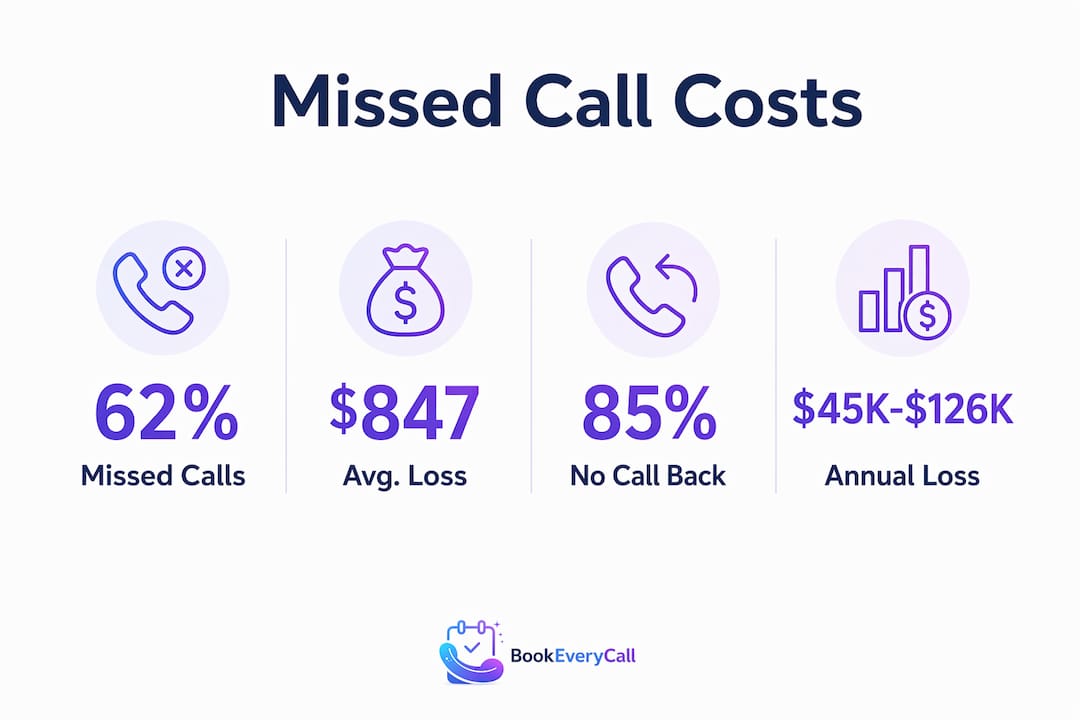
Missed calls do not just cost you the sale. Businesses with a 62% missed call rate spent $3,100 per month generating calls that went to voicemail. That is advertising budget producing zero return. The true cost of a missed call is therefore the lost job value plus the sunk marketing spend that generated the call.
Industry variables that change the calculation
Close rates and average job values differ sharply across sectors. A GP clinic in Melbourne converting 70% of new patient calls at $180 per consultation calculates very differently from a commercial HVAC contractor in Brisbane converting 25% of calls at $4,500 per job. Both businesses lose money from missed calls. The HVAC contractor loses it faster.
Pro Tip: Run your missed call calculation quarterly, not annually. Call volumes shift with seasons, and a tradie who misses more calls in summer than winter needs a different staffing or automation strategy for each period.
What does a missed call cost across australian industries and cities?
The financial impact of missed calls varies by industry and geography. HVAC, roofing, and plumbing businesses face 300–400% higher missed call revenue loss than lower-ticket service businesses. That gap comes directly from higher average job values and the urgency-driven nature of those enquiries.
The table below shows estimated per-call revenue loss and annual impact across key Australian industries and cities.
| Industry | City | Avg. Job Value | Est. Loss Per Missed Call | Est. Annual Loss (18 missed calls/month) |
|---|---|---|---|---|
| Plumbing | Sydney | $600 | $240 | $51,840 |
| HVAC / Air Conditioning | Melbourne | $2,200 | $880 | $190,080 |
| Electrical | Brisbane | $450 | $180 | $38,880 |
| Medical / GP Clinic | Perth | $180 | $126 | $27,216 |
| Legal Services | Sydney | $1,500 | $600 | $129,600 |
| Real estate (property management) | Melbourne | $3,000 | $1,200 | $259,200 |
Estimates based on a 40% close rate and 18 missed calls per month. Adjust for your actual figures.
Why sydney and melbourne businesses feel it more
Sydney and Melbourne businesses typically operate at higher call volumes due to population density and competitive markets. A plumbing business in Sydney’s inner west fielding 40 calls per day faces a structurally different missed call problem than a sole trader in regional South Australia fielding 8. Higher call volume means more calls drop during peak periods, lunch breaks, and after hours. The revenue loss per missed call is the same. The frequency multiplies the damage.
High-ticket industries carry disproportionate risk
A single missed call from a commercial property manager in Melbourne seeking an urgent HVAC repair can represent a $4,000 to $8,000 job. Some trades lose $3,375 monthly from just 18 missed calls. For legal and real estate professionals, the per-call loss is even higher because client lifetime value extends well beyond the first transaction.
Pro Tip: If your business operates across multiple cities, track missed call rates by location separately. A Melbourne office may have a coverage gap on Friday afternoons while your Brisbane branch handles calls fine. City-level data prevents you from averaging away a real problem.
What operational factors amplify revenue loss from missed calls?
Revenue loss from missed calls is not evenly distributed across the business day. Missed calls concentrate in predictable windows: after hours, lunch breaks, and weekends. Identifying those windows is more valuable than knowing your annual loss figure, because it tells you exactly where to intervene.
Coverage gaps are the primary driver
A coverage gap is any period when your phone goes unanswered because no one is available to pick it up. This is different from a call that is genuinely unanswerable, such as a call during an active emergency job where the technician cannot stop. Separating these two categories is the most important diagnostic step a business can take. Interventions targeted at capacity gaps deliver real ROI. Interventions targeted at inherently unanswerable calls do not.
The operational factors that most commonly amplify missed call costs include:
- After-hours enquiries. Customers in urgent situations call at 7pm, 8pm, and on weekends. Trades and medical services are especially exposed.
- Lunch break blackouts. A solo operator or small front desk team creates a predictable 12pm to 1pm gap every day.
- Peak demand periods. A roofing company after a hailstorm in Brisbane receives call volumes that overwhelm any manual answering system.
- Staff illness and leave. Unplanned absences create unplanned gaps with no warning.
- High call concurrency. Two calls arriving simultaneously means one goes to voicemail, even during business hours.
How timestamp analysis changes your decision-making
Call timestamp data from tools like CallRail, Dialpad, or your phone system’s reporting module shows you exactly when calls are being missed. If 60% of your missed calls arrive between 5pm and 8pm, the answer is not hiring a full-time receptionist. The answer is an after-hours booking system or an AI voice receptionist that operates outside business hours. Timestamp analysis converts a vague revenue problem into a specific staffing or automation decision.
How do AI answering services reduce missed call revenue loss?
AI voice receptionists are the most cost-effective solution for Australian businesses facing persistent missed call problems. The evidence is specific: AI call handling delivered a 34% increase in new customer acquisition and $276,000 in additional annual revenue for a median company, at a system cost of $5,964 per year. That is a 46 to 1 return on investment.
What AI receptionists actually do
An AI voice receptionist answers every call, qualifies the caller, and books appointments directly into your calendar. It does not take messages and hope someone calls back. 85% of callers who reach voicemail will not call back. An AI receptionist eliminates that drop-off entirely by converting the call into a booked job in real time.
The table below compares the key features and expected outcomes of AI answering services versus traditional staffing approaches.
| Feature | Human Receptionist | AI Voice Receptionist |
|---|---|---|
| Operating hours | Business hours only | 24/7, including weekends |
| Cost per month | $4,000–$7,000 (salary + on-costs) | $200–$600 |
| Call concurrency | One call at a time | Unlimited simultaneous calls |
| Appointment booking | Manual, subject to error | Automated, direct to calendar |
| After-hours coverage | Requires overtime or additional staff | Included as standard |
| Scalability during peak demand | Limited by headcount | Scales instantly |
Use cases across australian industries
For tradies in Australia, an AI receptionist captures emergency job bookings at 9pm on a Sunday without the business owner needing to be near a phone. For a real estate property management firm in Melbourne, it handles after-hours maintenance requests and books inspection times around the clock. For a GP clinic in Perth, it books new patient appointments outside reception hours, reducing the Monday morning backlog.
The benefits of automated call booking extend beyond revenue recovery. Businesses report reduced staff stress, fewer double-bookings, and higher customer satisfaction scores when callers reach a live response rather than voicemail.
Selecting the right AI solution for your business
The right AI answering service depends on your call volume, industry, and the complexity of your booking process. A sole-trader electrician in Brisbane needs a different configuration than a 20-person legal firm in Sydney. Look for a solution that integrates with your existing calendar and CRM, handles your specific call scripts, and provides reporting on call outcomes. Bookeverycall is purpose-built for Australian SMEs and tradies, with 24/7 AI call handling that qualifies callers and books jobs directly into your schedule.
Key takeaways
Missed calls cost Australian businesses between $45,000 and $126,000 per year, and AI voice receptionists are the most cost-effective way to recover that revenue at a fraction of the cost of additional staff.
| Point | Details |
|---|---|
| Calculate your actual loss | Multiply monthly missed calls by your close rate and average job value to get a real dollar figure. |
| High-ticket industries lose most | HVAC, plumbing, legal, and real estate face 300–400% higher per-call losses than low-ticket sectors. |
| Coverage gaps drive the problem | After-hours, lunch breaks, and peak periods account for the majority of missed calls and lost revenue. |
| Separate capacity from unanswerable calls | Only capacity-gap calls are recoverable. Focus your investment on those, not inherently unanswerable calls. |
| AI delivers measurable ROI | AI call handling generates up to 46 times return on investment by converting missed calls into booked jobs. |
The number most business owners get wrong
I have spoken with hundreds of Australian business owners about their phone systems, and almost every one of them underestimates their missed call problem. They think about the calls they know they missed. They do not think about the calls that rang out silently while they were on a job, at lunch, or asleep.
The number that actually matters is not how many calls you missed. It is how many of those callers never tried again. When 62% of small business calls go unanswered and 85% of those callers do not call back, you are not just losing a call. You are losing a customer who has already decided to buy and simply needed someone to answer.
What I have found consistently is that businesses invest in marketing to generate more calls before they fix the problem of not answering the calls they already receive. That is the wrong order. A plumber spending $2,000 per month on Google Ads while missing 30% of inbound calls is paying to generate leads for their competitors.
My advice is to run your missed call calculation before you spend another dollar on advertising. Pull three months of call data, identify your coverage gaps by time of day, and calculate the revenue sitting in those gaps. For most businesses I have worked with, the number is large enough to justify an AI receptionist within the first week of deployment.
The other mistake I see is treating AI and human staff as an either/or choice. The best setups use AI to handle overflow, after-hours, and peak periods while keeping a human receptionist for complex or sensitive calls during business hours. That combination captures nearly every recoverable call without the cost of full-time after-hours staffing.
— Chay
Stop losing revenue to unanswered calls
Every missed call is a confirmed revenue loss. Bookeverycall’s Voice AI receptionist answers every call 24/7, qualifies the caller, and books the job directly into your calendar. Australian SMEs and tradies use it to capture after-hours enquiries, handle peak-period overflow, and recover revenue that would otherwise go to a competitor who picked up the phone.
Bookeverycall is purpose-built for Australian businesses, with configurations available for trades, real estate, medical, and professional services. The missed call AI service is live within days, not weeks. If you want to know exactly how much your missed calls are costing you, book a strategy call and get a revenue impact assessment specific to your business.
FAQ
How much does a single missed call cost a business?
The average lost revenue per missed call is around $847, based on an analysis of 47 companies accounting for lead acquisition costs and close rates. High-ticket industries like HVAC and legal services can lose significantly more per call.
What percentage of small business calls go unanswered?
62% of small business calls go unanswered. Of those missed callers, 85% will not call back, meaning the majority of missed calls result in a permanent loss of that customer.
When are most missed calls happening in australian businesses?
Missed calls concentrate in after-hours periods, lunch breaks, and weekends. Call timestamp analysis from tools like CallRail or your phone system’s reporting module identifies the specific windows where your business is most exposed.
Is an AI receptionist worth the cost for a small business?
AI call handling has delivered a 34% increase in new customer acquisition and $276,000 in additional annual revenue for a median company, at a system cost of $5,964 per year. That represents a 46 to 1 return on investment, making it one of the highest-ROI tools available to small businesses.
How do i calculate my missed call revenue loss?
Multiply your monthly missed calls by your inbound close rate and your average job value. For example, 20 missed calls per month at a 35% close rate and a $500 average job value equals $3,500 in monthly lost revenue, or $42,000 per year.
Permalink
Permalink
Permalink
Permalink
Permalink
Permalink