

TL;DR:
- Proper after-hours call handling helps Australian small businesses prevent revenue loss caused by missed or unanswered calls.
- Tools like AI voice agents, call forwarding, and answering services enable companies to manage urgent and routine calls efficiently without extra staffing costs.
After-hours call handling setup is the process of configuring your phone systems and services to manage customer calls outside regular business hours, so no lead is lost and urgent calls are prioritised. For Australian small businesses and tradies, this is not a nice-to-have. Missed calls without voicemail have a 69% chance of no follow-up, meaning the majority of after-hours callers who cannot reach you will simply call your competitor. Bookeverycall estimates that recurring missed calls can cost a business up to $312,000 in lost revenue annually. The tools available today, including AI voice agents, call forwarding, and professional answering services, make a proper setup achievable for any budget.
What are the common challenges in after-hours call management?
After-hours call management is where most small businesses haemorrhage revenue without realising it. The problem is not just volume. It is the combination of high call rates, no system to handle them, and customers who will not wait until morning.
High missed call rates and lost leads
Missed calls peak at different times across major Australian cities, and most businesses have no coverage during those windows. A plumber in Brisbane or an electrician in Perth who finishes work at 5pm is effectively invisible to any customer who calls at 6pm. That caller does not leave a voicemail. They call the next tradie on Google.
Inability to triage urgent versus routine calls
Not every after-hours call is an emergency, but your system needs to know the difference. A burst pipe at 11pm requires immediate dispatch. A quote request for a bathroom renovation can wait until Tuesday. Without a triage layer, either everything gets escalated unnecessarily or genuine emergencies go unanswered.
Staffing limitations and cost
Hiring a receptionist to cover evenings and weekends is expensive and impractical for most small businesses. A full-time after-hours staff member adds significant payroll cost, superannuation, and rostering complexity. For a sole trader or a team of five, that cost is simply not viable.
Customer frustration and reputational damage
Customers who cannot reach a business after hours do not stay loyal. They leave Google reviews about being unable to get through. They tell their neighbours. For service businesses in competitive suburbs like Parramatta, Fitzroy, or Fortitude Valley, a reputation for being unreachable is a direct revenue problem.
Pro Tip: Track your missed call rate for two weeks before choosing a solution. Most VoIP providers like Vonage or your carrier dashboard will show unanswered call counts by hour. That data tells you exactly when your coverage gap is largest.
What tools are essential for after-hours call handling?
The right tools for your after-hours call handling setup depend on your call volume, budget, and whether you need emergency dispatch capability. The table below compares the main options.
| Tool | Best for | Key benefit | Approximate cost |
|---|---|---|---|
| AI voice agent | High volume, 24/7 coverage | Qualifies leads, books appointments, no staff required | Low monthly subscription |
| Professional answering service | Personal touch, complex calls | Human operators, bilingual options | Per-minute or monthly fee |
| Call forwarding with routing rules | Simple setups, low volume | Easy to configure, no new software | Usually included with VoIP |
| Voicemail with custom greeting | Minimal budget | Sets expectations, prompts detailed messages | Free with most phone plans |
| Automated text-back system | High lead conversion priority | Fast follow-up increases conversions by 391% | Low monthly subscription |
AI voice agents
AI voice agents qualify leads, handle routine questions, and route emergencies automatically, providing 24/7 support with no human staffing required overnight. They converse naturally, collect caller details, and push bookings directly into your calendar. For a plumbing business or HVAC company, this means a customer calling at 9pm can have a job booked before they hang up.
Professional answering services
Human answering services suit businesses where callers expect a personal conversation, such as allied health clinics or legal practices. Operators follow a script you provide, escalate emergencies to your on-call number, and log all messages. The trade-off is cost per minute and the risk of inconsistent quality across operators.
Call forwarding and conditional routing
Most phone systems support conditional call forwarding based on time of day, busy signals, or no answer. This is the backbone of any after-hours setup. You configure a rule: calls received after 5:30pm forward to your AI agent or answering service. No new hardware required.
Voicemail with a custom greeting
A well-crafted voicemail greeting is the minimum viable setup. Voicemail messages should state response times and offer alternative contact channels for urgent queries. “You’ve reached ABC Plumbing. We’re closed until 7am. For emergencies, text 0400 000 000. Otherwise, leave your name and number and we’ll call back first thing.” That single change reduces customer frustration immediately.
Pro Tip: Combine an AI voice agent with an automated text-back for maximum conversion. The AI answers and books, and the text-back fires within 60 seconds for any call the AI cannot fully resolve. That two-layer approach captures the widest range of callers.
How to set up after-hours call handling step by step
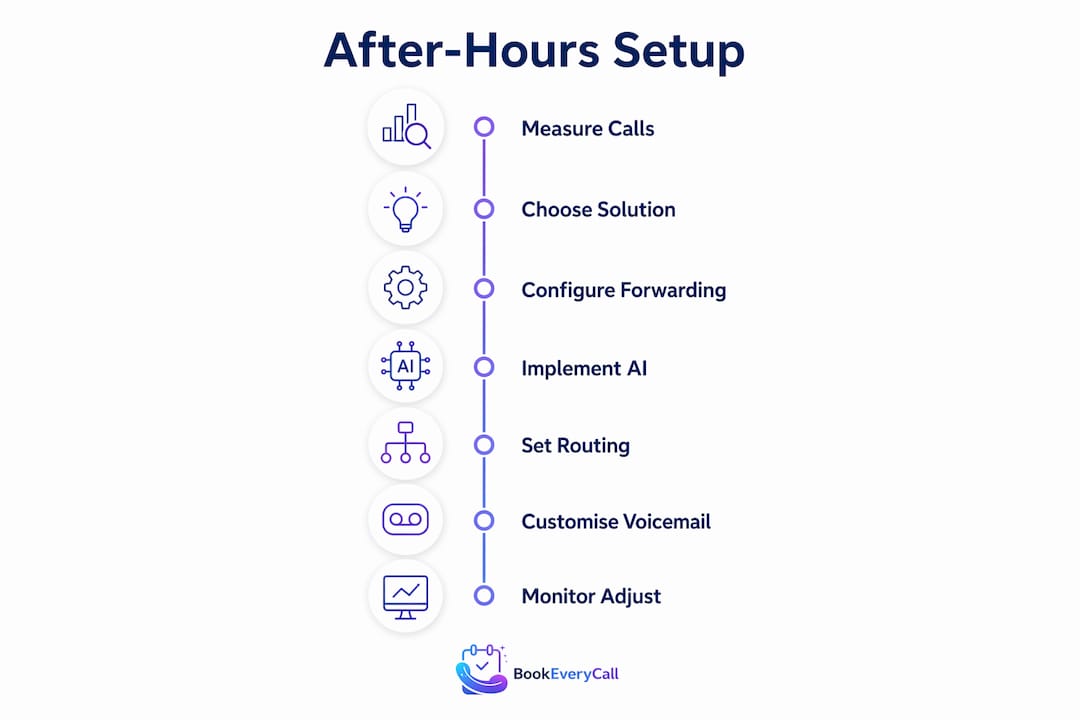
A structured after-hours call handling setup takes most small businesses less than a week to configure. Follow these steps in order.
Step 1: Measure your current missed call volume
Pull your call data from your VoIP dashboard, mobile carrier, or CRM for the past 30 days. Identify how many calls arrive outside business hours and at what times. This tells you the scale of the problem and which solution tier you need.
Step 2: Choose your solution based on volume and budget
Use the table below as a guide.
| Monthly after-hours calls | Recommended solution |
|---|---|
| Fewer than 20 | Custom voicemail greeting plus text-back |
| 20–80 | Professional answering service |
| More than 80 | AI voice agent with calendar integration |
Step 3: Configure call forwarding rules
Log into your VoIP provider (such as RingCentral, 3CX, or your Telstra or Optus business account) and set a time-based forwarding rule. Route all calls received outside your business hours to your chosen after-hours number or service. Test the rule by calling your main number at 6pm from a mobile.
Step 4: Implement your AI receptionist or answering service
If you are using an AI voice agent, connect it to your phone number and configure the greeting script, lead qualification questions, and calendar integration. Bookeverycall’s AI receptionist setup walks through this process specifically for Australian small businesses, including integration with common booking platforms.
Step 5: Set up emergency versus non-emergency routing
Emergencies like gas leaks or burst pipes require immediate routing to on-call staff. Routine calls get scheduled for the next business day. Configure your AI agent or answering service with a clear triage script. Ask callers one qualifying question: “Is this an emergency requiring immediate attention?” Route yes answers to your on-call mobile. Route no answers to booking or voicemail.
For tradies, Bookeverycall has published emergency job booking best practices that cover exactly how to structure this triage for plumbing, electrical, and HVAC businesses.
Step 6: Customise your voicemail greeting
Record a greeting that states your business name, your response time, and an alternative for urgent matters. Keep it under 20 seconds. Avoid generic greetings like “We are unavailable.” Specific, warm greetings reduce hang-ups and increase the rate of callers leaving useful messages.
Step 7: Monitor and adjust
Review your after-hours call data weekly for the first month. Track how many calls were answered, how many were booked, and how many escalated to emergency. Adjust your routing rules, greeting script, or triage questions based on what you find. A good setup improves over time.
Pro Tip: Set a calendar reminder to review your after-hours setup every quarter. Business hours change, staff rosters shift, and peak call times evolve. A setup that worked in january may need adjustment by july.
How does after-hours call handling differ across Sydney, Melbourne, and Brisbane?
Missed calls peak at different times across major Australian cities, and a one-size-fits-all setup will leave gaps. Localising your configuration makes a measurable difference.
Sydney businesses face high after-hours call volumes during the early evening window, roughly 5pm to 8pm. Sydney’s dense population and competitive tradie market mean callers move quickly. A plumber in Parramatta or an electrician in Chatswood who does not answer at 6pm will lose that job to a competitor who does. Sydney businesses benefit most from AI voice agents that can book jobs in real time rather than taking messages.
Melbourne businesses see similar early-evening patterns, with additional spikes on Friday afternoons as residents plan weekend projects. Trades in suburbs like Richmond, Fitzroy, and Dandenong report that Friday evening calls are among their highest-value leads, as customers want weekend availability confirmed. An after-hours booking system that can confirm weekend slots instantly converts these callers at a far higher rate than voicemail.
Brisbane businesses experience later-night call peaks compared to Sydney and Melbourne. Callers in suburbs like Fortitude Valley and Chermside tend to ring later in the evening. This means a Brisbane tradie who cuts off call coverage at 8pm may still be missing significant volume. Extending AI coverage to 10pm or later is worth testing for Brisbane-based service businesses.
Key considerations for any Australian city:
- Check whether your VoIP provider has local number options for each city if you operate across multiple markets.
- Confirm your AI agent or answering service can handle Australian accents and local terminology (such as “arvo” or suburb names).
- Align your emergency routing with local emergency services contacts relevant to your trade and state.
- Review local competitor availability. If every other plumber in your suburb goes to voicemail after 6pm, being the one who answers is a direct competitive advantage.
Key takeaways
A structured after-hours call handling setup is the single most direct way for Australian small businesses to stop losing revenue to missed calls outside business hours.
| Point | Details |
|---|---|
| Missed calls cost real money | 69% of unanswered after-hours calls result in no follow-up, meaning lost leads and lost revenue. |
| Triage is non-negotiable | Separate emergency calls from routine enquiries to protect staff and serve urgent customers. |
| AI agents outperform voicemail | AI voice agents book jobs in real time, converting callers that voicemail would lose. |
| Text-back drives conversions | Automated text replies within one minute increase conversion rates by 391% compared to no response. |
| Localise your setup | Sydney, Melbourne, and Brisbane each have distinct after-hours call patterns that require different coverage windows. |
Why I think most businesses are solving this problem backwards
Here is what I have seen repeatedly: business owners spend weeks choosing the right AI tool or answering service, then go live with a generic greeting and no triage logic. The technology is fine. The thinking behind it is not.
The mistake is treating after-hours call handling as a passive function. You set up voicemail, you feel covered, and you move on. But the system should qualify calls and book appointments in real time rather than merely taking messages. That distinction is the difference between recovering revenue and just appearing to have a system.
The businesses I have seen get this right treat their after-hours setup as an extension of their sales process, not their phone system. They write triage scripts the same way they would train a receptionist. They test the caller experience by ringing their own number at 9pm. They review booking data weekly and adjust. That level of attention is what separates a setup that converts from one that just answers.
The other thing worth saying: hybrid models combining AI and human answering services work better than either alone for most small businesses. AI handles volume and routine calls. A human operator handles the complex or emotionally charged calls that need a real voice. Getting that balance right takes a month of data, not a guess on day one.
The future of after-hours call management in Australia is not about more technology. It is about businesses finally treating every call as a revenue event, regardless of what time it comes in.
— Chay
How Bookeverycall handles after-hours calls for Australian businesses
Bookeverycall functions as a fully managed AI receptionist that answers, qualifies, and books calls around the clock, with no staff required after hours.
The platform integrates directly with your existing phone number and booking calendar, so after-hours callers get a real conversation, not a voicemail. Bookeverycall qualifies each caller, separates emergencies from routine enquiries, and books confirmed appointments before the call ends. For Australian tradies and small business owners ready to stop losing jobs after hours, the AI receptionist setup guide covers every configuration step for the Australian market. You can also explore the full Voice AI service to see how it fits your business.
FAQ
What is after-hours call handling?
After-hours call handling is the process of managing customer calls received outside regular business hours using tools such as AI voice agents, answering services, call forwarding, or voicemail systems.
What is after-hours emergency answering?
After-hours emergency answering is a call routing setup that identifies urgent calls, such as gas leaks or burst pipes, and connects them immediately to an on-call staff member while routing non-urgent calls to voicemail or a booking system.
How much revenue do missed after-hours calls cost?
Businesses lose approximately 69% of after-hours calls that go unanswered with no voicemail left, and Bookeverycall estimates recurring missed calls can cost up to $312,000 annually in lost revenue.
Can a small business set up after-hours call handling without hiring staff?
Yes. AI voice agents and automated text-back systems handle after-hours calls, qualify leads, and book appointments with no human staffing required overnight, making them viable for sole traders and small teams.
How do I choose between an AI agent and a professional answering service?
Businesses receiving more than 80 after-hours calls per month benefit most from an AI voice agent with calendar integration. Lower-volume businesses or those needing a personal touch for complex calls are better served by a professional answering service or a hybrid of both.