

TL;DR:
- Automated call answering in Australia uses AI voice agents to handle calls 24/7, qualifying leads and booking appointments without human staff. It offers a lower cost per minute and consistent service, capturing more revenue from missed calls. Integration with existing tools is quick, and privacy complies with Australian laws, making it suitable for many industries.
Automated call answering in Australia is the use of AI voice agents to manage inbound business calls instantly, around the clock, without a human receptionist on the line. These systems do far more than play a recorded menu. They qualify leads, book appointments directly into calendars, pull live client data from CRMs like HubSpot and Calendly, and transfer calls with full context to the right team member. AI costs start as low as $0.55 AUD per minute, compared to $1.50–$3.00 per minute for a human receptionist. For Australian small businesses missing calls after hours or during peak periods, that gap represents real, recoverable revenue.
What is automated call answering and how does it work in Australia?
Automated call answering, also called an AI voice receptionist, is a phone system where an AI agent answers calls, holds a natural conversation, and completes tasks like booking jobs or routing enquiries. The industry term is “AI voice agent.” The phrase “automated call answering” describes the outcome: every call gets answered, every time.
The technology works in real time. When a call arrives, the AI agent answers within one ring, speaks in a natural Australian accent, and immediately begins qualifying the caller. Live CRM lookups happen before the greeting finishes. That means the system already knows whether the caller is an existing client, what service they need, and which team member should handle them.
This is the feature that separates AI voice agents from basic IVR phone menus. A traditional IVR plays options and waits for a keypress. An AI voice agent holds a genuine back-and-forth conversation, captures the caller’s details, and takes action. The difference in caller experience is significant.
AI receptionist solutions can be deployed and live within 24–48 hours. Human receptionists cover roughly 21% of total annual hours. AI covers 100%.
How does automated call answering technology work for Australian businesses?
The core of any AI call answering system is a large language model trained to handle phone conversations. The agent listens, interprets intent, responds naturally, and triggers back-end actions based on what the caller says.
Here is what happens on a typical inbound call:
- The AI answers within one ring with no hold music and no voicemail delay.
- It identifies the caller using a live lookup against your CRM or scheduling platform.
- It qualifies the enquiry by asking the right questions for your business type.
- It books the appointment directly into Google Calendar or Calendly, or routes the call to the right person with a warm transfer and full transcript context.
- It sends an SMS or email notification to your team the moment the call ends.
AI voice agents integrate with Australian 13, 1300, and 1800 number inbound call plans. You do not need to change your existing phone number or provider. The system sits in front of your current setup and handles calls before they ever reach voicemail.
Privacy is a genuine concern for Australian businesses. All call data is handled within Australian infrastructure and complies with the Australian Privacy Act 1988. Data does not leave the country.

Pro Tip: Ask your provider whether their AI uses local Australian servers before you sign up. Offshore data handling creates compliance risk under the Australian Privacy Act, particularly for health clinics and financial services businesses.
Automated call answering vs human receptionists: which is better for Australian businesses?
The honest answer is that AI wins on availability, cost, and consistency. Human receptionists win on complex emotional situations and nuanced judgement calls. For most Australian small businesses, the volume of calls requiring human judgement is far smaller than the volume requiring a reliable, fast answer.
Human receptionists cover roughly 21% of total annual hours. That leaves 79% of the year where calls go to voicemail or ring out. For a tradie in Brisbane or a plumber in Perth, a missed call at 7pm on a Friday is often a lost job.
The cost difference is direct. AI call answering starts at approximately $0.55 AUD per minute or around $37 per day for continuous coverage. A human receptionist costs $1.50–$3.00 per minute during business hours only. After hours, you either pay overtime rates or accept missed calls.
| Feature | AI voice agent | Human receptionist |
|---|---|---|
| Availability | 24/7, 365 days | Business hours only (approx. 21% of year) |
| Cost per minute | From $0.55 AUD | $1.50–$3.00 AUD |
| Call consistency | Identical quality every call | Varies by staff member and time of day |
| After-hours coverage | Full coverage | Not available without overtime |
| CRM integration | Live lookup during call | Manual entry after call |
| Warm transfer with context | Full transcript passed on | Verbal handover only |
| Privacy compliance | Australian Privacy Act compliant | Depends on staff training |
| Setup time | 24–48 hours | Weeks to hire and train |
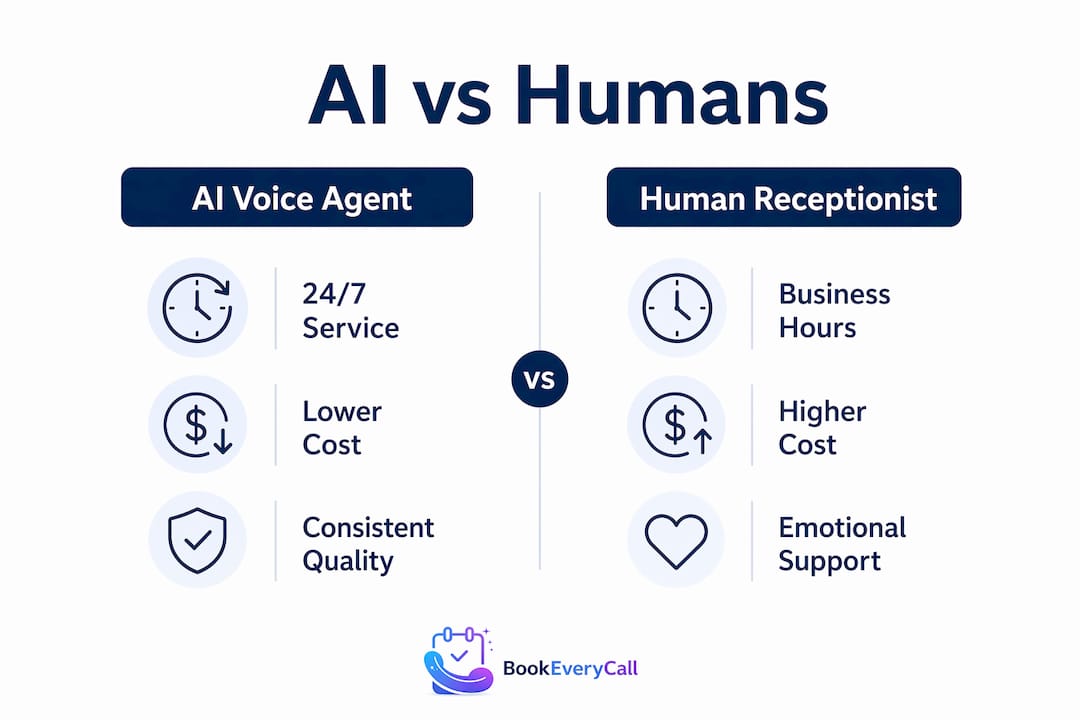
Consistent 24/7 service quality means the AI delivers the same experience at 3am on a Sunday as at 3pm on a Tuesday. No tired staff, no rushed answers, no calls dropped because the receptionist is on another line.
Pro Tip: Run a two-week audit of your missed calls before switching. Log every call that went to voicemail and estimate the job value. Most Australian trade businesses are surprised by how much revenue they are leaving on the table each fortnight.
The cost of missed calls for Australian businesses is substantial. Bookeverycall estimates businesses can lose up to $312,000 annually from recurring missed calls. That figure puts the cost of AI call answering into sharp perspective.
How do Australian businesses integrate automated call answering with existing tools?
Integration is where most businesses hesitate. The good news is that modern AI call answering systems are built to connect with the tools you already use, not replace them.
Step-by-step integration process
- Audit your current call flow. Map where calls come in, who answers them, and what happens when no one does. Identify the gaps, particularly after hours and during peak periods.
- Connect your CRM. Platforms like HubSpot, Pipedrive, and Zoho CRM connect directly. The AI pulls client records live during the call and pushes new lead data back after the call ends.
- Link your scheduling tool. Google Calendar and Calendly are the most common integrations. The AI books appointments in real time without any manual step from your team.
- Set up call routing rules. Define which calls go to which team member, by territory, skill, or product line. Multi-rep round-robin distribution handles overflow automatically.
- Configure notifications. Set SMS and email alerts so your team knows immediately when a new lead has been captured or a job has been booked.
- Test before going live. Call your own number and run through the most common enquiry types. Adjust the AI’s responses based on what you hear.
Setups range from same-day for focused AI receptionist builds to a few days for more complex implementations. Fast onboarding means you start capturing calls quickly without a long disruption to your business.
The best integrations share a few common traits:
- Clear qualification questions defined upfront so the AI knows what to ask.
- A single source of truth for your calendar so double bookings cannot occur.
- Notification rules that match your team’s actual working patterns.
- A fallback warm transfer option for calls the AI cannot resolve.
Pro Tip: Build your AI’s qualification script around the three questions your team asks on every call. For a plumber, that might be: What is the problem? What suburb are you in? Are you available this week? Keep it short and the AI will capture more complete leads.
For businesses wanting a detailed walkthrough, the AI receptionist setup guide from Bookeverycall covers the full process for Australian small businesses.
Automated call answering in Sydney, Melbourne, Brisbane, and Perth
Demand for inbound call automation across Australia’s major cities reflects the specific pressures each market faces. The technology is the same, but the business case shifts depending on your city.
Sydney businesses deal with high call volumes driven by dense population and competitive service markets. Real estate agencies, health clinics, and trade businesses in Sydney’s outer suburbs report the highest rates of after-hours missed calls. AI voice receptionists for real estate and property management are particularly active in Sydney’s western growth corridors.
Melbourne has strong adoption among professional services and health clinics. The city’s spread across multiple suburbs means territory-based call routing is a priority. Businesses in Melbourne’s south-east use round-robin distribution to send calls to the nearest available technician.
Brisbane is seeing rapid uptake among tradies, particularly electricians, plumbers, and HVAC businesses. The Queensland construction boom has pushed call volumes beyond what small teams can handle manually. AI receptionists for tradies in Brisbane are capturing jobs that previously went to competitors who answered faster.
Perth businesses face a unique time zone challenge. Clients in Perth calling eastern-state suppliers or partners often call outside standard business hours for the east coast. AI call answering solves this without requiring staff to work split shifts.
Across all four cities, AI systems trained on Australian accents and local phrasing perform noticeably better than generic voice agents. Callers respond more naturally when the AI sounds like it belongs here.
Key takeaways
Automated call answering in Australia gives local businesses 24/7 coverage at a fraction of the cost of a human receptionist, with live CRM integration and instant appointment booking built in.
| Point | Details |
|---|---|
| Coverage gap is real | Human receptionists cover only 21% of annual hours, leaving most of the year unattended. |
| Cost advantage is clear | AI answering starts at $0.55 AUD per minute versus $1.50–$3.00 for human reception. |
| Integration is straightforward | Connect HubSpot, Pipedrive, Google Calendar, or Calendly in 24–48 hours with no number change. |
| Privacy is protected | Australian Privacy Act 1988 compliance means all call data stays on local infrastructure. |
| City context matters | Sydney, Melbourne, Brisbane, and Perth each have distinct call patterns that AI routing handles automatically. |
Why I think most Australian businesses are still underestimating this technology
I have watched Australian small businesses wrestle with missed calls for years. The common response is to hire a part-time receptionist or set up a better voicemail. Neither solves the problem. A part-time receptionist covers a few more hours. A better voicemail still means the caller hangs up and calls your competitor.
The shift I have seen recently is businesses realising that the AI does not just answer calls. It qualifies the lead, books the job, and notifies the team before the caller has even hung up. That is a fundamentally different outcome from anything a voicemail or a phone menu delivers.
The hesitation I hear most often is about caller experience. Business owners worry that their customers will not accept talking to an AI. The data does not support that concern. When the AI speaks in a natural Australian accent, answers immediately, and actually solves the caller’s problem, most callers do not care whether they spoke to a person or a machine. They care that they got an answer.
The businesses I see getting the most from this technology are the ones who treat the AI as a first-line qualifier, not a replacement for their whole team. The AI handles the volume. The humans handle the complexity. That division of labour is where the real efficiency sits.
My advice for any Australian business considering this in 2026: do not wait until you have lost enough jobs to feel the pain. Run the numbers on your missed calls now. The gap between what you are capturing and what you could be capturing is almost always larger than you expect.
— Chay
How Bookeverycall helps Australian businesses answer every call
Bookeverycall is a fully managed AI receptionist service built specifically for Australian businesses. It answers calls 24/7, qualifies enquiries, and books jobs directly into your calendar without any manual input from your team.
The service connects with HubSpot, Pipedrive, Google Calendar, and Calendly out of the box. Setup takes as little as one day. Bookeverycall supports tradies, electricians, HVAC businesses, real estate agencies, and health clinics across Sydney, Melbourne, Brisbane, and Perth. For businesses ready to stop losing revenue to missed calls, the Voice AI service page covers exactly how it works. You can also book a strategy call directly at bookeverycall.com to talk through your specific setup.
FAQ
What is automated call answering in Australia?
Automated call answering in Australia is the use of AI voice agents to answer inbound business calls 24/7, qualify leads, book appointments, and route calls without a human receptionist. It differs from basic IVR systems by holding natural conversations and integrating live with CRMs and scheduling tools.
How much does automated call answering cost in Australia?
AI call answering starts at approximately $0.55 AUD per minute, compared to $1.50–$3.00 per minute for a human receptionist during business hours. Most providers also offer flat daily rates, with continuous 24/7 coverage available from around $37 per day.
How quickly can I set up an AI call answering system?
Most AI receptionist builds go live within 24–48 hours for focused setups. More complex implementations with multiple CRM integrations and call routing rules typically take a few days.
Does AI call answering comply with Australian privacy laws?
Yes. Reputable Australian AI call answering providers comply with the Australian Privacy Act 1988 and store all call data on local infrastructure. Always confirm with your provider that data does not leave Australian servers.
Which industries benefit most from automated call answering in Australia?
Tradies, electricians, plumbers, HVAC businesses, real estate agencies, and health clinics see the strongest results. These industries share high inbound call volumes, frequent after-hours enquiries, and clear job-booking workflows that AI agents handle well.