

TL;DR:
- An emergency job booking system automates urgent service requests, ensuring real-time technician dispatch without disrupting confirmed appointments. It boosts revenue by capturing higher-margin jobs, improves operational efficiency, and enhances customer satisfaction through automated notifications and optimized scheduling. Proper implementation involves process mapping, designated emergency technicians, voice AI integration, and local calibration for cities like Sydney and Melbourne.
An emergency job booking system is software that captures, assigns, and schedules urgent service requests in real time without displacing confirmed appointments. For Australian trades and service businesses, this is the difference between recovering a $1,500 emergency call-out and losing it to a competitor who picks up the phone. Tools like RevoField and FieldCamp have built entire platforms around this problem, and Bookeverycall addresses the front end of it by ensuring no urgent call goes unanswered in the first place. Missed calls cost Australian businesses millions in lost revenue every year, making automated emergency booking one of the highest-return investments a service business can make.
What is an emergency job booking system?
An emergency job booking system is a specialised scheduling platform that handles unplanned, urgent service requests without collapsing the rest of the day’s work. It sits between your incoming calls or digital requests and your dispatch team, making real-time decisions about technician availability, skill match, and travel time.
The term “emergency job booking system” is the common search phrase, but the recognised industry term is emergency dispatch software. Both refer to the same category of tools. Emergency dispatch software provides a real-time decision layer that maintains operational clarity, ensuring the right technician arrives with the correct parts within the agreed service level.
This is not the same as standard job scheduling software, which manages planned work. Emergency booking systems are built specifically for disruption. They handle the moment a burst pipe call comes in at 7pm on a Friday when three of your four technicians are already committed. Without a system, that call either goes unanswered or causes a cascade of rescheduling that frustrates multiple customers. With one, it gets handled in seconds.
The importance of emergency job booking cannot be overstated for trades businesses in Australia. Plumbers, electricians, HVAC technicians, and property managers all face unpredictable demand. A system that manages that demand without human scrambling is a direct revenue and reputation asset.
How does emergency job booking work?
Emergency job booking works through a five-step automated process that runs from the moment a request comes in to the moment a technician is dispatched and the customer is notified.
- Request capture. The system receives the emergency request via phone, SMS, web form, or app. AI-powered tools like Bookeverycall capture this at the call stage, qualifying the job type and urgency before it even reaches a dispatcher.
- Technician evaluation. AI dispatching assigns technicians using weighted scoring across skills, proximity, current workload, and schedule impact. This happens in seconds, not minutes.
- Parts and inventory check. The system cross-references van stock or warehouse inventory to confirm the technician has what they need. Sending someone without the right parts wastes time and damages trust.
- Schedule insertion. The emergency job is slotted into the technician’s day using gap insertion logic. Confirmed appointments are not moved. The system finds breaks, travel buffers, or next-available windows.
- Customer and team notification. Automated SMS messages go to the customer with an ETA. The technician receives a one-tap update on their mobile app. The dispatcher sees everything on a live dashboard.
This workflow is why AI reduces decision time from minutes to seconds and handles multiple simultaneous emergencies without disrupting normal operations. A human dispatcher managing three urgent calls at once will make errors. The system does not.
Pro Tip: Designate at least one “emergency-ready” technician per shift before the day starts. Feed this designation into your dispatch system so the AI knows who to assign first when an urgent job arrives.
The integration layer matters too. Platforms like ServiceTitan, Jobber, Housecall Pro, and FieldEdge all connect with emergency dispatch tools for job creation, technician location tracking, and schedule syncing. If you are already using one of these field service management platforms, adding emergency dispatch capability is a configuration exercise, not a full system replacement.
What are the benefits of emergency job booking systems?
Emergency job booking systems deliver three categories of benefit: financial, operational, and reputational. Each one compounds the others.
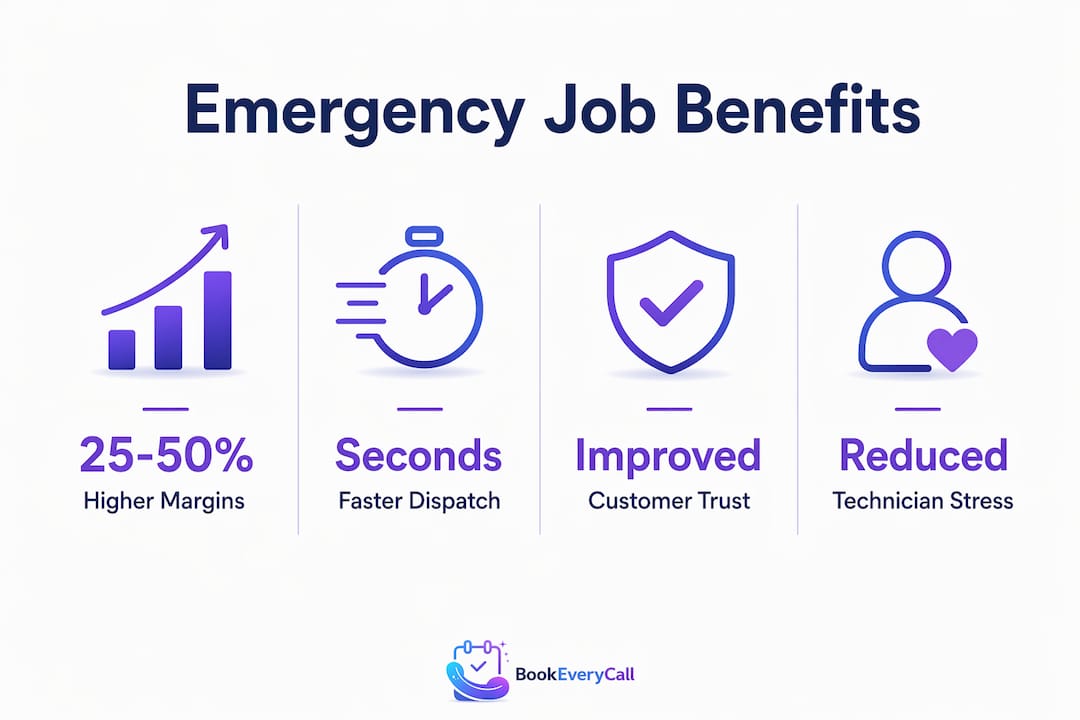
Financial uplift is the most immediate. Emergency jobs generate 25–50% higher margins than standard scheduled work. That premium exists because customers in urgent situations prioritise speed over price. A plumber who arrives within two hours of a burst pipe call commands a call-out rate that a routine maintenance booking never will. Capturing those jobs consistently adds up fast.
The risk side of the equation is equally real. One unmanaged emergency dispatch can delay three to five subsequent jobs. That means unhappy customers, refund requests, and negative reviews. A system that inserts emergency work cleanly prevents that cascade entirely.
Operational benefits include:
- Reduced dispatcher stress and decision fatigue during peak periods
- Consistent technician utilisation across the day rather than feast-and-famine scheduling
- Fewer double-bookings and last-minute rescheduling calls
- Real-time visibility across the entire field team from a single dashboard
- Lower overtime costs because work is distributed more evenly
Reputational gains are harder to quantify but equally important. Customers who receive an accurate ETA and a timely arrival tell others. Customers who are told “we’ll try to get someone out today” and then hear nothing do not come back. Automated SMS notifications and real-time updates set clear expectations and reduce inbound “where is my technician?” calls by a significant margin.
Technician wellbeing is a less-discussed benefit. Poor dispatch logic creates situations where one technician is overloaded while another sits idle. Better assignment logic distributes work fairly, which reduces burnout and improves retention. In a tight labour market like Australia’s trades sector, keeping good technicians is a direct business advantage.
What features do modern emergency job booking tools include?
Modern emergency job booking tools have moved well beyond basic scheduling. The technology now includes AI scoring, protected appointment logic, voice integration, and real-time inventory visibility.
| Feature | What It Does | Why It Matters |
|---|---|---|
| AI weighted scoring | Evaluates skills, proximity, workload, and schedule impact simultaneously | Assigns the best technician in seconds, not minutes |
| Protected appointment logic | Treats confirmed bookings as immovable; inserts emergencies into gaps only | Prevents existing customers from being displaced |
| Gap insertion logic | Finds schedule windows including breaks and travel buffers | Maximises daily job capacity without overloading technicians |
| Voice AI integration | Captures and qualifies emergency calls before they reach dispatch | Eliminates missed calls during peak and after-hours periods |
| Real-time inventory check | Verifies van stock before dispatch | Reduces failed first visits |
| Automated notifications | Sends SMS to customer and app update to technician | Reduces inbound status calls and improves customer experience |
Protected appointment logic is the feature most businesses underestimate. Without it, an emergency insertion can bump a confirmed booking, creating a second unhappy customer in the process of serving the first. The system treats pinned appointments as immovable, inserting emergency jobs only into gaps, breaks, or next-day slots.
Pro Tip: When evaluating emergency job booking tools, ask specifically whether the platform uses protected appointment logic. If the vendor cannot explain how confirmed bookings are protected during emergency insertions, the system is not mature enough for a busy service operation.
Voice AI is the front-end complement to dispatch software. Bookeverycall handles this layer by answering calls 24/7, qualifying the job type, and booking directly into the calendar. This means the emergency dispatch system receives clean, structured job data rather than a voicemail that someone has to transcribe and action manually. The combination of voice AI at intake and AI dispatch at assignment is the most effective approach to emergency scheduling for Australian service businesses in 2026.
How do you implement an emergency job booking system?
Implementing an emergency job booking system does not require a full technology overhaul. Most businesses can be operational within a week by following a structured approach.
- Audit your current process. Map how emergency calls currently arrive, who handles them, and how long it takes from call to dispatch. This baseline tells you where the biggest delays and revenue losses are occurring.
- Designate emergency-ready technicians. Identify one or two technicians per shift who can take urgent jobs. Build this into your scheduling rules so the system knows who is available for emergency assignment. Successful emergency workflows combine designated emergency techs, rolling reassignment policies, and GPS-enabled proximity routing.
- Set up automated communication protocols. Configure SMS templates for customer notifications and app alerts for technicians. These should trigger automatically on job assignment, not require manual sending.
- Integrate with your existing FSM platform. If you use ServiceTitan, Jobber, or a similar platform, connect your emergency dispatch tool via API. This ensures job data, technician location, and schedule changes sync in real time without manual data entry.
- Enable GPS-based proximity routing. Set the system to factor in real-time technician location when scoring assignments. A technician who is two kilometres away beats one who is technically “available” but forty minutes across town.
- Add voice AI for call capture. Connect a tool like Bookeverycall to handle incoming calls outside business hours and during peak periods. This closes the gap between a customer calling and a job entering the system.
- Review and refine weekly. Check your emergency job data each week for the first month. Look at response times, first-visit completion rates, and any jobs that caused schedule disruption. Adjust your rules accordingly.
The most common implementation mistake is skipping step one. Businesses that jump straight to software without understanding their current failure points end up automating a broken process. The audit takes two hours and saves weeks of troubleshooting later.
How do emergency booking systems work across australian cities?
Emergency job booking systems need to account for local conditions, and Australia’s major cities present very different operational environments.
- Sydney has the most complex traffic patterns of any Australian city. Peak hour on the M1 or M5 can add forty-five minutes to a job that looks close on a map. Proximity routing must use real-time traffic data, not straight-line distance. Businesses in Sydney’s outer suburbs also face longer technician travel times, making accurate ETA communication even more critical.
- Melbourne has a large and dense inner-city zone surrounded by sprawling outer suburbs. Emergency demand in Melbourne tends to spike during extreme weather events, particularly heatwaves that drive HVAC call-outs. Having pre-designated emergency technicians in both the inner and outer zones prevents the system from routing a technician from Frankston to Fitzroy.
- Brisbane is growing rapidly, with new residential developments in the north and south corridors creating high demand for trades. Emergency booking systems in Brisbane need to account for technician availability in growth corridors like Ipswich, Logan, and the Sunshine Coast fringe.
- Perth operates in a unique time zone and has a geographically spread population. After-hours emergency calls are common, and the distance between suburbs means travel time is a dominant factor in dispatch decisions. Voice AI tools that capture calls outside business hours are particularly valuable here.
- Adelaide has a smaller market but strong demand for emergency trades in older residential areas. Technician availability can be tighter than in larger cities, making skills-based matching more important than proximity alone.
Across all five cities, the AI appointment scheduling approach works best when it is calibrated to local traffic, technician distribution, and demand patterns rather than using generic national settings.
Key takeaways
An emergency job booking system captures revenue and protects schedule stability by automating technician assignment, customer communication, and job insertion the moment an urgent request arrives.
| Point | Details |
|---|---|
| Core definition | Emergency dispatch software assigns urgent jobs in real time without displacing confirmed bookings. |
| Revenue impact | Emergency jobs generate 25–50% higher margins but require proper management to avoid cascading delays. |
| Protected appointment logic | Confirmed bookings are treated as immovable; emergencies slot into gaps only. |
| Implementation priority | Designate emergency-ready technicians and integrate voice AI before configuring dispatch rules. |
| City-specific calibration | Proximity routing must use real-time traffic data, especially in Sydney and Melbourne. |
Why most businesses get emergency booking wrong
I have seen a lot of service businesses invest in field service management software and then wonder why their emergency response is still chaotic. The problem is almost never the software. It is the assumption that software alone fixes a process problem.
The businesses that get the most out of emergency job booking systems are the ones that treat it as a workflow design exercise first and a technology purchase second. They map the failure points, designate the right people, and set clear rules before they configure a single automation. The software then executes those rules at speed. That is the correct order of operations.
The other misconception I see constantly is that emergency booking is only relevant for after-hours calls. The data does not support this. A significant portion of emergency requests arrive during business hours when the team is already at capacity. The system needs to handle that scenario just as well as the 11pm burst pipe call.
Voice AI at the front end changes the economics entirely. When Bookeverycall answers a call, qualifies the job, and drops a structured booking into the dispatch queue, the dispatcher is not starting from scratch. They are confirming a decision the system has already prepared. That shift from reactive to prepared is where the real time savings come from.
The future of this space is tighter integration between voice AI, dispatch software, and inventory management. Businesses that connect all three will have a genuine operational advantage over those still relying on a human to answer, transcribe, and manually schedule every urgent call. The after-hours booking setup is where most businesses should start, because that is where the most revenue is currently leaking.
— Chay
How Bookeverycall handles emergency job booking for australian businesses
Bookeverycall functions as a fully managed AI receptionist that captures emergency calls 24/7, qualifies the job, and books it directly into your calendar without any manual intervention.
For trades and service businesses across Sydney, Melbourne, Brisbane, Perth, and Adelaide, this means no urgent call goes to voicemail during a busy afternoon or after hours. The platform connects directly with your scheduling system, so every emergency request becomes a structured booking rather than a missed opportunity. Australian businesses that rely on Bookeverycall recover up to $312,000 annually in revenue that would otherwise be lost to unanswered calls. Whether you run an HVAC business or an electrical contracting operation, the platform is built for the specific demands of Australian service businesses. Visit bookeverycall.com to see how it works.
FAQ
What is an emergency job booking system?
An emergency job booking system is software that captures urgent service requests and assigns the right technician in real time without displacing confirmed appointments. It automates the entire process from call intake to dispatch and customer notification.
How does emergency job booking work in practice?
The system receives a request, evaluates available technicians using AI scoring across skills and proximity, checks parts availability, inserts the job into a schedule gap, and sends automated notifications to both the customer and technician.
What is the difference between job scheduling software and emergency dispatch software?
Standard job scheduling software manages planned, pre-booked work. Emergency dispatch software is built specifically for unplanned urgent requests, using protected appointment logic and real-time routing to handle disruptions without collapsing the existing schedule.
How much revenue do australian businesses lose from missed emergency calls?
Australian businesses lose significant revenue from missed calls annually, with some estimates reaching $312,000 per year for businesses with recurring missed call patterns. Emergency calls carry 25–50% higher margins, making each missed one particularly costly.
What features should i look for in an emergency job booking tool?
Look for AI-weighted technician scoring, protected appointment logic, automated SMS notifications, GPS proximity routing, and integration with your existing FSM platform such as ServiceTitan or Jobber. Voice AI integration for call capture is the feature most businesses overlook but benefit from most.