
TL;DR:
- Proper after-hours call answering captures urgent inquiries, schedules bookings, and prevents missed revenue. AI solutions offer cost-effective, fast setup with accurate local accents and automatic call recording disclosures for Australian compliance. Selecting the right service depends on your call volume, urgency needs, and integration with existing booking systems to maximize small business growth.
After hours call answering is the practice of routing and handling incoming calls to your business outside standard trading hours, using voicemail, human operators, or AI-powered services. For Australian small businesses, missing these calls is a direct revenue problem. Lost emergency jobs from missed after-hours calls can cost tradies between $500 and $2,000 per job. Most callers will not leave a voicemail. They call the next business on the list. Whether you run a plumbing company in Brisbane, a medical practice in Melbourne, or a cleaning service in Perth, the right after hours call answering solution keeps you competitive and your calendar full.
What after hours call answering options are available to Australian small businesses?
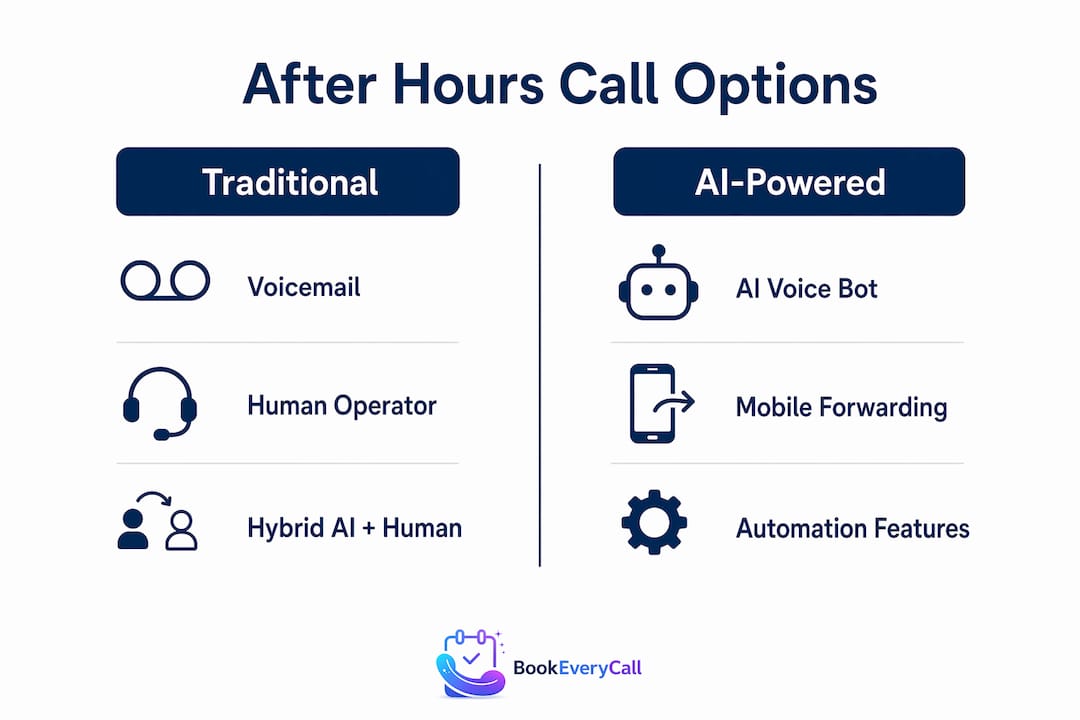
After-hours answering options for Australian small businesses fall into four main categories: voicemail, mobile forwarding, traditional human answering services, and AI virtual receptionists. Each differs significantly in how quickly it captures enquiries and how well it converts callers into booked jobs.
Voicemail is the default for most small businesses and the worst performer for revenue. Research confirms most callers simply hang up rather than leave a message, which means you lose the lead entirely. Voicemail is free but costs you every time a high-intent caller moves on to a competitor.
Traditional human answering services use trained operators to answer calls on your behalf, take messages, and sometimes book appointments. These services typically cost between $200 and $500+ per month in Australia. They offer a personal touch and can handle complex or sensitive calls, but they are the most expensive option and quality can vary between operators and shifts.
AI-powered answering services like those offered by Bookeverycall, TransferToAI, and Waboom AI use voice AI to answer calls 24/7, qualify callers, and book appointments directly into your calendar. AI virtual receptionists provide consistent service with Australian accents and integrate with CRM and calendar tools to automate bookings. Pricing typically ranges from $75 to $299 per month, making them the most cost-effective option for most small businesses.
Hybrid AI plus human services combine automated call handling with human escalation for complex situations. These suit businesses that receive a mix of routine enquiries and sensitive calls requiring human judgement. Hybrid services generally start from around $145 per month.
| Option | Coverage | Emergency triage | Booking capability | Typical monthly cost |
|---|---|---|---|---|
| Voicemail | After hours only | None | None | Free |
| Human answering service | 24/7 available | Limited | Message only | $200 to $500+ |
| AI virtual receptionist | 24/7 | Yes, automated | Direct calendar booking | $75 to $299 |
| Hybrid AI plus human | 24/7 | Yes, escalated | Direct booking + human review | $145+ |
Pro Tip: If your business receives urgent calls outside hours, such as emergency plumbing or after-hours medical queries, prioritise any service with live emergency triage over one that simply takes a message.
How to choose the best after hours answering service for your small business
Choosing the right service starts with understanding your actual call patterns. A café in Adelaide that closes at 3pm has different needs from a 24-hour locksmith in Sydney. Before comparing providers, answer three questions: When do most of your missed calls arrive? Are any of those calls urgent? And what do you need the service to do beyond taking a message?
Here is a practical checklist for evaluating providers:
- Coverage hours. Confirm whether you need full 24/7 call answering services or after-hours coverage only. Some providers charge more for overnight and weekend coverage.
- Emergency triage capability. If your business handles urgent jobs, the service must be able to identify and escalate those calls immediately rather than queuing them for a morning callback.
- Direct booking integration. The most valuable services book appointments straight into your calendar using tools like Google Calendar, Calendly, or your existing CRM. Passive message-taking loses revenue.
- Australian accent and local presence. Local accents and prompt handling increase customer comfort and trust, particularly in cities like Sydney and Melbourne where callers expect professional, locally familiar service.
- Compliance with Australian call recording laws. Any service that records calls must disclose this at the start of the call. Confirm the provider’s script includes this disclosure before you sign up.
- CRM and calendar integration. Check that the service connects with the tools you already use. A service that delivers call summaries by SMS or email but does not sync with your booking system creates extra admin work.
- Contract terms and pricing transparency. Avoid providers with long lock-in contracts if you are testing the service for the first time. Per-call or month-to-month pricing gives you flexibility.
Pro Tip: Ask any provider for a sample call recording before committing. This tells you more about call quality, accent, and script accuracy than any brochure.
Cost versus features is the central trade-off. A human answering service at $400 per month may feel more personal but delivers no booking capability. An AI service at $150 per month that books jobs directly into your calendar pays for itself with a single converted call. For most Australian small businesses, the AI receptionist comparison shows AI wins on both cost and conversion rate.
How to set up after hours call answering quickly and effectively
Most small business owners delay setting up after hours phone support because they assume it is complicated. It is not. AI services can be onboarded the same day for focused setups, while human virtual receptionist services typically take one to two weeks to configure and train.
Follow these steps to get your service running with minimal disruption:
- Document your business details. Write down your trading hours, services offered, service area, pricing if you share it over the phone, and your emergency policy. The more specific you are, the better the service performs.
- Set up call forwarding with your carrier. Telstra, Optus, and Vodafone all support conditional call forwarding, which routes calls to your answering service only when your line is busy or unanswered. This is a standard feature and takes minutes to activate.
- Prepare your call script. A good script captures the caller’s name, suburb, nature of the issue, and preferred callback time. Effective scripting captures caller name, issue, suburb, and callback time, then immediately books or escalates urgent calls rather than just leaving messages.
- Run test calls. Call your own number after hours and evaluate the experience as a customer would. Check that the greeting is accurate, the booking process works, and urgent calls are escalated correctly.
- Connect your CRM and calendar. Most AI services integrate directly with Google Calendar, HubSpot, or Jobber. Set this up before going live so every booked call appears in your system automatically.
- Review your first week of call summaries. Most services deliver SMS or email summaries after each call. Read these daily for the first week to catch any scripting gaps or missed escalations.
Common mistakes include setting up forwarding but forgetting to test it, providing vague service descriptions that confuse the AI or operator, and skipping CRM integration so call data sits in a separate inbox nobody checks. For businesses exploring AI chatbot appointment booking alongside voice answering, the same principle applies: structured data capture beats open-ended message-taking every time.
Pro Tip: Record a short voice memo describing your business as if explaining it to a new employee. Use that as the basis for your answering service script. It is faster and more accurate than filling in a generic form.
How do compliance and privacy regulations affect after hours call answering in Australia?
Call recording law in Australia is not uniform across states, which catches many small business owners off guard. The key distinction is between all-party consent jurisdictions and one-party consent jurisdictions.
- All-party consent states: New South Wales, Western Australia, South Australia, Tasmania, and the ACT require all parties to consent before a call is recorded.
- One-party consent states: Victoria, Queensland, and the Northern Territory require only one party to consent, meaning the business recording the call satisfies the requirement.
The practical solution is straightforward. AI voice agents comply with all jurisdictions by playing a single opening-line disclosure at the start of every call. The caller’s continued engagement after hearing the disclosure implies consent, satisfying both all-party and one-party consent requirements simultaneously. This approach covers State Surveillance Devices Acts and privacy laws across Australia.
“Consent disclosure handled by AI voice agents can satisfy multiple state laws simultaneously without complicating customer calls.” — Waboom AI
When evaluating any provider, confirm the following:
- The call script includes an upfront recording disclosure before any personal information is collected.
- The provider’s data storage practices comply with the Australian Privacy Act 1988 and the Office of the Australian Information Commissioner (OAIC) guidelines.
- Call recordings and transcripts are stored securely and deleted according to a defined retention policy.
- The provider can supply a copy of their privacy policy and data processing agreement on request.
Skipping compliance checks is a risk that small businesses routinely underestimate. A single complaint to the OAIC about unlawful call recording can result in significant reputational and financial consequences. Choosing a provider that handles disclosure automatically removes this risk from your operations entirely.
City-specific considerations for after hours call answering in Australia
After hours call volumes and customer expectations differ meaningfully across Australian cities, and the right setup for a Sydney tradie is not necessarily the right setup for an Adelaide professional services firm.
Sydney generates the highest after-hours call volumes of any Australian city, driven by its density of trade businesses, medical practices, and professional services. Callers in Sydney expect fast response times and are less tolerant of voicemail. AI services with immediate booking capability and native Australian voices perform best here. The best AI answering service for plumbers in Sydney, for example, needs to handle emergency triage and same-day booking without hesitation.
Melbourne has a strong professional services culture where callers expect polished, articulate responses. Hybrid AI plus human services suit Melbourne businesses that handle sensitive enquiries, such as legal, financial, or healthcare queries, where a human escalation option adds reassurance.
Brisbane businesses, particularly in construction, trades, and property services, see significant after-hours demand from residential customers calling after work hours. A 24/7 AI receptionist with direct calendar booking is the most practical solution for Brisbane tradies managing high call volumes at low cost.
Perth operates in a time zone that creates a natural after-hours gap with eastern states clients. Perth businesses that serve national clients or eastern-state customers should configure their answering service to reflect AWST business hours clearly, so callers understand when a callback will occur.
Adelaide small businesses tend to have lower call volumes but higher average job values in sectors like HVAC, electrical, and specialist trades. For Adelaide operators, the priority is emergency triage accuracy over raw call volume capacity. A well-scripted AI service that correctly identifies urgent jobs and books them immediately delivers strong ROI even at modest call volumes.
Pro Tip: If you operate across multiple cities, set up separate call scripts for each location with city-specific service areas and emergency protocols. Generic scripts lose jobs that location-specific ones would capture.
For businesses managing online booking integration alongside phone answering, combining both channels creates a complete after-hours capture system that leaves no enquiry unaddressed.
Key takeaways
After hours call answering for Australian small businesses delivers the strongest return when it combines AI-powered 24/7 coverage with direct calendar booking and compliant call recording disclosure.
| Point | Details |
|---|---|
| Missed calls cost real money | Lost after-hours jobs can cost tradies $500 to $2,000 per missed call, making passive voicemail a revenue risk. |
| AI services offer the best value | AI answering services priced at $75 to $299 per month outperform voicemail and often match human services on conversion. |
| Compliance is non-negotiable | All-party consent states require upfront recording disclosure; choose a provider that handles this automatically. |
| Setup is faster than expected | AI services can go live the same day; human services take one to two weeks to configure. |
| City context shapes your choice | Sydney and Brisbane prioritise speed and booking; Melbourne and Adelaide benefit from hybrid or scripted AI services. |
What I have learned about after hours answering that most guides skip
After spending time working with Australian small business owners on their call handling, the single biggest mistake I see is treating after hours answering as a message-taking exercise. Businesses set up a service, get a transcript of the caller’s name and number, and consider the job done. It is not done. A message is not a booking. A booking is revenue.
The businesses that get the most out of their after hours call answering investment are the ones that obsess over their call script. They define exactly what information the service must capture, what constitutes an urgent call, and what the immediate action should be for each scenario. They treat the script like a sales process, not an admin form.
CRM integration is the second thing most businesses skip, and it is where the real efficiency gains live. When every after-hours call automatically creates a contact record, logs the enquiry, and drops a booking into the calendar, your morning starts with a full schedule rather than a list of callbacks to make. That shift alone changes how a small business operates.
I have also noticed that businesses reassess their provider far too rarely. A service that worked well at launch may develop scripting gaps as your services change, or may not keep pace with AI improvements in the market. Reviewing call recordings monthly and comparing conversion rates quarterly keeps your setup performing at its best.
The trend towards AI and hybrid services in Australia is accelerating, and the gap between businesses using these tools and those relying on voicemail is widening. The cost of doing nothing is not zero. It is the value of every call that goes unanswered.
— Chay
How Bookeverycall handles after hours calls for Australian small businesses
Bookeverycall is a fully managed AI voice receptionist built specifically for Australian small businesses. It answers every call 24/7 using a native Australian voice, qualifies the caller, and books the job directly into your calendar without any manual follow-up from you. There are no lock-in contracts, and pricing is transparent on a per-call basis so you only pay for what you use. Setup is fast, with most businesses live within a day. Bookeverycall integrates with Google Calendar, common CRM platforms, and job management tools, making it a practical fit for tradies, professional services, and service businesses across Sydney, Melbourne, Brisbane, Perth, and Adelaide. To see how it works for your business, visit bookeverycall.com.
FAQ
What is after hours call answering for small businesses?
After hours call answering is a service that handles incoming calls to your business outside standard trading hours, using voicemail, human operators, or AI voice agents to capture enquiries and book jobs.
How much does an after hours answering service cost in Australia?
Costs range from $75 to $299 per month for AI services, $200 to $500+ per month for traditional human answering services, and $145+ per month for hybrid AI plus human options.
Is call recording legal for after hours answering services in Australia?
Call recording is legal across all Australian states provided upfront disclosure is given at the start of the call. AI services handle this automatically with an opening-line disclosure that satisfies both all-party and one-party consent jurisdictions.
How quickly can I set up an after hours call answering service?
AI answering services can be configured and live the same day for straightforward setups. Human virtual receptionist services typically require one to two weeks for training and onboarding.
What should a good after hours call script capture?
A well-designed script captures the caller’s name, suburb, nature of the issue, and preferred callback time, then immediately books urgent calls or escalates them rather than simply recording a message.
Permalink