

TL;DR:
- An AI receptionist automates lead qualification and booking for Australian cleaning businesses 24/7, reducing missed calls and increasing revenue. It integrates with scheduling platforms, captures detailed job info, and handles high-volume after-hours inquiries efficiently. Implementing this technology costs less than human coordinators and rapidly recovers lost revenue through smarter client communication.
An AI receptionist for cleaning business Australia is a fully automated system that answers calls, qualifies leads, and books jobs 24/7 without a human picking up the phone. This technology reduces inquiry response times to under two minutes and increases job conversion rates by 20% to 35%. That conversion lift translates directly to revenue on your calendar, not enquiries sitting unanswered in a voicemail. Australian cleaning operators currently miss 25% to 40% of inbound calls during business hours, with annual revenue losses reaching $80,000 to $250,000 for small to mid-sized firms. Platforms like Bookeverycall, Jobber, and ZenMaid are already reshaping how cleaning businesses handle client communication, and the gap between operators who adopt this technology and those who don’t is widening fast.
How does an AI receptionist automate cleaning business workflows?
An AI receptionist does far more than take a message. It fully automates lead intake, qualification, and calendar booking across SMS, voice, web chat, email, and WhatsApp simultaneously. When a prospective client calls at 9 pm on a Sunday asking about a fortnightly house clean in Parramatta, the AI answers instantly, gathers the job details, checks availability, and locks in the booking without any input from you.
The integration depth is what separates modern AI receptionists from basic chatbots. These systems read and write to over 2,700 integrations and APIs, meaning they connect live to scheduling platforms like Jobber, ZenMaid, and Housecall Pro. When a booking is confirmed, it appears directly in your calendar with all the intake details already filled in. No double entry, no missed notes, no follow-up calls to clarify scope.
The system also handles the complexity that cleaning jobs actually involve. It captures frequency preferences (one-off, weekly, fortnightly), property type (residential apartment, commercial office, post-construction), location, and special requirements like pet-friendly products or end-of-lease checklists. This is intake work that would otherwise consume 15 to 20 minutes of a coordinator’s time per enquiry.
Missed calls are recovered automatically. Automated text-back within 60 seconds sends a booking link to any caller who didn’t connect, and 90% of those texts are read within three minutes. That recovery window is the difference between a booked job and a lead who called your competitor next.
- Answers calls and web enquiries 24/7 with no hold time
- Qualifies leads by property type, frequency, location, and scope
- Syncs confirmed bookings directly to Jobber, ZenMaid, or Housecall Pro
- Sends automated text-back with booking links to missed callers within 60 seconds
- Escalates complex complaints or sensitive queries to a human staff member with full conversation history attached
Pro Tip: Configure your escalation triggers before you go live. Define exactly which scenarios, such as complaints, commercial contract enquiries, or requests above a certain job value, should be handed to a human. This keeps automation benefits intact while protecting client relationships where they matter most.
AI receptionist vs virtual assistant vs answering service: which is right for you?
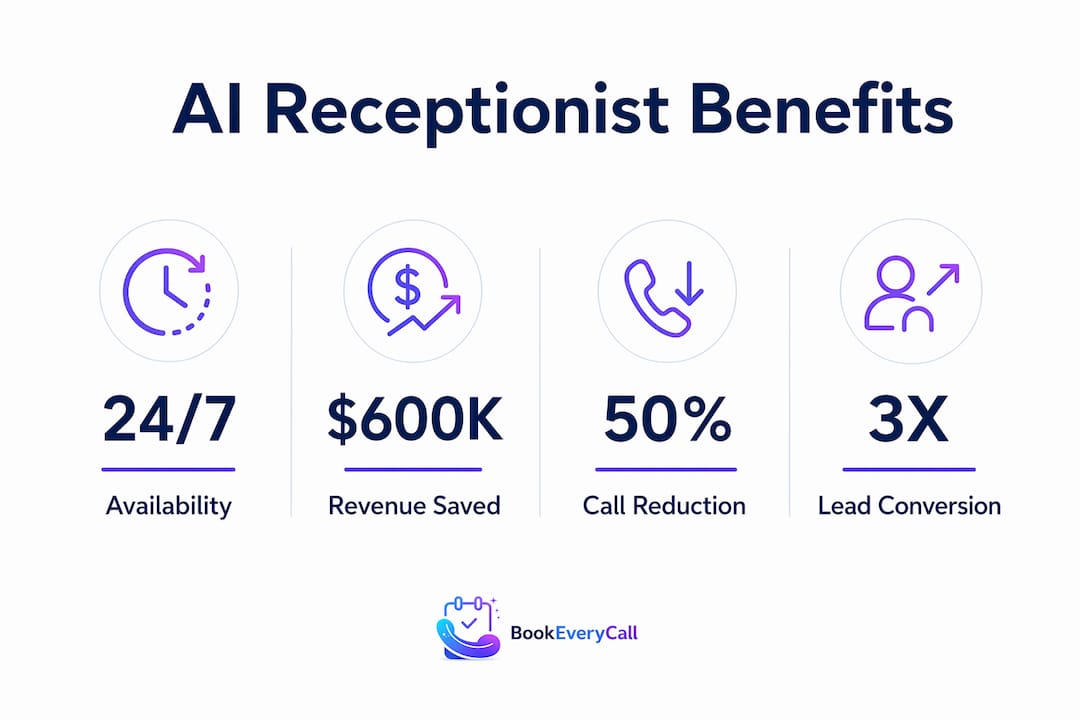
The three options are not interchangeable, and the differences in cost and capability are significant. A traditional answering service takes a message and emails it to you. A human virtual assistant (VA) can handle some booking tasks but works limited hours and costs considerably more. An AI receptionist operates 24/7, books directly into your calendar, and integrates with your CRM without supervision.
The cost comparison alone makes the decision straightforward for most cleaning operators. AI receptionists cost $200 to $600 per month, while a part-time inbound coordinator typically runs $2,500 to $3,500 monthly. That is a saving of $2,000 to $3,000 per month before you account for the revenue recovered from calls that would otherwise go unanswered after hours.
Human VAs do have a place. For carpet cleaning businesses specifically, professional VAs improve schedule fill rates from 65% to over 90%, adding $48,000 or more in annual revenue through timely follow-up. The limitation is availability. A VA working business hours misses every evening and weekend enquiry, which is precisely when residential cleaning clients are most likely to call.
| Feature | Answering service | Human VA | AI receptionist |
|---|---|---|---|
| Available hours | Business hours | Business hours | 24/7 |
| Books directly into calendar | No | Sometimes | Yes |
| CRM integration | No | Limited | Full (2,700+ integrations) |
| Handles SMS, web, WhatsApp | No | Rarely | Yes |
| Monthly cost (AUD) | $300–$800 | $2,500–$3,500 | $200–$600 |
| Scales with call volume | No | No | Yes |
The table above reflects the operational reality for most Australian cleaning businesses. An answering service is a stopgap. A VA is a part-time solution. An AI receptionist is a full-time system that scales without adding headcount.
Pro Tip: If you currently use a human VA, don’t replace them immediately. Run the AI receptionist for after-hours and overflow calls first. Track the booking rate from those calls for 30 days, then make the decision based on data rather than assumption.
How AI receptionists serve cleaning businesses across Australian cities
Australian capital cities each have distinct demand patterns that affect how and when cleaning enquiries arrive. Understanding these patterns helps you configure your AI receptionist to capture the highest-value calls at the right moments.
Evening and weekend call volumes spike significantly across Sydney, Melbourne, Brisbane, Perth, and Adelaide, creating a demand window that falls entirely outside standard business hours. This is the single biggest gap that an automated receptionist for cleaners closes.
- Sydney: High-density apartment living in suburbs like Surry Hills, Newtown, and Chatswood generates strong demand for regular residential cleans. Clients typically call between 7 pm and 9 pm on weekdays after work. End-of-lease cleaning enquiries spike at month-end, often requiring same-week availability checks that an AI booking system handles instantly.
- Melbourne: Commercial cleaning contracts in the CBD and inner suburbs like Fitzroy and Collingwood involve multi-site scope discussions. AI receptionists capture the initial enquiry and route commercial leads to a senior staff member, keeping the intake process fast without losing the nuance of a larger contract.
- Brisbane: Rapid population growth in outer suburbs like Springfield and North Lakes means new residential clients are entering the market constantly. An AI receptionist captures these first-time callers who have no existing relationship with a cleaning provider and converts them before they move on.
- Perth: The resources sector drives a strong market for FIFO worker home management and regular property maintenance cleans. Clients in suburbs like Baldivis and Ellenbrook often book recurring services and expect fast, frictionless scheduling. AI receptionists handle recurring booking logic without manual intervention.
- Adelaide: A growing short-term rental market in areas like Glenelg and the Adelaide Hills creates demand for turnaround cleans between guest stays. These bookings are time-sensitive and often come through multiple channels simultaneously. A multi-channel AI receptionist captures them all.
Across all five cities, the pattern is consistent: the highest-value enquiries arrive outside business hours, and the businesses that answer first win the job. A smart receptionist solution built for the Australian market accounts for these local demand peaks by design.
How to implement an AI receptionist for your cleaning business
Setup is faster than most operators expect. Typical configuration takes 5 to 15 business days depending on integration depth, with simpler setups (voice and SMS only, no CRM sync) completing in under a week. The process follows a clear sequence that you can manage without technical expertise.
- Define your intake variables. List every question your team currently asks a new caller: property type, number of bedrooms, frequency, preferred day, location, and any special requirements. These become the AI’s qualification script.
- Choose your integrations. Connect the AI receptionist to your existing scheduling platform. Jobber, ZenMaid, and Housecall Pro are the most common choices for Australian cleaning businesses. Platforms like chatbot CRM integration tools can support this sync if your current setup requires a custom connection.
- Set escalation triggers. Define which call types require a human response. Complaints, commercial contract enquiries over a set dollar value, and clients requesting to speak with the owner are common escalation points. The AI passes the call with full conversation history attached.
- Configure your channels. Decide which communication channels the AI will monitor: phone, SMS, web chat, email, WhatsApp, or all five. Multi-channel coverage captures the broadest range of enquiries.
- Train your team on handoffs. Staff need to understand when and how the AI escalates to them. A 30-minute briefing covering escalation scenarios and how to read the AI’s conversation summary is sufficient for most teams.
- Set your performance benchmarks. Before going live, record your current response time, booking rate, and missed call volume. These are your baseline metrics for measuring ROI after 30 and 90 days.
| Metric to track | Baseline target | Post-implementation target |
|---|---|---|
| Average response time | Under 2 minutes | Under 60 seconds |
| Booking conversion rate | Current rate | 20–35% improvement |
| Missed call rate | Current rate | Under 5% |
| After-hours bookings | Near zero | 20–40% of total bookings |
Pricing models vary. Most AI receptionist platforms offer monthly subscriptions with no lock-in contracts, which suits the cash flow patterns of small cleaning businesses. Pay-as-you-go credit models work well for seasonal operators who have quieter months. Bookeverycall operates on a subscription model with no long-term commitment, which means you can assess results and adjust without financial risk.
Pro Tip: Pull your phone records for the last 90 days before you start. Count every missed call and estimate the average job value. Multiply missed calls by your close rate and average job value. That number is your minimum annual revenue recovery figure, and it will tell you exactly how quickly the AI receptionist pays for itself.
Key takeaways
An AI receptionist for cleaning businesses in Australia recovers missed revenue, books jobs 24/7, and costs a fraction of a human coordinator, making it the most cost-effective client communication upgrade available to Australian cleaning operators right now.
| Point | Details |
|---|---|
| Revenue recovery is quantifiable | Missed calls cost cleaning businesses $80,000 to $250,000 annually; AI receptionists recapture this directly. |
| Cost advantage is substantial | AI receptionists cost $200 to $600 per month versus $2,500 to $3,500 for a part-time coordinator. |
| After-hours coverage drives bookings | Evening and weekend enquiries are the highest-volume window; 24/7 AI coverage captures them all. |
| Integration depth matters | Full CRM sync with Jobber, ZenMaid, and Housecall Pro eliminates double entry and booking errors. |
| Setup is fast and low-risk | Most configurations complete in 5 to 15 business days with no lock-in contracts required. |
Why Australian cleaning businesses are getting this right faster than most industries
I’ve watched a lot of service businesses adopt automation tools and then underuse them because the setup was too generic. What’s different about AI receptionists in the cleaning sector is that the use case is unusually well-defined. Cleaning enquiries follow predictable patterns: scope, frequency, location, timing. That predictability makes AI qualification scripts genuinely effective, not just theoretically possible.
The businesses I’ve seen get the most out of this technology are the ones who treated the AI as a workflow tool, not just a call-answering service. AI receptionists embed into cleaning business operations as integrated systems, not bolt-on features. When the AI writes directly to your Jobber calendar and sends the client a confirmation SMS in one sequence, you’ve removed three manual steps from every single booking. Over a month of 80 to 100 bookings, that’s hours of admin recovered.
The honest challenge is the initial configuration. Operators who rush the intake script setup end up with an AI that asks the wrong questions or misses key qualification criteria. Spending two hours mapping your current intake process before you configure anything will save you weeks of tweaking later.
I’m also cautious about the idea that AI receptionists replace human judgement entirely. The human-in-the-loop approach is not a fallback. It’s a deliberate design choice. Complex complaints, large commercial contracts, and clients who are clearly frustrated need a human voice. The AI’s job is to handle the volume so your team has capacity to handle those moments well.
The cleaning businesses in Sydney and Melbourne that adopted AI receptionists in 2024 and 2025 are now operating with materially better booking rates and lower admin overhead than their competitors. That gap will only grow. The question for 2026 isn’t whether to adopt this technology. It’s how quickly you can configure it properly.
— Chay
See how Bookeverycall works for cleaning businesses
Bookeverycall is built specifically for Australian service businesses that can’t afford to miss a call or lose a lead to slow response times. The platform answers every enquiry 24/7, qualifies the caller, and books the job directly into your calendar across voice, SMS, web chat, and WhatsApp.
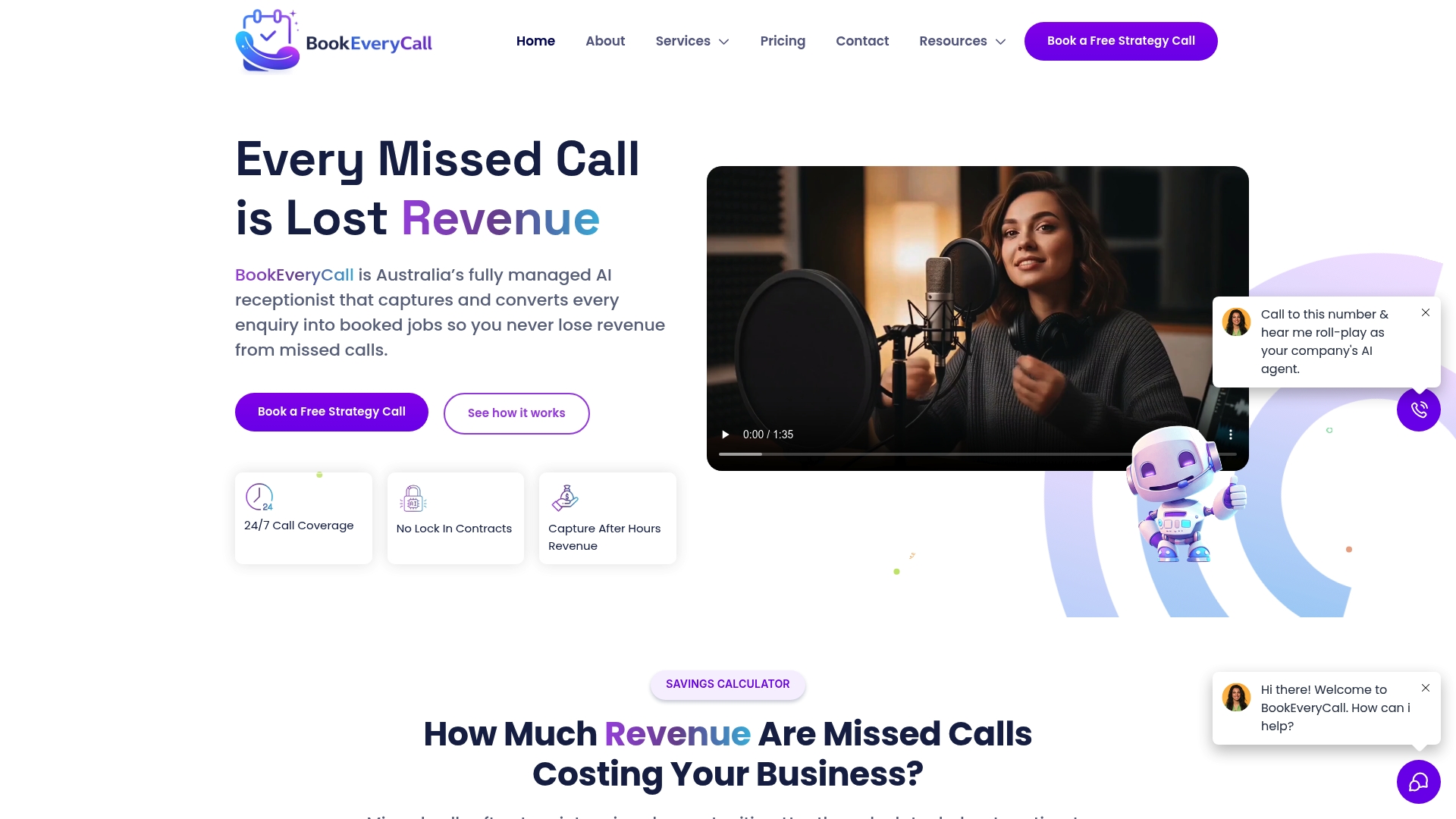
For cleaning businesses across Sydney, Melbourne, Brisbane, Perth, and Adelaide, Bookeverycall integrates with Jobber, ZenMaid, and Housecall Pro out of the box. Setup takes as little as five business days, and there are no lock-in contracts. Explore the AI receptionist for cleaning businesses or see the full voice AI service to understand what’s possible for your operation. Visit bookeverycall.com to get started.
FAQ
What is an AI receptionist for a cleaning business?
An AI receptionist is an automated system that answers calls, qualifies leads, and books jobs 24/7 without human involvement. It integrates with scheduling platforms like Jobber and ZenMaid to write bookings directly to your calendar.
How much does an AI receptionist cost in Australia?
AI receptionists typically cost $200 to $600 per month in Australia, compared to $2,500 to $3,500 monthly for a part-time inbound coordinator. Most platforms offer month-to-month subscriptions with no lock-in contracts.
Can an AI receptionist handle after-hours cleaning enquiries?
Yes. AI receptionists operate 24/7 and are specifically designed to capture the evening and weekend call volumes that fall outside standard business hours. These are the peak enquiry windows for residential cleaning clients across Australian cities.
How long does setup take for a cleaning business?
Setup typically takes 5 to 15 business days depending on the complexity of your CRM integration. Voice and SMS-only configurations with no CRM sync can be completed in under a week.
Will an AI receptionist work with my existing booking software?
Modern AI receptionists connect to over 2,700 integrations, including Jobber, ZenMaid, Housecall Pro, and most major calendar and CRM platforms used by Australian cleaning businesses.
Permalink