
TL;DR:
- AI receptionists for Australian HVAC businesses answer calls instantly, detect emergencies, book jobs directly into FSM software, and operate 24/7 without additional costs. They reduce missed calls, improve emergency response times, and provide consistent, scalable coverage during peak demand periods at a fraction of human staffing expenses. Setup is quick, typically within one business day, and they help recapture significant revenue lost from out-of-hours and peak-period call mismanagement.
An AI receptionist for HVAC Australia is an automated voice agent that answers every inbound call within seconds, identifies urgent issues like gas leaks or failed cooling systems, books service jobs directly into your field service management (FSM) software, and sends confirmation messages to customers without any human involvement. The industry term for this technology is an AI voice agent or conversational AI receptionist. For Australian HVAC businesses losing revenue to missed calls after hours, during heatwaves, or across peak winter demand, this technology is the most direct fix available. Services like Bookeverycall, Rivet CSR, and Waboom AI have built platforms specifically for the trades, with HVAC emergency triage and FSM integration at their core.
How does an AI receptionist work for HVAC companies in Australia?
An AI voice receptionist answers your business line in under three to five seconds and holds a natural conversation with the caller using natural language processing. It does not play a recorded menu or ask callers to press buttons. It listens, responds, and acts. That distinction matters because HVAC customers calling about a broken air conditioner at 11pm are not patient. They want to speak to someone, and an AI receptionist delivers exactly that experience.
The operational flow for an HVAC business works like this:
- Call answered instantly: The AI greets the caller using your business name and a script you approve during setup.
- Emergency detection: The system listens for HVAC-specific emergency keywords. Platforms like Rivet CSR recognise phrases including “no heat,” “gas smell,” “frozen pipes,” “no cool,” and “carbon monoxide alarm,” then escalate immediately to an on-call technician.
- Routine job booking: For non-urgent calls, the AI captures the customer’s name, address, problem description, and preferred time, then books the job directly into your FSM platform.
- Automatic confirmation: The system sends the customer an SMS confirmation with the booking details, reducing no-shows and building trust.
- Data handoff: Every call record, including urgency level, site address, and dispatch notes, is written into your FSM software automatically.
The difference from a traditional answering service is significant. A human answering service takes a message and emails it to you. An AI receptionist books the job, pages your on-call tech, and sends the customer a confirmation, all before you have looked at your phone. Waboom AI, which operates specifically across Australia and New Zealand, notes that 70% of urgent HVAC calls occur outside standard business hours. A message-taking service does not solve that problem. An AI voice agent does.
Pro Tip: Ask your AI receptionist provider to share the exact list of emergency keywords they use by default. Then add your own based on the most common urgent calls your business receives. Generic keyword lists miss nuances specific to your local market.

What are the key benefits of using an AI receptionist for HVAC businesses in Australia?
The benefits of AI receptionists for HVAC businesses go well beyond answering phones. They change the economics of running a trades business.
24/7 call coverage without overtime costs. Your AI receptionist works every hour of every day, including public holidays and Christmas. There is no penalty rate, no sick leave, and no gap in coverage during a Melbourne cold snap or a Sydney summer heatwave.
Dramatic reduction in missed calls. AI receptionists resolve or forward 75% of calls autonomously, adding over 35 hours a week of effective capacity to small teams. For a two-technician HVAC business, that is the equivalent of hiring a part-time office manager without the payroll cost.
Lower cost than any human alternative. A full-time customer service representative costs between $40,000 and $60,000 per year fully loaded. A traditional call centre runs $1,500 to $4,000 per month for HVAC call volumes. AI receptionist platforms like Rivet CSR and Bookeverycall start at $299 per month, a fraction of either alternative.
Scalability during peak demand. During a Brisbane heatwave or a Perth summer surge, call volumes can spike eight to ten times above normal. AI systems maintain answer rates above 95% even at those volumes. No human team can match that without significant advance hiring.
Faster emergency response. When a caller reports a refrigerant leak or a carbon monoxide alarm, the AI does not put them on hold. It routes the call with severity, site address, and contact number to your on-call technician immediately, while providing the customer with safety guidance.
Cleaner data and less admin. Because the AI writes directly into ServiceTitan, Jobber, simPRO, or FieldEdge, there are no handwritten message slips, no missed details, and no double-entry errors. Your team starts each morning with a clean, accurate job queue.
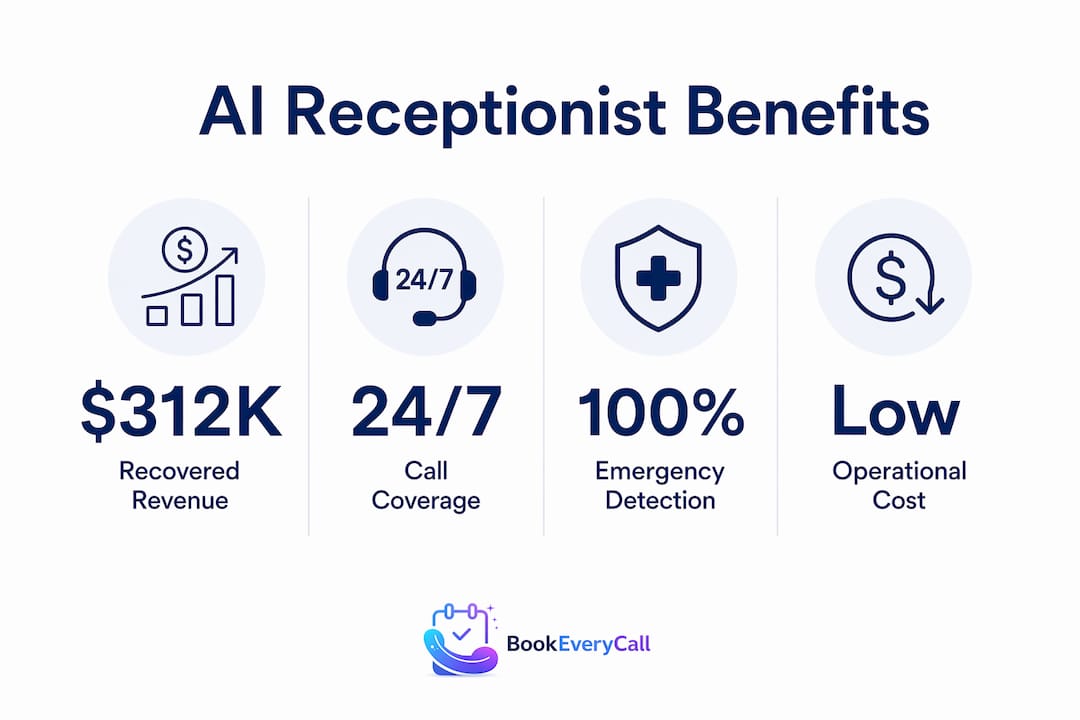
Bookeverycall estimates that HVAC businesses recovering from recurring missed calls can recapture up to $312,000 in annual revenue. That figure reflects the compounding effect of after-hours bookings, emergency jobs captured, and repeat customers retained through reliable service. For a guide to AI receptionist pricing and ROI, the numbers are worth reviewing before you make a decision.
How to set up an AI receptionist with your HVAC business systems
Setup for an AI receptionist is faster than most HVAC business owners expect. Providers like Rivet CSR and Waboom AI complete full configuration in 30 minutes to one business day, including FSM connection, job type definitions, emergency keyword mapping, and number forwarding.
The practical steps look like this:
- Gather your FSM credentials. You will need login access to ServiceTitan, simPRO, Jobber, FieldEdge, or Workiz, depending on which platform you use. The AI provider connects directly via API or integration layer.
- Define your job types. List the service categories your business handles: ducted system service, split system installation, evaporative cooler repair, gas heating, commercial HVAC maintenance. The AI uses these to classify and book calls correctly.
- Map your emergency thresholds. This step is critical. Defining specific emergency thresholds such as gas smell, refrigerant leak, and CO alarms during onboarding is what separates a properly configured AI from one that mishandles urgent calls. Do not rely on generic emergency questions.
- Set up number forwarding or porting. You can forward your existing business number to the AI system or port it entirely. Most businesses start with forwarding to test the setup before committing.
- Run a soft launch. Have a team member call in as a test customer across several scenarios: a routine booking, an after-hours emergency, and a callback request. Verify the FSM entries are accurate and the emergency escalation fires correctly.
- Monitor the first two weeks. Review call recordings and booking data daily during the initial period. Adjust scripts, keywords, and job type definitions based on what you hear.
Rivet CSR supports multi-language answering including English and Spanish, which is useful for HVAC businesses in areas with diverse customer bases. Bookeverycall offers Australian-based support throughout the setup process, which matters when you are configuring emergency protocols and want someone who understands local compliance and customer expectations.
Pro Tip: Set up a dedicated test phone number during your soft launch phase. Call it from multiple devices and run through every scenario your team encounters in a typical week. Fix the edge cases before you go live, not after a real customer hits them.
How do AI receptionists support HVAC businesses in major Australian cities?
Australian HVAC businesses face city-specific demand patterns that make automated call handling particularly valuable. The table below outlines the key dynamics across the five major markets.
| City | Peak demand period | Primary missed call risk | AI receptionist advantage |
|---|---|---|---|
| Sydney | Summer (Dec to Feb) | After-hours cooling failures | 24/7 booking during heatwave surges |
| Melbourne | Winter (Jun to Aug) | Late-night heating emergencies | Emergency triage for gas heating calls |
| Brisbane | Year-round heat | Weekend and public holiday calls | Consistent coverage without penalty rates |
| Perth | Summer (Nov to Mar) | Evaporative cooler breakdowns | High-volume surge handling above 95% answer rate |
| Adelaide | Summer heatwaves | After-hours ducted system failures | Immediate escalation to on-call technicians |
Missed calls in Sydney and Melbourne during after-hours periods translate to thousands of lost dollars per month for HVAC businesses. A single missed emergency call in Melbourne on a winter night can represent a $400 to $800 service job, plus the long-term value of a repeat customer. Multiply that across a week of after-hours calls and the revenue loss becomes material very quickly.
Brisbane businesses face a different challenge. Demand is less seasonal but more consistent, meaning the risk is not a single peak period but a steady bleed of missed weekend and public holiday calls. An AI assistant for HVAC in Brisbane captures those calls at no additional cost, regardless of the day.
Perth and Adelaide both experience intense summer heatwaves that compress enormous call volume into short windows. During those periods, a two-person office team simply cannot answer every call. An AI receptionist handles the surge without dropping a single enquiry, then scales back down when demand normalises. That elasticity is something no human staffing model can replicate affordably.
AI receptionist vs traditional receptionist: which is right for HVAC?
The comparison between an AI receptionist and a traditional human receptionist or call centre comes down to five factors: cost, availability, consistency, integration, and scalability.
| Factor | AI receptionist | Human receptionist or call centre |
|---|---|---|
| Monthly cost | From $299/month | $3,300+ per month (full-time) or $1,500 to $4,000/month (call centre) |
| Availability | 24/7, 365 days | Business hours only, or premium after-hours rates |
| FSM integration | Direct, automatic | Manual message relay or email |
| Scalability | Handles 8 to 10x volume spikes | Requires advance hiring or overflow contracts |
| Consistency | Same script, same quality, every call | Varies by staff member and shift |
The cost difference alone is decisive for most small to mid-size HVAC businesses. A human receptionist at $40,000 to $60,000 per year fully loaded costs more in a single month than an AI receptionist costs in a year at entry-level pricing. The call centre option is cheaper than a full-time hire but still four to thirteen times more expensive than AI, and it does not write into your FSM software automatically.
The consistency argument is underappreciated. A human receptionist has good days and bad days. They miss keywords, forget to ask for the site address, or fail to flag an emergency correctly when they are busy. An AI receptionist follows the same protocol on every single call, at 2am on a Sunday as reliably as at 9am on a Tuesday. For HVAC businesses where a missed emergency keyword can mean a dangerous situation for a customer, that consistency has real value beyond the cost saving.
For a broader look at how AI receptionists for tradies compare across different trade categories, the patterns are consistent across plumbing, electrical, and HVAC alike.
Key takeaways
An AI receptionist for HVAC businesses in Australia captures every call, triages emergencies correctly, books jobs into FSM software automatically, and costs a fraction of any human alternative.
| Point | Details |
|---|---|
| 24/7 coverage is non-negotiable | 70% of urgent HVAC calls occur outside business hours, making after-hours answering a revenue requirement. |
| Emergency keyword tuning is critical | Configure specific phrases like “gas smell” and “CO alarm” during setup, not generic emergency questions. |
| Cost advantage is substantial | AI receptionists start at $299/month versus $40,000 to $60,000 per year for a full-time receptionist. |
| City-specific demand varies | Sydney, Melbourne, Perth, Brisbane, and Adelaide each have distinct peak periods requiring consistent call coverage. |
| Setup is fast | Full configuration including FSM integration takes 30 minutes to one business day with providers like Rivet CSR and Bookeverycall. |
Why I think most HVAC businesses are solving the wrong problem
When HVAC business owners tell me they are losing customers, the conversation usually starts with marketing. They want more Google Ads spend, a better website, or more leads from SEO. My experience tells me the problem is almost never lead volume. It is lead capture.
You are already getting calls. The question is how many of them you are actually converting into booked jobs. A missed call at 7pm on a Friday is not a marketing failure. It is a systems failure. And it is one of the most fixable problems in a trades business.
The misconception I see most often is that an AI receptionist will feel robotic to customers and damage the relationship. That concern is legitimate if you deploy a poorly configured system. But a well-tuned AI voice agent, one that uses your business name, follows your service categories, and escalates emergencies correctly, sounds professional and responsive. Most customers do not know they are speaking to an AI. What they know is that someone answered, took their details, and booked their job. That is the experience they care about.
The other mistake I see is treating AI as an all-or-nothing replacement for human staff. The smarter approach is a hybrid model. Let the AI handle routine bookings, after-hours calls, and emergency triage. Keep a human in the loop for complex quotes, complaints, and relationship-sensitive conversations. That combination gives you the cost efficiency of automation without sacrificing the human judgement that genuinely complex situations require.
Start with after-hours coverage. It is the lowest-risk entry point and the highest-return use case for most HVAC businesses. Get that working well, review the call recordings after two weeks, and then decide whether to expand coverage to business hours as well.
— Chay
How Bookeverycall can transform your HVAC call handling
Bookeverycall is a fully managed AI voice receptionist built specifically for Australian trade businesses, including HVAC. It answers every call 24/7, triages emergencies using HVAC-specific keyword detection, books jobs directly into your FSM software, and sends customers automatic confirmation messages. Setup takes less than a day, pricing starts at $299 per month, and Australian-based support is included throughout onboarding and beyond.
HVAC businesses using Bookeverycall recover an average of up to $312,000 in previously lost annual revenue by capturing after-hours and peak-period calls that previously went unanswered. If your business is missing calls during heatwaves, winter emergencies, or simply after 5pm, Bookeverycall is the most direct solution available. Book a strategy call at bookeverycall.com and see exactly how many calls your business is currently missing.
FAQ
What is an AI receptionist for HVAC businesses?
An AI receptionist for HVAC is an automated voice agent that answers inbound calls instantly, detects emergency keywords like “gas smell” or “no heat,” books service jobs into FSM software, and sends customers confirmation messages, all without human involvement.
How much does an AI receptionist cost for an HVAC business in Australia?
AI receptionist platforms for HVAC businesses start at $299 per month, compared to $1,500 to $4,000 per month for a traditional call centre and $40,000 to $60,000 per year for a full-time receptionist.
Can an AI receptionist handle HVAC emergencies correctly?
Yes, provided the system is configured with HVAC-specific emergency keywords during setup. Platforms like Rivet CSR and Waboom AI recognise phrases including “carbon monoxide alarm,” “gas smell,” and “frozen pipes,” then page on-call technicians immediately.
Which FSM platforms does an AI receptionist integrate with?
Most AI receptionist providers for HVAC integrate directly with ServiceTitan, Jobber, simPRO, FieldEdge, and Workiz, writing booking details, urgency levels, and customer information automatically into the job queue.
How long does it take to set up an AI receptionist for an HVAC business?
Full setup, including FSM integration, emergency keyword configuration, and number forwarding, takes between 30 minutes and one business day with providers like Rivet CSR and Bookeverycall.