
TL;DR:
- Automated call booking systems operate 24/7, capturing more revenue by handling after-hours enquiries and reducing missed calls. They significantly decrease no-show rates through automated reminders, boost lead conversion to over 95%, and free staff from routine scheduling tasks. Implementing such systems improves customer experience, saves costs, and maximizes revenue potential across Australian markets and industries.
Every missed call is a missed invoice. For Australian small and medium businesses running on tight margins, manual booking systems bleed money silently. Research shows appointment booking time drops from over 8 minutes to mere seconds with automation, yet most business owners still rely on a receptionist, a notepad, or a voicemail that nobody checks. The benefits of automated call booking go well beyond convenience. They touch revenue recovery, customer satisfaction, staff productivity, and your ability to compete in markets where the business that responds fastest wins the job.
Table of Contents
- Key takeaways
- 1. The real benefits of automated call booking start at 11pm
- 2. Fewer no-shows, more protected revenue
- 3. Time and cost savings that show up in your accounts
- 4. Better lead capture and higher booking conversion rates
- 5. Customer experience that actually builds loyalty
- 6. How automation helps Australian businesses deal with referral friction
- 7. City-specific advantages: what automation means across Australian markets
- My honest take on implementing automated call booking
- How Bookeverycall turns missed calls into booked jobs
- FAQ
Key takeaways
| Point | Details |
|---|---|
| 24/7 booking captures more revenue | Over 40% of bookings happen outside business hours, so automation fills the gap manual staffing cannot. |
| No-shows drop significantly | Automated reminders reduce no-show rates by 30 to 50%, protecting your billable hours directly. |
| Lead conversion lifts dramatically | AI call booking captures over 95% of booking-intent calls live, versus 15 to 30% with callbacks. |
| Staff time is freed for real work | Automation improves staff productivity by 30 to 40%, cutting routine scheduling from your team’s day. |
| Scalability requires no extra headcount | AI systems handle call volume spikes instantly without putting anyone on hold or hiring more staff. |
1. The real benefits of automated call booking start at 11pm
The average tradie, physio, or property manager finishes client-facing work somewhere between 5pm and 6pm. Their phone, however, does not stop ringing. 40% of bookings happen outside traditional business hours, which means if your booking system clocks off when you do, you are handing those leads to whoever picks up next.
Automated booking systems operate continuously without any additional staffing cost. An AI receptionist answers at 11pm on a Tuesday the same way it answers at 10am on a Monday. It checks your live calendar, confirms the appointment slot, and sends the customer a confirmation. By the time you start work the next morning, the job is already locked in.
Key outcomes of round-the-clock availability include:
- Revenue capture from after-hours enquiries that would otherwise go to voicemail
- Zero hold times at any hour, which lifts customer satisfaction instantly
- Reduction in reception staffing costs by up to 20% without losing call coverage
- Consistent booking quality regardless of staff fatigue or shift patterns
For service businesses in Australia where emergency work, weekend bookings, and after-hours enquiries are routine, this is where the financial case for automation becomes undeniable. A plumbing business in Perth receiving three after-hours calls per week at an average job value of $400 is leaving over $60,000 per year on the table if those calls go unanswered.
Pro Tip: Set your automated system to flag after-hours bookings with a priority tag in your CRM. This lets you review high-value jobs first thing in the morning and allocate staff accordingly before your day fills up.
For deeper context on how Australian businesses are handling after-hours calls, the operational challenges and solutions are worth understanding before you choose a system.
2. Fewer no-shows, more protected revenue
No-shows are not just annoying. They are a direct hit to your bottom line. A physiotherapy clinic in Brisbane charging $120 per session and experiencing six no-shows per week loses over $37,000 in billable revenue annually. A lawn care business in Adelaide with a similar pattern loses equipment time, fuel, and the opportunity to book paying work in those gaps.
The efficiency of call scheduling improves sharply when automated reminders are part of the system. Automated SMS and email reminders reduce no-show rates by 30 to 50%, with post-reminder rates dropping to between 10 and 15%. That is not a marginal improvement. It changes the economics of running appointment-based work.
Here is how a well-configured automated reminder sequence works in practice:
- Booking confirmation is sent immediately after the appointment is made, reinforcing the customer’s commitment.
- 48-hour reminder is delivered via SMS or email, giving the customer enough time to reschedule if needed.
- 24-hour reminder follows with a direct link to confirm, cancel, or reschedule without calling in.
- Same-day reminder goes out two hours before the appointment for high-value or time-critical jobs.
- Post-appointment follow-up is triggered automatically, which opens the door to rebooking and reviews.
Each of these touchpoints is handled without your team lifting a finger. The customer feels looked after. You protect your schedule.
Pro Tip: Include a one-click reschedule link in your reminder messages rather than asking customers to call. This removes friction, reduces cancellations, and keeps the appointment on the books in a new slot rather than losing it entirely.
3. Time and cost savings that show up in your accounts
Manual scheduling is expensive in ways that do not show up on a single line in your profit and loss statement. It is buried in wages, errors, double bookings, and the hours your team spends on the phone instead of doing revenue-generating work.
Consider the numbers. Automation improves staff productivity by 30 to 40%, and scheduling time drops from over eight minutes per appointment to a matter of seconds. For a business booking 30 appointments per week, that is four hours of staff time saved every single week. At an average Australian admin wage of $28 per hour, that is over $5,800 per year in direct wage savings from scheduling alone.
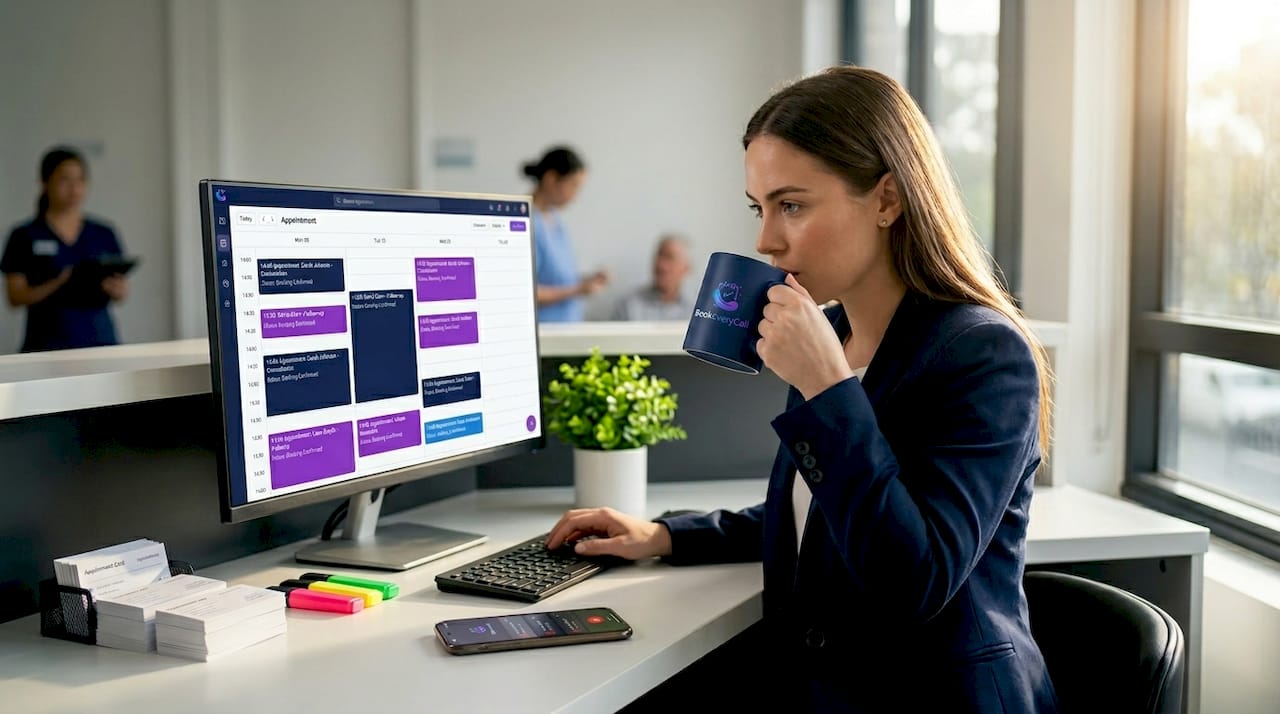
The cost comparison between manual and automated booking is stark:
| Factor | Manual booking | Automated booking |
|---|---|---|
| Time per appointment | 8+ minutes | Under 30 seconds |
| After-hours coverage | Requires extra staff or missed calls | Fully covered at no extra cost |
| Error rate | Human-dependent, inconsistent | Consistent, calendar-synced |
| Staff productivity impact | Low. Routine tasks dominate | High. Team focuses on skilled work |
| Annual admin cost (30 appts/week) | $8,000 to $15,000+ | $1,200 to $3,600 in platform fees |
Beyond direct wage savings, there are the softer costs worth naming. Recruitment, onboarding, and turnover for reception roles add up fast. Outsourcing routine tasks to automated systems follows the same logic as outsourcing bookkeeping. You pay a fraction of the cost of a full-time employee and get a more consistent output.
Staff freed from scheduling calls can take on client follow-up, upselling, quality checks, or simply focus on the skilled work they were hired to do. That is not a soft benefit. It compounds across your entire operation.
- Reduced overtime caused by scheduling backlogs
- Lower error-related rework from double bookings or miscommunications
- Elimination of training time for reception tasks when staff turn over
4. Better lead capture and higher booking conversion rates
Here is a number worth sitting with. AI phone booking captures over 95% of booking-intent calls live. Traditional callback services convert only 15 to 30% of those same leads. The gap between those two figures is where most small businesses are quietly losing revenue every month without realising it.
The reason callback models fail is simple. By the time you return a call, the customer has already called someone else. Lead capture while the prospect is still on the call prevents this entirely, yielding a conversion rate that callback-dependent businesses simply cannot match. When a potential customer calls your number and immediately speaks to an AI that checks your availability, confirms a time, and sends a booking confirmation in real time, they have no reason to keep dialling.
Key advantages of real-time AI call booking include:
- Immediate availability checking against your live calendar prevents overbooking and removes back-and-forth
- Live booking confirmation reduces the gap between enquiry and commitment, which is where most leads are lost
- Context-aware routing ensures high-intent callers are prioritised and matched to the right service or staff member
- No voicemail dead-ends where customers hang up without leaving a message or never receive a callback
For a Melbourne HVAC business receiving 40 calls per week, moving from a 25% callback conversion rate to a 95% live booking rate means the difference between 10 booked jobs and 38. At $350 average job value, that is an additional $9,800 per week in secured revenue. The impact of automated scheduling at that scale is not incremental. It fundamentally changes what growth looks like.
5. Customer experience that actually builds loyalty
Customers do not remember when things go smoothly. They remember when they were put on hold for 12 minutes, when they called back three times and nobody answered, or when they showed up to an appointment that was never confirmed. Those experiences do not just cost you one job. They cost you the reviews, the referrals, and the repeat business that follow.
77% of customers prefer digital booking options for the convenience they provide. Automated systems deliver exactly that. Instant confirmation, flexible scheduling, and no hold times create a frictionless experience that feels premium without requiring premium staffing.
The call booking benefits for customer experience stack up quickly:
- No hold times at any point in the booking process
- Real-time confirmation sent by SMS or email the moment a booking is made
- Easy self-service rescheduling that does not require a phone call to your office
- Consistent, professional interaction regardless of when the customer calls
Pro Tip: Use your automated system’s post-booking message to include a link to a short explainer about what to expect before their appointment. This one extra touchpoint reduces anxiety-driven cancellations and positions you as a professional before the customer even meets you.
On the scalability side, AI systems handle sudden call volume spikes without degradation. During a summer storm in Queensland, a roofing business might receive 80 calls in a single afternoon. A manual system buckles. An automated system handles every call simultaneously, books every willing customer, and lets you triage the work in priority order.
6. How automation helps Australian businesses deal with referral friction
Referral leads are often treated as guaranteed conversions. They are not. A customer who was referred to you still has to get through your booking process, and if that process is clunky, delayed, or requires multiple phone calls, a meaningful portion will not complete it.
Offering a self-scheduling link in referral communications improves lead conversion by 2 to 3 times. This is one of the most underused tactics in Australian service businesses. A mechanic in Sydney who sends every new referral a text message with a direct booking link converts that warm lead before it cools. The referred customer clicks, picks a time, and receives a confirmation. No phone tag. No delay.
For industries where referrals are the primary growth channel, such as allied health, legal services, financial planning, and trades, this single change to the booking flow can meaningfully shift monthly revenue. The advantages of call automation compound when referral conversion lifts alongside cold call conversion. You are capturing more of every type of lead, not just the ones who happened to call during business hours.
Bookeverycall’s approach to missed call recovery operates on the same principle. Every unanswered enquiry is a warm lead that deserves an immediate, competent response. Whether it arrives via a referral, a Google search, or a suburb-specific ad campaign, the system captures it before it walks away.
7. City-specific advantages: what automation means across Australian markets
The advantages of call automation are not uniform across Australia. Local market conditions, industry mix, and customer expectations vary enough that it is worth looking at how automated booking systems perform in specific cities.
Sydney businesses contend with one of the most competitive service markets in the country. Tradies, medical clinics, and property managers in the greater Sydney region face high call volumes, aggressive competition, and customers with low tolerance for poor response times. Automation here means capturing the enquiry before the customer tries the next business in Google’s local pack.
Melbourne’s large population of allied health practitioners and professional service firms benefit most from the no-show reduction and reminder automation that booking systems provide. A physiotherapy clinic in Brunswick running 60 appointments per week recovers thousands in lost revenue annually simply by running automated confirmation sequences.
Brisbane and South East Queensland see strong demand for trades and construction services. The volume of after-hours emergency enquiries, particularly for plumbing, electrical, and roofing, makes 24/7 call availability particularly valuable. AI receptionists tailored for plumbers in this region directly address this pattern.
Perth’s distance from eastern markets means many businesses operate in relative isolation from major competitors but also with smaller customer pools. Retention matters more. Automated follow-up, rebooking reminders, and professional booking experiences help Perth businesses hold onto customers they already have.
Adelaide has a strong concentration of small family-run service businesses where the owner often answers the phone personally. Automation here does not replace a personal touch. It backs it up. When the owner is on the tools, the system handles enquiries without losing the lead.
Key industries across all five cities seeing measurable returns from automated booking systems include:
- Trades and construction (plumbing, electrical, roofing, HVAC)
- Allied health and specialist medical clinics
- Property management and real estate
- Automotive repair and servicing
- Legal, financial, and professional services
My honest take on implementing automated call booking
I have seen businesses approach automation as a technology decision when it is actually a revenue decision. The instinct is to evaluate platforms on features. The right question is how much you are currently losing by not having one.
What surprises most business owners is not the efficiency gain. It is the lead capture data. When they first see how many booking-intent calls were being missed or abandoned, the conversation about cost quickly reverses. Automation is not an expense. It is recovery of revenue that was already being earned and then lost.
That said, I have also seen automation deployed badly. The businesses that get the most from it integrate it with CRM data from day one. They use booking data to understand their most valuable lead sources, their highest-converting time slots, and their most common service requests. That visibility makes every subsequent decision sharper.
My strongest advice: do not treat this as set and forget. Spend the first 60 days reviewing what the system captures, how it routes calls, and where customers are dropping off. AI systems layered with CRM data for smart booking prioritisation outperform basic automation significantly. The technology handles the volume. Your job is to make sure the data it generates is feeding your strategy.
One more thing worth naming: automation does not remove the human element from your business. It removes the friction. Your customers still deal with you, your team, and your service quality. The booking process just stops being the thing that loses them before they get there.
— Chay
How Bookeverycall turns missed calls into booked jobs
If you recognise your business in any of these scenarios — calls going to voicemail after hours, no-shows eating into your schedule, or referrals that never converted — Bookeverycall is built to solve exactly those problems.
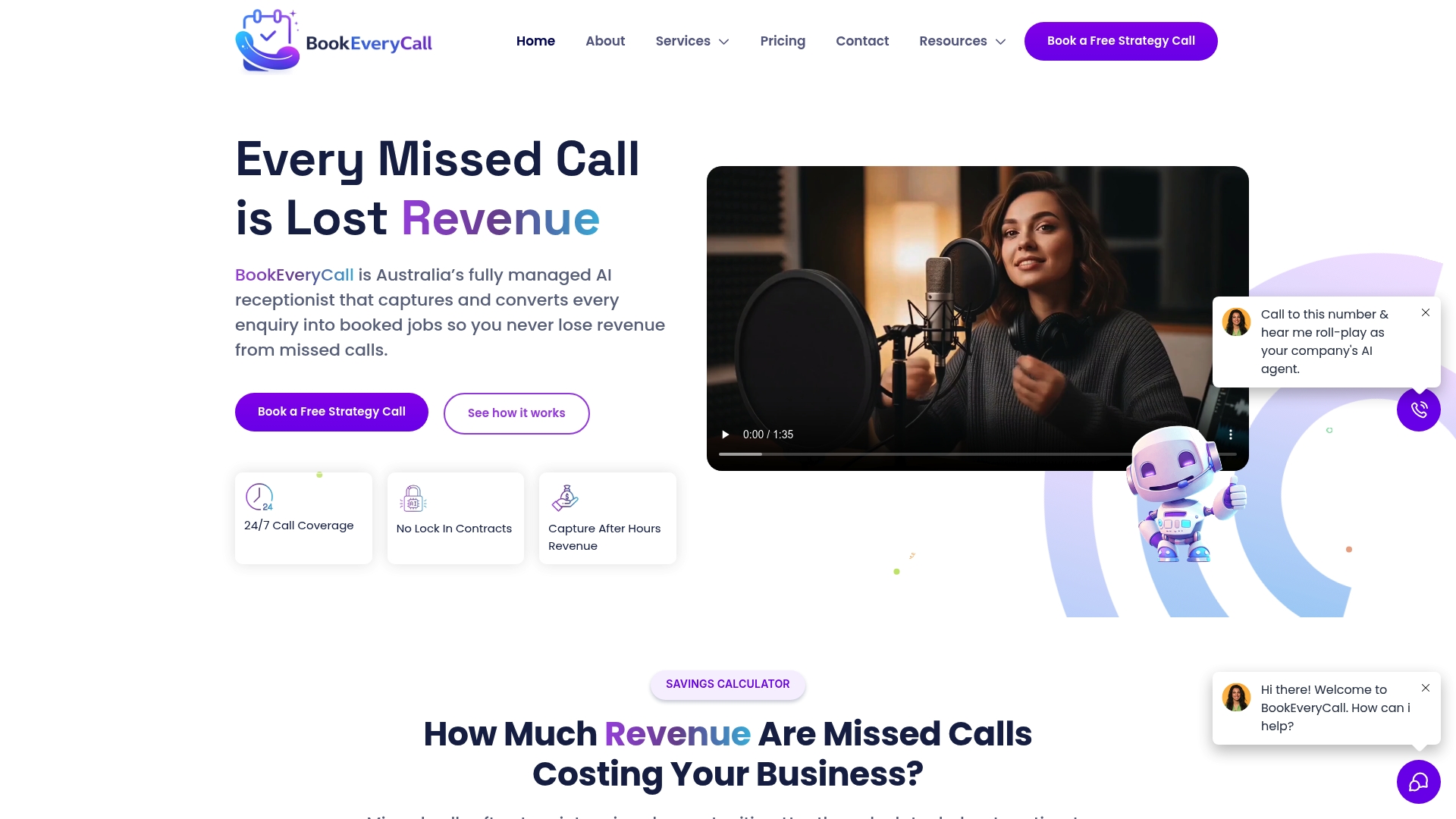
Bookeverycall operates as a fully managed AI voice receptionist that answers calls 24/7, qualifies enquiries, and books appointments directly into your calendar. It is not a voicemail service. It does not ask customers to call back. It books the job on the spot. For tradies, allied health clinics, property managers, and service businesses across Australia, the platform has been shown to recover up to $312,000 in annual revenue from calls that would otherwise go unanswered. Whether you operate in Sydney, Melbourne, Brisbane, Perth, or Adelaide, the system adapts to your service type, your hours, and your booking rules. Book a strategy call to see what your missed call data actually looks like.
FAQ
What are the main benefits of automated call booking?
Automated call booking captures leads 24/7, reduces no-show rates by 30 to 50%, cuts scheduling time from over eight minutes to seconds, and improves booking conversion rates to over 95% compared to 15 to 30% with callbacks.
How much can automated booking save an Australian small business?
Savings vary by business size and call volume, but the combination of reduced staffing costs, no-show reduction, and improved lead conversion can recover tens of thousands of dollars annually. Bookeverycall cites recoverable revenue of up to $312,000 for businesses experiencing recurring missed calls.
Does automated booking work for after-hours enquiries?
Yes. Automated systems operate continuously with no hold times, meaning enquiries received at night or on weekends are booked immediately rather than lost to voicemail or competitors.
Will customers accept booking with an AI instead of a person?
Research shows 77% of customers prefer digital and self-service booking options. Most customers prioritise a fast, frictionless experience over speaking with a human, particularly for routine appointment scheduling.
How do I start automating call bookings for my business?
The most practical starting point is a consultation with a specialist who can audit your current call volume, missed call rate, and booking process. From there, a system can be configured to match your calendar, service types, and routing rules within days.
Permalink