
TL;DR:
- Modern AI chatbots utilize natural language processing and machine learning to understand customer intent, preserve conversation context, and connect with existing systems, unlike traditional scripted responses. Effective implementation involves integrating AI with your data sources, designing clear escalation paths, and continuously refining your knowledge base to ensure accurate and helpful responses. Properly managed, AI enhances customer service, reduces missed calls, and drives revenue, especially for Australian businesses facing high costs from unattended inquiries.
Most business owners assume AI chatbots work like glorified FAQ pages. You type a question, the bot pattern-matches a keyword, and out comes a scripted reply. That’s not how modern AI handles customer questions. Today’s systems use natural language processing (NLP) and machine learning to understand intent, preserve context across a conversation, connect to your CRM and knowledge base, and escalate to a human agent without losing a single detail. For Australian businesses losing revenue to missed calls and slow response times, understanding how this technology actually works is the difference between a tool that converts and one that frustrates.
Table of Contents
- Key takeaways
- How AI understands and processes customer questions
- AI workflows: from query to resolution
- Challenges and best practices for AI question handling
- AI for Australian businesses: real-world applications
- How to choose and implement AI customer support tools
- My honest take on AI customer question handling
- How Bookeverycall helps Australian businesses handle every enquiry
- FAQ
Key takeaways
| Point | Details |
|---|---|
| AI reads intent, not just keywords | Modern AI uses NLP to understand what a customer means, even with typos or unusual phrasing. |
| Integration determines answer quality | AI connected to your CRM and knowledge base gives accurate, up-to-date answers rather than generic responses. |
| Escalation design is non-negotiable | Smooth handoff to a human agent, with full context preserved, protects customer trust and reduces repeat effort. |
| Australian businesses face real missed-call costs | Missed enquiries can cost local businesses up to $312,000 annually, making 24/7 AI coverage a revenue decision. |
| Choose tools with measurable ROI metrics | Track automation coverage, resolution rates, and customer satisfaction to know if your AI investment is working. |
How AI understands and processes customer questions
The industry term for what most people call an “AI chatbot” handling complex queries is a conversational AI agent. Understanding the difference matters, because rule-based bots and conversational AI agents operate on completely different foundations.
A rule-based bot follows a decision tree. If the customer types “refund,” it returns a scripted response about your returns policy. If they type “get money back,” the bot may not recognise the intent at all and loops them into a dead end. Conversational AI agents use NLP to extract three things from every message: intent (what the customer wants to achieve), entities (specific details like dates, order numbers, or locations), and context (what was said earlier in the conversation). This is why a modern AI can correctly interpret “Can I change that to next Tuesday instead?” without the customer repeating their booking details.
Generative AI versus retrieval-based approaches
There are two broad methods AI uses to produce answers. Generative models, including large language models (LLMs), predict responses token by token based on training data. Retrieval-based systems pull exact answers from a structured knowledge base. Neither approach alone is ideal for business use.
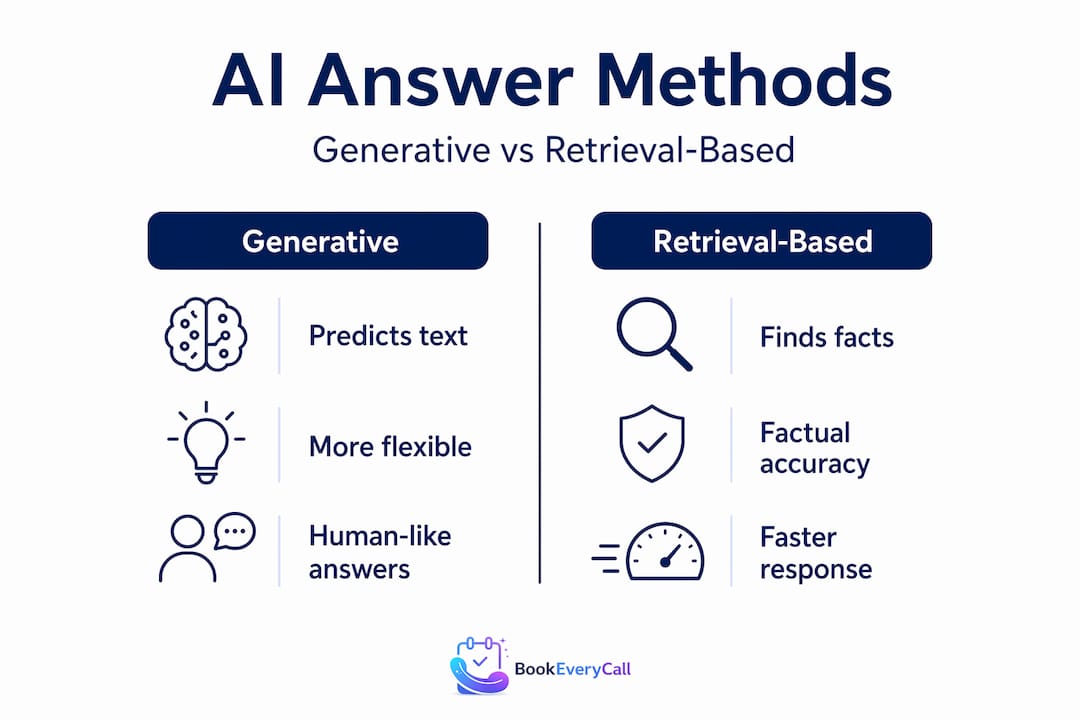
The most reliable production AI systems combine both. They use retrieval-augmented generation (RAG), which means the AI retrieves relevant content from your internal databases first, then generates a response grounded in that content. LLM plus RAG architectures significantly reduce hallucinations and keep answers accurate and customer-specific. For a plumbing business in Brisbane, that means the AI draws on your current pricing, service areas, and availability before composing a reply. It does not make something up.
Here is what a well-designed AI processes during a single customer interaction:
- Spelling and phrasing variations: “Hows my oder” is correctly interpreted as a status enquiry on an order.
- Follow-up questions: The AI retains the context of earlier messages so the customer does not repeat themselves.
- Ambiguity resolution: When intent is unclear, the AI asks a targeted clarifying question rather than guessing or returning a generic answer.
- Multi-step requests: Natural language understanding enables AI to take follow-up actions like opening a support ticket, not just reply with information.
Pro Tip: Build your AI’s knowledge base with the exact phrases your customers actually use, not just formal product descriptions. Review your support tickets and phone enquiries for the real language your audience relies on.
AI workflows: from query to resolution
Knowing how AI comprehends a question is one thing. Understanding what it does next is where the real business value lives. A well-deployed AI does not simply answer and close the conversation. It operates as a resolution engine by automating tasks and routing intelligently using live data from connected systems.
A typical AI customer query workflow looks like this:
- Customer sends a message via phone, chat, or web form.
- AI parses intent and entities using NLP and checks confidence level against a threshold you define.
- AI queries connected systems including your CRM, ticketing platform, order management system, or knowledge base to retrieve relevant data.
- AI composes and delivers a response grounded in retrieved data, not fabricated from training alone.
- Routine queries are resolved end-to-end. Booking confirmations, pricing questions, service area checks, and appointment changes are handled without human involvement.
- Complex or sensitive cases trigger escalation. When confidence falls below threshold or the customer requests a person, the AI hands off to a human agent.
- Full context transfers with the handoff. Pending goals, subtasks, and tool outputs are passed to the agent so the customer never has to repeat themselves.
The escalation step deserves more attention than most businesses give it. A handoff that dumps only a chat transcript on the human agent is a failed handoff. The agent needs to know what the AI tried, what the customer’s original goal was, and where the conversation stalled. When that transfer is done properly, handle time drops and customer satisfaction rises.
| Query type | Handled by AI | Escalated to human |
|---|---|---|
| Pricing and availability | Yes | No |
| Appointment booking | Yes | No |
| Account changes | Yes (standard) | Yes (complex) |
| Complaints and disputes | Partial triage | Yes |
| Technical troubleshooting | Partial (known issues) | Yes (novel issues) |
Pro Tip: Set your escalation threshold conservatively at first. It is far better to over-escalate to a human early in your deployment than to have the AI attempt answers it is not equipped to handle accurately.
Challenges and best practices for AI question handling
The single biggest failure mode in automated customer service is not a technical one. It is a design one. Customers trapped in loops where the AI cannot help them and will not let them reach a person is the fastest way to destroy trust. Chatbot frustration costs businesses in lost conversions, negative reviews, and damaged brand reputation.
“Customers trapped in chatbot loops lose trust rapidly. Seamless handoff preserving full context is not a nice-to-have. It is the difference between a customer who stays and one who leaves.”
Here are the most common pitfalls and how to address each one:
- Looping without progress: The AI keeps asking the same clarifying question because it cannot parse the answer. Fix this by explicitly designing AI capability boundaries so the system recognises when it is stuck and escalates instead of looping.
- No visible progress signals: Customers abandon conversations when they cannot tell if anything is happening. Explicitly communicating system steps and next actions builds confidence far better than a generic “Please wait” message.
- Hidden AI identity: Disclosing that the customer is speaking with an AI at the start of the interaction is not just good practice. It aligns with transparency frameworks that regulators are increasingly enforcing.
- Shallow knowledge bases: An AI is only as good as the information it can access. If your product documentation is incomplete or outdated, the AI will produce incomplete or outdated answers.
- Abrupt escalation without context: When a human agent receives a customer with no background information, the customer must start from scratch. That experience is worse than no AI at all.
Balancing automation with genuine human empathy means being honest about what AI should and should not own. Routine, high-volume queries are perfect for AI. Emotionally charged conversations, disputes, and high-value relationship moments belong with your best people. The AI frees those people to do what they do best.
AI for Australian businesses: real-world applications

Australian businesses face a specific and costly problem. Missed calls during peak periods and after hours represent enquiries that convert to competitors or disappear entirely. Bookeverycall’s data points to losses of up to $312,000 annually for businesses with recurring missed calls. That figure is not theoretical. It reflects what happens when a tradie in Perth is on a job, a clinic receptionist in Melbourne is at lunch, or a real estate property manager in Sydney is showing a property.
Here is how AI customer support tools are being applied across Australian industries right now:
- Tradies (plumbers, electricians, builders): AI for Australian tradies answers after-hours calls, qualifies the job type and location, and books the appointment directly into the tradie’s calendar. No missed opportunity, no voicemail that never gets returned.
- Real estate and property management: AI voice receptionists handle routine rental enquiries, maintenance request triage, and inspection booking. An agency in Brisbane managing 300 properties cannot have every routine call answered manually.
- Allied health clinics: Appointment booking, rebooking, and general enquiries are handled 24/7. A physiotherapy clinic in Adelaide that closes at 6pm still captures a new patient enquiry at 9pm.
- Professional services (accountants, solicitors): AI qualifies the nature of the enquiry, captures contact details, and schedules a consultation call. The professional returns to a full calendar rather than a voicemail inbox.
The AI systems delivering results in these sectors do more than answer questions. AI automating up to 80% of interactions means your team handles only the conversations that genuinely require human judgement. Everything else is resolved, booked, or routed without lifting a finger.
Cities like Sydney, Melbourne, and Perth have competitive service markets where response speed directly affects conversion. A customer looking for an emergency plumber at 11pm on a Saturday in Melbourne will call three businesses. The one that answers wins the job. That is the practical case for AI voice receptionists in Australia.
How to choose and implement AI customer support tools
Selecting the right AI solution requires more than comparing feature lists. The questions that matter most are about fit with your specific workflows, your data quality, and your team’s capacity to manage the rollout.
Follow these steps to evaluate and implement AI question-handling tools effectively:
- Map your actual enquiry types. Audit your last 90 days of calls, emails, and chat messages. Categorise them by type and volume. This tells you what the AI will handle most and what your knowledge base must cover.
- Assess integration requirements. Does the AI connect to your CRM, booking platform, or ticketing system? AI linked to internal data delivers accurate answers. Standalone AI that cannot access your systems will frustrate customers faster than it helps them.
- Build a rich knowledge base before launch. Include detailed product and service descriptions, FAQs derived from real customer questions, pricing, service areas, and escalation contact details. Thin documentation produces thin answers.
- Start with a limited rollout. Deploy AI on one channel or one query category first. Review performance weekly and expand only when resolution rates and customer satisfaction scores meet your targets.
- Keep humans in the loop with oversight dashboards. Monitor escalation rates, resolution times, and customer satisfaction continuously. Your AI should improve with use, not stagnate.
- Evaluate vendors on escalation design specifically. Ask any vendor how context is transferred during a human handoff. If they cannot give you a clear, specific answer about state transfer during handoff, that is a red flag.
Pro Tip: Request a pilot deployment on real enquiries before committing to any AI customer support platform. Controlled demos rarely surface the edge cases that will define your customers’ actual experience.
The metrics that matter most are automation coverage rate (the percentage of queries resolved without human involvement), first-contact resolution rate, and customer satisfaction score post-interaction. Track these from day one and tie them to revenue impact.
My honest take on AI customer question handling
I have worked with enough businesses deploying AI support systems to know that the technology gap is rarely the problem. The design gap is.
Most deployments I have seen fail at the handoff. The AI answers questions well enough, but the moment it cannot help, the customer hits a wall. The human agent who picks up has no idea what the customer already tried to do, what information they provided, or where the AI got stuck. The customer has to start again. That single experience undoes all the goodwill the AI built in the first two minutes.
The other thing I keep seeing is what I call the illusion of responsiveness. A business deploys an AI that replies instantly, but the replies are vague and do not actually resolve anything. The customer feels heard but is no closer to getting what they need. That is worse than a short wait for a knowledgeable human, because it uses up the customer’s patience without delivering value.
My advice to any Australian business exploring this technology: do not automate a broken process. If your human team cannot clearly explain the answers to your 20 most common questions, your AI will not be able to either. The AI amplifies what you give it. If you give it a well-documented, well-organised knowledge base and clear escalation rules, it will perform brilliantly. If you give it vague notes and hope for the best, you will get frustrated customers and embarrassing bot responses.
The businesses I have seen get genuine results from AI are the ones who treat the knowledge base as a living document, review escalation transcripts every week, and stay genuinely curious about where the AI is falling short. That discipline is what separates a system that works from one that just looks like it does.
— Chay
How Bookeverycall helps Australian businesses handle every enquiry
Bookeverycall is a fully managed AI voice receptionist built specifically for Australian businesses. It answers calls 24/7, qualifies enquiries, and books jobs directly into your calendar. Whether you run a trade business in Perth, a property management agency in Melbourne, or an allied health clinic in Brisbane, Bookeverycall captures every call that would otherwise go unanswered and converts it into a confirmed booking. The missed call AI service also recovers enquiries from customers who called but did not leave a voicemail, targeting one of the most overlooked revenue leaks in small and medium business. To see how Bookeverycall can work for your specific industry, visit bookeverycall.com and book a strategy call today.
FAQ
How does AI understand customer questions without scripted answers?
Modern conversational AI uses natural language processing to extract intent, entities, and context from each message. This allows it to interpret varied phrasing, follow-up questions, and even typos without relying on exact keyword matches.
What happens when AI cannot answer a customer question?
When the AI’s confidence falls below a set threshold or the query exceeds its authority, it escalates to a human agent. Best-practice systems transfer the full conversation state, including what the customer asked and what the AI attempted, so the customer does not repeat themselves.
Can AI handle after-hours calls for Australian businesses?
Yes. AI voice receptionists like those offered by Bookeverycall operate 24/7, answering calls, qualifying enquiries, and booking appointments even outside business hours. This is particularly valuable for tradies and service businesses that lose jobs to missed after-hours calls.
How accurate are AI responses compared to human agents?
AI connected to a well-maintained knowledge base and CRM resolves routine enquiries with high accuracy. Systems using retrieval-augmented generation reduce hallucinations significantly. For complex or sensitive queries, escalation to a human agent remains the most reliable path.
How long does it take to set up an AI customer support system?
Setup time varies by platform and integration complexity, but most managed AI receptionist services like Bookeverycall can be configured and live within days. The critical factor is the quality of your knowledge base and the clarity of your escalation rules before launch.