

TL;DR:
- An AI receptionist for plumbers automatically answers calls, qualifies requests, and books jobs into scheduling systems, reducing missed opportunities and costs. It handles urgent triage, captures detailed customer information, and manages high call volumes around the clock at a fraction of traditional staffing expenses. Tailored to Australian cities, AI receptionists improve efficiency, customer trust, and revenue by addressing regional call patterns and language needs.
An AI receptionist for plumbers is an automated voice agent that answers every inbound call instantly, qualifies the service request, and books the job directly into your calendar without any manual input. Australian tradies miss an estimated 270,000 calls every single day. That figure represents real revenue walking out the door while your phone rings out on a job site. Tools like Voice.ai, Chime Labs, and Rivet CSR have built AI voice agents specifically for trade businesses, integrating with schedulers like Housecall Pro, ServiceTitan, and Jobber to turn missed calls into confirmed bookings around the clock.
How does an AI receptionist work for plumbing businesses in Australia?
An AI receptionist for plumbers operates as a virtual receptionist for your plumbing business, sitting between your phone number and your calendar. When a call comes in, the AI answers within one or two rings, greets the caller in natural Australian English, and immediately begins gathering the information your business needs to act.
The call handling process follows a structured sequence that mirrors what a trained human receptionist would do, but faster and without gaps in coverage.
- Emergency triage: The AI identifies whether the call is urgent. A burst pipe emergency triggers immediate escalation to your on-call plumber, complete with the caller’s address, shut-off valve status, and urgency level. Routine bookings follow a standard intake flow.
- Job information capture: The system collects customer name, property address, fixture type, urgency rating, whether pets are on-site, and preferred appointment windows. Rivet CSR’s AI receptionist captures all of these fields and pushes them directly into Housecall Pro, Jobber, or ServiceTitan without any manual data entry.
- Simultaneous call handling: No busy signals or voicemails occur because the AI handles unlimited concurrent calls. During a storm event in Brisbane when ten customers call at once, every single one gets answered.
- Appointment confirmation: The AI checks your live calendar availability and books the job on the spot, sending a confirmation SMS or email to the customer automatically.
- After-hours coverage: Calls at 11pm on a Sunday receive the same quality response as a Monday morning call during business hours.
The underlying technology is natural language processing, which is the same category of AI that powers tools like Google Assistant and Apple’s Siri. What makes trade-specific AI receptionists different is that they are trained on plumbing terminology, common Australian customer phrasing, and the specific decision trees that plumbing businesses use to qualify and prioritise jobs.
Pro Tip: Set your AI receptionist to ask callers whether the water is currently shut off during any leak-related call. This single question lets your on-call plumber assess urgency before calling back, saving significant time on every emergency job.

AI receptionist vs traditional answering: what is the real cost difference?
The cost comparison between an AI receptionist and traditional alternatives is stark, and the numbers favour automation decisively for most Australian plumbing businesses.
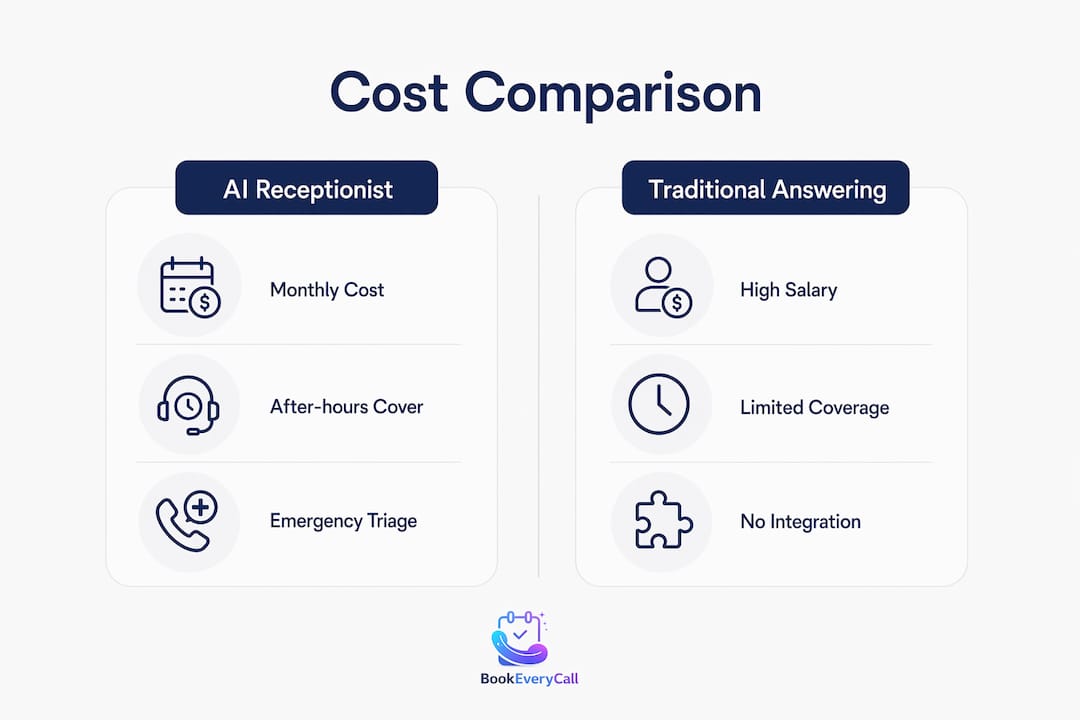
A full-time in-house receptionist in Australia costs approximately $3,500 per month when you factor in salary, superannuation, leave entitlements, and payroll overhead. A human answering service typically runs between $300 and $600 per month, but those services often use offshore staff who lack plumbing knowledge and cannot book directly into your CRM. AI receptionist flat monthly fees start at $299, with no penalty for call volume spikes and no sick days.
| Option | Monthly cost (AUD) | After-hours cover | CRM integration | Emergency triage |
|---|---|---|---|---|
| In-house receptionist | ~$3,500 | No | Manual entry | Limited |
| Human answering service | $300 to $600 | Partial | Rarely | Basic |
| AI receptionist | $299 to $899 | Yes, 24/7 | Automatic | Programmed logic |
| Voicemail only | $0 | Technically yes | No | No |
Voicemail appears free, but it carries a hidden cost that compounds over time. Bookeverycall estimates that recurring missed calls can cost a plumbing business up to $312,000 annually in lost revenue. A customer who calls a plumber and reaches voicemail at 7pm on a Friday will almost always call the next business on their list. You never know the call happened.
The scalability advantage is equally significant. During Queensland’s wet season or after a cold snap in Melbourne that causes pipe bursts across the city, call volume can triple overnight. An in-house receptionist cannot handle ten simultaneous calls. An AI receptionist handles all of them without degradation in quality or response time.
Pro Tip: When calculating your ROI on an AI receptionist, count only the jobs you currently know you are losing. Check your missed call log for the past 30 days and multiply by your average job value. Most plumbers are surprised by the result.
How are AI receptionists tailored for plumbers across Australian cities?
Australian plumbing businesses face genuinely different call patterns depending on their city, and a well-configured AI receptionist accounts for these differences rather than applying a generic national script.
The regional picture looks like this across the major metros:
- Sydney: High-density apartment living generates a large volume of strata-related calls involving body corporate approvals, access restrictions, and shared pipe systems. Sydney callers also tend to ask about licensing and insurance upfront, reflecting the competitive market. An AI receptionist configured for Sydney should be scripted to address these questions and capture strata plan numbers where relevant.
- Melbourne: Cold winters create seasonal spikes in hot water system failures and burst pipe calls. Melbourne also has a large multicultural population, and AI receptionists with multilingual support handle calls in languages beyond English, which is directly relevant in suburbs like Footscray, Springvale, and Dandenong.
- Brisbane and South-East Queensland: Storm season between November and April drives emergency call surges. AI receptionists deployed in Brisbane need strong emergency triage logic and the ability to manage high concurrent call volumes during weather events.
- Perth: The isolation of Perth’s suburban sprawl means customers are acutely aware of travel time and callout fees. AI receptionists in Perth benefit from scripting that captures the customer’s suburb early in the call so the system can provide an accurate callout fee estimate or flag the job for manual pricing review.
- Adelaide: Smaller market, but with a high proportion of older housing stock that generates frequent hot water, drainage, and gas fitting calls. AI receptionists here benefit from scripting that distinguishes between plumbing and gas work, since many callers conflate the two.
The natural language processing in modern AI receptionists understands Australian English dialects and common local phrases. A caller in Brisbane saying “the dunny’s blocked” or a Melbourne caller describing a “dripping tap” both get correctly classified without the AI misunderstanding colloquial language. This matters because customer trust drops immediately if an automated system sounds foreign or robotic.
For plumbers operating across multiple cities or running multi-truck operations, an AI receptionist can be configured with location-specific routing rules so that a call from a Perth number goes to the Perth team’s calendar while a Sydney call books into the Sydney schedule.
What features should plumbers look for in an AI receptionist?
Choosing the right automated receptionist for your trade business comes down to a specific set of features. Not every AI voice platform is built for plumbing, and the difference between a generic AI answering tool and a trade-specific one is significant in practice.
Here are the features that matter most, ranked by operational impact:
- Direct CRM and scheduler integration. The AI must book jobs into Housecall Pro, ServiceTitan, or Jobber without requiring manual transfer. Any system that emails you a summary and expects you to enter the booking yourself defeats the purpose.
- Emergency call triage with escalation logic. The system needs programmed rules for what constitutes an emergency and a clear escalation path. Voice.ai’s Emergency Logic feature classifies burst pipes, gas leaks, and flooding separately from routine bookings and routes them to an on-call number immediately.
- Australian English voice and language understanding. The voice should sound natural to Australian ears. Callers who detect an obviously American or robotic voice are more likely to hang up before completing the booking.
- After-hours and weekend coverage. The after-hours call management capability is where AI receptionists generate the most immediate ROI for plumbers, since emergency calls outside business hours are both common and high-value.
- Customisable scripting. Your AI receptionist should ask the questions specific to your business. A plumber who specialises in gas fitting needs different intake questions than one focused on residential drainage.
- Flat monthly pricing. Per-call pricing models become expensive quickly during busy periods. Flat monthly fees between $299 and $899 give you predictable costs regardless of call volume.
- Multilingual support. In multicultural cities like Sydney and Melbourne, the ability to handle calls in Mandarin, Vietnamese, or Arabic expands your serviceable customer base without adding staff.
| Feature | Why it matters for plumbers |
|---|---|
| CRM integration | Eliminates double-handling and data entry errors |
| Emergency triage | Ensures burst pipes and gas leaks reach a human immediately |
| Australian voice | Builds caller trust and reduces hang-up rates |
| Flat pricing | Keeps costs predictable during storm season call spikes |
| Multilingual support | Captures jobs from non-English speaking customers |
The best AI receptionist services for Australian plumbers combine all of these features in a single platform rather than requiring you to stitch together separate tools. When evaluating options, ask the provider for a live demo using a real plumbing scenario, specifically a burst pipe call at 10pm on a Saturday, and assess whether the system handles it the way your business would.
Key takeaways
An AI receptionist for plumbers in Australia captures missed calls, books jobs automatically, and costs a fraction of in-house reception, making it the most cost-effective call management option for trade businesses of any size.
| Point | Details |
|---|---|
| Scale of the missed call problem | Australian tradies miss 270,000 calls daily, representing substantial lost revenue across the industry. |
| Cost advantage over alternatives | AI receptionists start at $299 per month versus $3,500 for in-house staff, with full 24/7 coverage included. |
| Emergency triage capability | AI systems classify burst pipes and gas leaks separately and escalate to on-call plumbers with full job details. |
| City-specific configuration | Sydney, Melbourne, Brisbane, Perth, and Adelaide each have distinct call patterns that require tailored AI scripting. |
| Feature selection criteria | CRM integration, emergency logic, Australian voice, and flat pricing are the four non-negotiable features for plumbers. |
Why I think most plumbers are thinking about this the wrong way
The conversation I hear most often goes like this: a plumber hears about AI receptionists, gets interested, then hesitates because they worry customers will feel deceived or annoyed by talking to a machine. That concern is understandable, but it misreads what customers actually want at the moment they call.
When someone calls a plumber at 9pm because water is coming through their ceiling, they do not want to leave a voicemail. They want someone to answer, take the details, and tell them help is coming. An AI that does exactly that is not a disappointment. It is a relief. The AI freeing human staff from repetitive call answering is the right framing. The AI handles the intake; your team handles the skilled work and the relationship.
Where I see plumbers go wrong is treating the AI receptionist as a set-and-forget tool. The script you write on day one will not be perfect. You need to review call recordings in the first month, identify where callers are dropping off or getting confused, and update the scripting accordingly. A plumber in Perth told me his AI was losing calls because it did not mention the callout fee upfront, which Perth customers specifically ask about. One script update fixed it.
The other mistake is skipping the pilot phase. Start with after-hours calls only. Let the AI handle the calls you were already missing entirely, measure the jobs it captures, and calculate the return before rolling it out to all hours. Most plumbers who do this find the ROI case is obvious within the first four weeks. The AI tools for plumbers that deliver the best results are the ones that are configured thoughtfully, not just switched on.
— Chay
Never miss another plumbing job with Bookeverycall
Bookeverycall is a fully managed AI voice receptionist built for Australian trade businesses, including plumbing companies of every size. It answers every call 24/7, qualifies the job, and books it directly into your existing scheduler, whether that is Housecall Pro, Jobber, or ServiceTitan.
Businesses using Bookeverycall’s AI voice receptionist report recovering jobs they had no idea they were losing, particularly after-hours emergency calls that previously went to voicemail and never converted. The service operates on flat monthly pricing designed for small to multi-truck plumbing operations, with no lock-in contracts and a free setup consultation included. If your phone is ringing while you are under a house or on a job site, Bookeverycall answers it. Visit bookeverycall.com to see how much revenue your missed calls are costing you.
FAQ
What is an AI receptionist for plumbers?
An AI receptionist for plumbers is an automated voice agent that answers inbound calls 24/7, collects job details, triages emergencies, and books appointments directly into your scheduling software without any human involvement.
How much does an AI receptionist cost for an Australian plumbing business?
AI receptionist services for Australian plumbers typically range from $299 to $899 per month on flat monthly pricing, compared to approximately $3,500 per month for a full-time in-house receptionist including superannuation and leave entitlements.
Can an AI receptionist handle emergency plumbing calls?
Yes. Trade-specific AI receptionists use emergency triage logic to identify urgent calls such as burst pipes or gas leaks, collect critical details including the caller’s address and shut-off status, and immediately escalate to your on-call plumber.
Will an AI receptionist integrate with my plumbing software?
Most trade-focused AI receptionists integrate directly with Housecall Pro, ServiceTitan, and Jobber, booking jobs and capturing intake fields automatically without requiring manual data entry from your team.
Is an AI receptionist suitable for plumbers in Sydney and Melbourne specifically?
Yes. AI receptionists can be configured with city-specific scripting to handle Sydney strata calls, Melbourne cold-weather pipe burst surges, and multilingual customer bases in both cities, making them well-suited to the specific demands of major Australian metro plumbing markets.