

TL;DR:
- Missed call AI automatically responds to unanswered calls with SMS or voice interactions to capture leads before competitors do. It integrates seamlessly with Australian phone systems, complies with local regulations, and offers features like two-way messaging and CRM synchronization. Implementing the right solution can recover substantial revenue, especially for trades and professional services, by ensuring prompt, compliant responses across diverse regions and industries.
Missed call AI is defined as automated technology that instantly replies to unanswered business calls with an SMS or AI voice interaction, capturing leads before they ring a competitor. For Australian businesses, this matters more than most realise. Studies show SMS delivery under 15 seconds is achievable across Telstra, Optus, and Vodafone networks, meaning a tradie on the tools or a clinic running behind schedule no longer has to choose between the job in front of them and the call they just missed. Providers like Bookeverycall, TapText, and Bonnie AI have built solutions specifically for this gap, and the revenue at stake is substantial. Bookeverycall estimates businesses can recover up to $312,000 annually by converting recurring missed calls into booked jobs.
How does missed call AI work with Australian business phone systems?
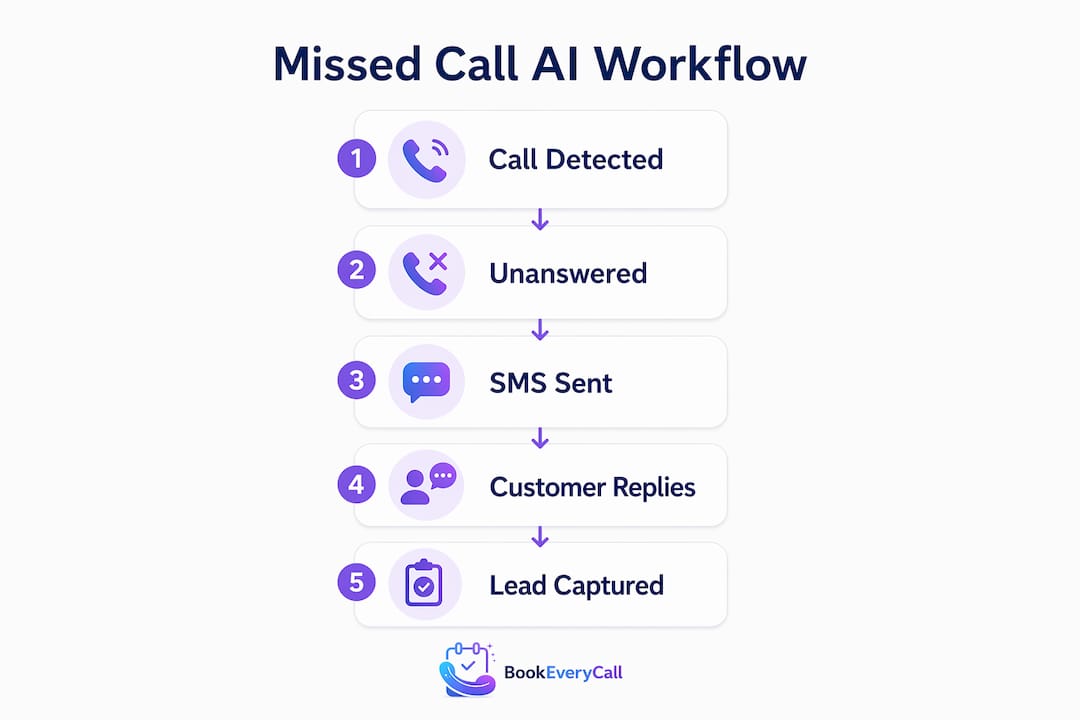
Missed call AI, also called missed call texting or automated call response technology, connects to your existing phone infrastructure and fires an SMS or triggers an AI voice callback the moment a call goes unanswered. The integration works across virtual numbers, existing landlines, and mobile numbers, which means there is no need to change your current phone number or carrier.
The call detection logic is straightforward. The system monitors your line and recognises three states: unanswered calls that ring out, busy signals, and diverted calls sent to voicemail. Each state can trigger a different response. A call that rings out after 20 seconds might send a personalised SMS. A call diverted after hours might trigger a booking link. You set the rules once and the system handles the rest.
Carrier-specific quirks across Telstra, Optus, and Vodafone are a real consideration for Australian businesses. Network architecture differences mean message delivery can vary, which is why reliable solutions use local SMS gateways rather than offshore routing. A local gateway keeps delivery rates high and latency low, which matters when a customer is deciding whether to wait for your reply or call the next number on Google.
The two-way messaging capability separates effective systems from basic SMS blasts. When a customer receives your automated reply and texts back with their address or job details, the system logs that conversation and can route it to your CRM or calendar. Two-way messaging creates conversational lead capture rather than a one-way notification that gets ignored. Bonnie AI takes this further by answering calls 24/7 in a natural voice, handling bookings and follow-ups without any human involvement, saving small businesses roughly 20 hours of call traffic monthly.
Most deployments use a two-stage flow: an immediate SMS acknowledgement arrives within seconds, followed by a follow-up intake via text reply or a booking link. This approach works well for trades and professional services because it does not try to automate complex, job-specific answers. It simply keeps the conversation alive until you can respond personally.

Pro Tip: Set your missed call trigger to fire after 15 to 20 seconds rather than immediately. This gives you a window to pick up the call yourself while still capturing leads when you genuinely cannot answer.
Compliance logging is built into quality systems. Every message sent and received is timestamped and stored, creating an audit trail that satisfies Privacy Act obligations and gives you a record if a dispute arises.
What are the Australian compliance rules for missed call SMS?
Australian telecommunications law places specific obligations on businesses that send automated messages, and missed call AI sits squarely within that regulatory scope. Getting this wrong is not a minor administrative issue. Non-compliance carries real financial consequences.
The most urgent change for 2026 is the ACMA Sender ID Register. From 1 July 2026, businesses must register alphanumeric SMS sender IDs with the Australian Communications and Media Authority to avoid their messages being blocked or labelled as scam content by carriers. The voluntary registration phase is already open, and registering your sender ID early avoids the risk of your automated replies being silently discarded before they reach your customers.
The Spam Act adds a second layer of obligation. Businesses must obtain consent before sending commercial electronic messages and must include a clear unsubscribe option that remains effective for at least 30 days. The practical implication for missed call AI is this: if your automated reply includes any promotional content, it may be classified as a commercial message and trigger these requirements. The safest approach is to design your automated replies as transactional acknowledgements. “Hi, we missed your call. We’ll be in touch shortly. Reply with your name and best time to call” is transactional. “Hi, we missed your call. Check out our current specials at…” is promotional and requires consent.
Automated texts following missed calls may classify as commercial messages under the Spam Act if they contain promotional content. Best practice is to design replies as transactional acknowledgements and keep marketing messages in a separate, consent-based campaign.
The financial risk of non-compliance is not theoretical. Lululemon Australia was fined $702,900 for failing to include proper unsubscribe mechanisms in marketing texts. For a small business, a penalty at that scale is existential.
Key compliance considerations for Australian businesses using missed call AI:
- Register your alphanumeric sender ID with ACMA before 1 July 2026 to prevent message blocking
- Keep automated replies transactional, not promotional, to avoid Spam Act consent requirements
- Include an opt-out mechanism in any message that could be classified as commercial
- Store all message logs with timestamps to satisfy Privacy Act data handling obligations
- Set SMS sending windows between 9am and 9pm in the recipient’s local time zone, which respects ACMA sending guidelines and covers Australia’s three time zones: AEST, ACST, and AWST
- Confirm your provider uses Australian data storage, not offshore servers, to meet Privacy Act requirements
Carrier differences across Telstra, Optus, and Vodafone also affect delivery. Telstra’s network has the broadest rural reach, which matters for tradies operating outside metro areas. Optus and Vodafone have stronger density in urban corridors. A provider that routes through a single carrier will have blind spots. Local multi-carrier gateways eliminate this problem.
Which features matter most for Australian small businesses and tradies?
Selecting a missed call AI solution comes down to a handful of features that separate tools that recover revenue from tools that just send texts. The comparison below covers what matters most for Australian service businesses.
| Feature | What to look for | Why it matters |
|---|---|---|
| Call trigger flexibility | Configurable timing: after X seconds, after hours, on busy signal | Lets you match the system to your actual workflow |
| Two-way messaging | Customer can reply and start a conversation | Converts a notification into a lead capture |
| CRM and calendar integration | Syncs with tools like HubSpot, ServiceM8, or Google Calendar | Eliminates manual data entry and books jobs automatically |
| Australian carrier compatibility | Multi-carrier local gateway covering Telstra, Optus, Vodafone | Guarantees delivery across metro and regional areas |
| Compliance features | Sender ID registration support, opt-out handling, message logging | Keeps you lawful under ACMA and Spam Act rules |
| Customisable templates | Branded messages with merge fields for name, time, service type | Feels personal rather than robotic to the customer |
Pricing for capable systems typically sits between $50 and $150 per month, and CRM-integrated solutions in this range deliver measurable ROI by recovering lost jobs, particularly in trades where a single appointment can be worth $300 to $800.
The case study that illustrates this best involves a sole-trader plumber in Epping, NSW. After setting up a missed call SMS reply that captured job details, he recovered approximately three additional jobs per month that had previously gone to voicemail and been lost. Setup took one working day. The templates were simple. There was no full automation of job quoting or scheduling, just a reliable first response that kept the lead warm until he could call back. At an average job value of $400, that is $1,200 per month in recovered revenue from a $50 to $100 monthly tool.
Pro Tip: Integrate your missed call AI with a chatbot CRM integration so that every text reply automatically creates a contact record. This removes the manual step of logging enquiries and ensures no lead falls through the cracks during busy periods.
For allied health and professional services, the priority shifts slightly toward calendar integration and appointment confirmation. A physio clinic in Brisbane that misses a call at 6pm needs the automated reply to offer a booking link, not just a “we’ll call you back” message. The best missed call features in AI for this sector include direct calendar booking, automated reminders, and intake form links sent via SMS.
How do missed call AI solutions differ across Australian cities and industries?
Australia’s geography and time zone spread create real operational differences that affect how missed call AI should be configured. A business in Perth operates on AWST, which is two hours behind Sydney and Melbourne on AEST. If your SMS sending window is set to 9am to 9pm without time zone awareness, a Perth customer who calls at 8am receives no automated reply until your system thinks it is 9am. That is a 60-minute gap where a competitor can step in.
City-specific considerations worth knowing:
- Sydney and Melbourne have the highest call volumes and the most competitive service markets. Automated responses need to be fast and professional because customers have more alternatives. Response time under 15 seconds is the standard to meet.
- Brisbane businesses often serve both metro and regional Queensland customers. Multi-carrier routing is more important here because Optus and Vodafone coverage thins out north of the Sunshine Coast.
- Perth requires explicit time zone configuration in your missed call AI settings. AWST is not automatically handled by systems designed for east coast businesses.
- Adelaide operates on ACST, a 30-minute offset that catches many national providers off guard. Confirm your provider handles half-hour time zone offsets correctly.
Industry differences are equally significant. Tradies, including plumbers, electricians, and builders, typically need simple, fast SMS replies with a call-back promise and a prompt for job details. The AI receptionist for tradies model works well here because the priority is speed and simplicity, not sophisticated dialogue.
Healthcare and allied health clinics face stricter messaging requirements. Patient communications may carry additional obligations under the Privacy Act, and messages should avoid referencing health conditions or appointment types in the SMS body. A generic “we missed your call, please book online” message with a booking link is safer than a message that references the service type.
Emergency trades like locksmiths and 24-hour plumbers in Sydney and Melbourne benefit most from after-hours AI call management. Customers calling at 11pm with a burst pipe are not going to wait until morning. An automated reply that acknowledges the call, confirms after-hours availability, and provides an estimated response time converts that caller into a confirmed job rather than a lost one.
Professional services firms in the CBD, including law firms, accountants, and financial advisers, need a more formal tone in their automated replies. The message template should reflect the brand’s positioning. A $500-per-hour solicitor’s office should not send an SMS that reads like it came from a tradie’s phone.
Key takeaways
Missed call AI is the most cost-effective tool Australian service businesses can deploy to recover lost revenue from unanswered calls, provided it is configured for local carrier requirements and ACMA compliance.
| Point | Details |
|---|---|
| Speed is the core advantage | SMS delivery under 15 seconds keeps leads warm before they call a competitor. |
| Compliance is non-negotiable | Register your sender ID with ACMA before July 2026 and keep automated replies transactional. |
| Two-way messaging wins | Systems that allow customers to reply and book convert more leads than one-way notifications. |
| City and time zone config matters | Perth, Adelaide, and regional Queensland require specific carrier and time zone settings to work correctly. |
| ROI is measurable and fast | A plumber recovering three jobs per month at $400 each covers a year’s subscription cost in the first month. |
Why I think most Australian businesses are still getting this wrong
Most of the businesses I speak with treat missed call AI as a nice-to-have rather than basic infrastructure. That framing is costing them real money. A missed call is not a minor inconvenience. It is a customer who had a problem, picked up the phone, and got nothing. In a competitive service market, that customer is already scrolling to the next result before your voicemail finishes playing.
The compliance piece is where I see the most avoidable mistakes. Businesses set up an automated SMS, add a promotional line about their current offer, and unknowingly step into Spam Act territory. The fix is simple: keep the automated reply transactional and run your promotions through a separate, consent-based channel. But most providers do not explain this clearly during onboarding, and most business owners do not know to ask.
The other mistake I see is over-engineering the automation. A tradie does not need an AI that tries to quote a job via SMS. They need a reliable first response that keeps the lead warm for 20 minutes until they can call back. The two-stage flow of immediate acknowledgement followed by a simple intake question is more effective than a complex chatbot that frustrates the customer before the first conversation even happens.
Customer expectations in 2026 have shifted. People expect a response within minutes, not hours. If your business cannot deliver that during peak periods or after hours, you are not just losing the odd call. You are building a reputation for being hard to reach. Missed call AI is not a luxury for businesses that can afford it. It is the minimum standard for businesses that want to compete.
— Chay
How Bookeverycall helps you capture every missed enquiry
Bookeverycall operates as a fully managed AI receptionist for small businesses across Australia, handling calls 24/7, qualifying enquiries, and booking jobs directly into your calendar. The service is built for Australian carrier infrastructure and includes compliance support for ACMA sender ID registration and Spam Act requirements.
For businesses ready to stop losing revenue to unanswered calls, Bookeverycall’s missed call AI service covers the full flow: instant SMS acknowledgement, two-way messaging, CRM integration, and local carrier routing across Telstra, Optus, and Vodafone. The onboarding process is straightforward, and the ROI from recovering even two or three jobs per month covers the cost many times over. Visit bookeverycall.com to see how it works for your industry.
FAQ
What is missed call AI and how does it work in Australia?
Missed call AI is automated technology that detects an unanswered call and instantly sends an SMS or triggers an AI voice response to the caller. In Australia, it integrates with existing phone lines and uses local carrier gateways across Telstra, Optus, and Vodafone to deliver messages within 15 seconds.
Do I need to register my SMS sender ID in Australia?
Yes. From 1 July 2026, ACMA requires businesses to register alphanumeric sender IDs to prevent messages from being blocked or flagged as scam content by Australian carriers. Registration is currently open in a voluntary phase, so acting early avoids disruption.
Can automated missed call texts get me in trouble under the Spam Act?
They can if the message contains promotional content without prior consent. Design your automated replies as transactional acknowledgements rather than marketing messages, and include an opt-out option if there is any doubt about classification.
How much does missed call AI cost for a small business in Australia?
Capable systems with CRM integration and Australian carrier support typically cost between $50 and $150 per month. For a tradie recovering two or three jobs per month at $300 to $800 each, the return on that investment is clear within the first billing cycle.
Which Australian industries benefit most from missed call AI?
Trades including plumbers, electricians, and builders see the fastest ROI because of high job values and frequent after-hours calls. Allied health clinics, professional services firms, and emergency service providers in cities like Sydney, Melbourne, and Brisbane also benefit significantly from automated call responses during peak and after-hours periods.
Permalink