

TL;DR:
- AI scheduling automates the full booking process, saving time, reducing errors, and increasing availability.
- It integrates machine learning, NLP, and voice AI to handle appointments 24/7, boosting revenue and customer satisfaction.
- Proper configuration and integration are essential for maximum benefit, especially regarding calendars, timezones, and fallback protocols.
Artificial intelligence scheduling is defined as the automated management of booking workflows using machine learning, natural language processing, and voice AI to replace manual calendar coordination. The role of AI in appointment scheduling goes well beyond simple calendar management. It transforms how Australian businesses capture, confirm, and retain customer bookings across every hour of the day. Tools like Engageware and HighLevel Voice AI demonstrate what is now possible: booking time reduced by over 96% compared to traditional methods, with human intervention cut by 70%. For a tradie in Brisbane or a medical clinic in Melbourne, that difference is not theoretical. It is revenue recovered and customers served.
How does AI appointment scheduling actually work?
AI-driven appointment management operates through three core technologies working in concert: machine learning, natural language processing (NLP), and voice AI. Understanding how each layer functions helps you evaluate which solution fits your business.
Machine learning for smarter booking decisions
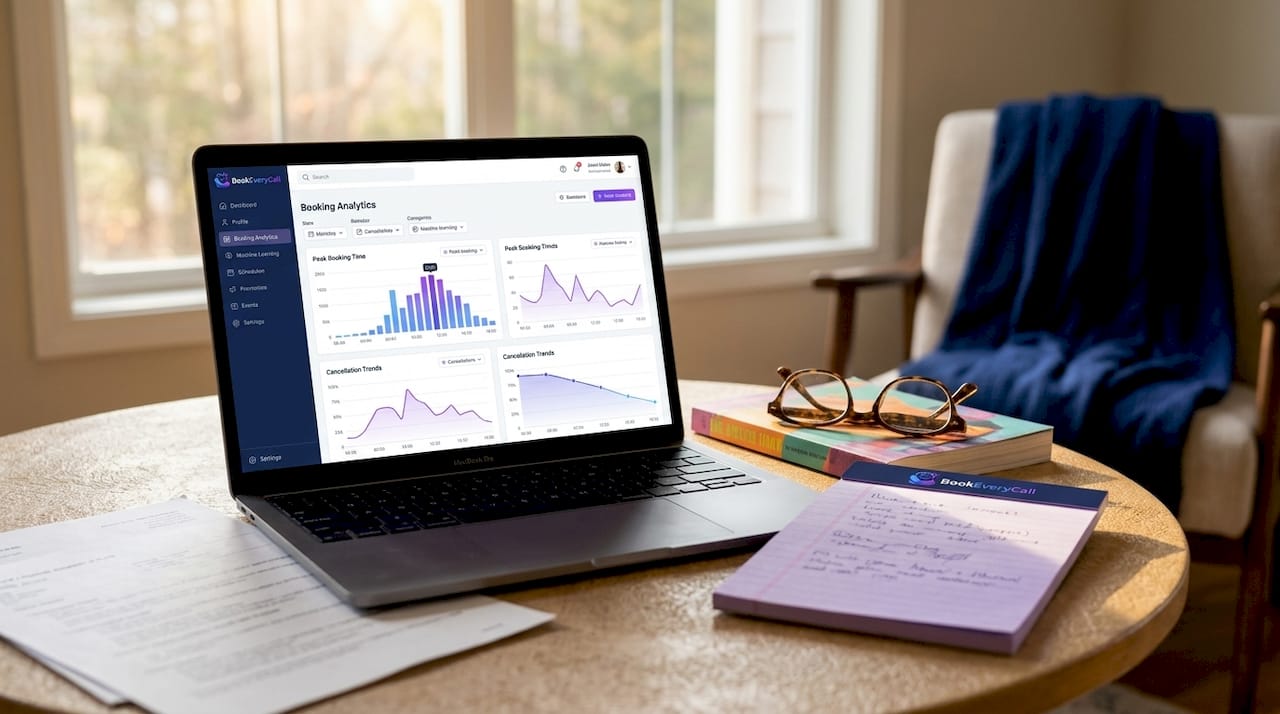
Machine learning analyses historical booking data to identify patterns, such as peak demand periods, common cancellation triggers, and optimal appointment durations. The system uses this intake data to match incoming requests with the right time slot, staff member, or service type without a human making that call. Over time, the model improves its accuracy as it processes more bookings. For a plumbing business in Sydney with ten technicians across different suburbs, this means the system learns which jobs take longer in certain postcodes and adjusts availability accordingly.
Natural language processing for human-style conversations
NLP allows AI scheduling tools to interpret customer requests written or spoken in plain language. A customer texting “Can I get someone out Thursday arvo?” is understood and matched to available slots without a staff member reading and responding manually. This technology powers chatbots on websites and SMS booking flows, converting casual enquiries into confirmed appointments. AI chatbots convert 25 to 40% of scheduling conversations into confirmed bookings, which means a significant portion of your web traffic can become paying appointments without any staff involvement.
Voice AI for real-time phone bookings
Voice AI is the most direct application for Australian small businesses that rely on inbound calls. Voice AI books appointments in real time during a live call by checking availability, collecting caller details, and confirming the booking without redirecting the customer to an external page or putting them on hold. HighLevel Voice AI supports both single-calendar and multi-calendar routing based on conversational context, meaning a caller asking for a specific service type gets matched to the right team member automatically.
Calendar and CRM integration
None of this works without tight integration into your existing systems. Two-way calendar synchronisation using OAuth 2.0 and API connections to Google Calendar and Microsoft Outlook prevents double bookings during live AI interactions. CRM integration means every booked appointment also creates or updates a customer record, so your team has full context before the job starts.
Pro Tip: When evaluating AI scheduling tools, confirm they support two-way sync rather than one-way push. One-way sync only writes to your calendar but does not read existing bookings, which creates double-booking risk during high-volume periods.
What are the benefits of AI in scheduling for Australian small businesses?
The benefits of AI in scheduling are most visible in three areas: time saved, revenue recovered, and customer satisfaction improved. Each of these matters differently depending on your industry, but the underlying mechanics are consistent.
Reduced admin time and manual workload
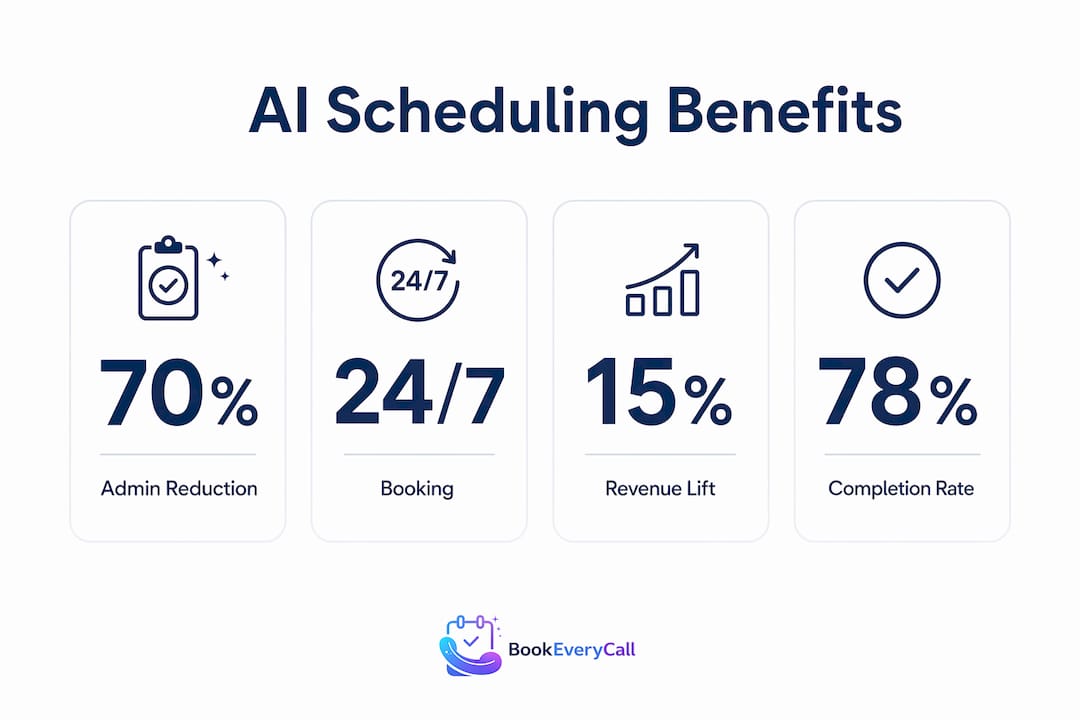
AI handles roughly 70% of scheduling enquiries without human involvement. For a sole trader or small team, this frees up hours each week that were previously spent answering calls, checking availability, and sending confirmation messages. A dental practice in Adelaide running 40 appointments per day could realistically recover two to three hours of receptionist time daily by deploying an automated scheduling solution.
Fewer no-shows and cancellations
Automated reminders sent via SMS or email before an appointment consistently reduce no-show rates. Research using Bayesian anti-scalping models shows that structured scheduling controls can lift appointment completion rates from 64.6% to 78.0%, cutting no-shows from 35.4% to 22.0%. That is a 13-percentage-point improvement in attendance, which translates directly into revenue for any service business charging by the appointment.
24/7 booking availability
Customers do not only decide to book during business hours. A homeowner in Perth searching for an electrician at 9pm on a Sunday will move on to the next available business if yours does not offer a way to book immediately. AI appointment booking removes this constraint entirely. Bookeverycall’s AI receptionist answers calls and books jobs around the clock, meaning a missed call at 11pm is no longer a lost customer.
Revenue recovery from missed calls
Missed calls are a direct revenue leak for Australian small businesses. Bookeverycall estimates that recurring missed calls can cost a business up to $312,000 annually when you account for the lifetime value of lost customers. The automated call booking benefits for Australian businesses extend beyond convenience. They represent a structural fix to a revenue problem that manual processes cannot solve after hours.
Pro Tip: Track your missed call rate for two weeks before implementing any AI scheduling tool. This gives you a baseline to measure actual revenue recovery once the system is live, and it makes the ROI case far easier to present to a business partner or accountant.
Here are the five core benefits Australian businesses report after adopting AI scheduling:
- Booking time cut dramatically. Simulated studies show AI reduces appointment booking time from over two hours to under six minutes in complex scheduling environments.
- No-show rates fall. Automated reminders and confirmation workflows reduce missed appointments by double-digit percentages.
- After-hours bookings captured. Customers book at times that suit them, not just when your office is staffed.
- Admin costs reduced. Fewer staff hours spent on phone-based scheduling means lower labour costs or redeployment to higher-value tasks.
- Customer experience improved. Faster booking confirmation and fewer errors build trust with first-time customers.
Traditional scheduling vs AI-driven systems: what is the real difference?
The gap between manual booking processes and AI-driven appointment management is wider than most business owners expect. The comparison below makes the distinction concrete.
| Factor | Traditional scheduling | AI-driven scheduling |
|---|---|---|
| Availability | Business hours only | 24 hours, 7 days a week |
| Booking speed | 5 to 15 minutes per call | Under 60 seconds per interaction |
| Human error rate | High (double bookings, missed details) | Low (calendar sync prevents conflicts) |
| No-show management | Manual follow-up calls | Automated SMS and email reminders |
| Scalability | Limited by staff headcount | Handles unlimited concurrent bookings |
| Cost per booking | High (staff time) | Low (automated after setup) |
Traditional phone-based booking creates three consistent problems for Australian businesses. First, calls during peak periods go unanswered, and most callers do not leave a voicemail. Second, staff manually entering booking details into calendars introduce errors, particularly when managing multiple service types or locations. Third, the process does not scale. Adding booking volume means adding staff, which adds cost.
AI scheduling addresses all three. End-to-end AI integration, from initial enquiry through to confirmed booking, achieves far greater efficiency than partial automation. A business that automates only the confirmation step but still takes bookings manually by phone captures a fraction of the available benefit. The full gain comes when the entire workflow, from first contact to calendar entry, runs without manual intervention.
Consider a real estate agency in Melbourne managing property inspection bookings across fifteen listings. A voice AI system can handle simultaneous inbound calls, check each property’s inspection schedule, match callers to available slots, and send confirmation messages, all without a receptionist. The same volume of work that previously required two staff members now runs automatically.
For tradies and service businesses using booking forms, the shift from paper-based or phone-only booking to AI-driven scheduling also reduces the friction that causes customers to abandon the booking process entirely.
How to implement AI appointment scheduling in your business
Adopting artificial intelligence scheduling is a structured process, not a plug-and-play installation. These steps apply whether you are a sole trader in Brisbane or a multi-location professional services firm in Sydney.
Step 1: Assess your current scheduling volume and pain points
Before selecting any tool, document how many appointments you book per week, how many calls go unanswered, and where errors most commonly occur. This baseline shapes every decision that follows. A business taking 20 calls per day has different requirements from one taking 200.
Step 2: Select a tool with the right integrations
Your AI scheduling tool must connect to the calendar system you already use. Google Calendar and Outlook integration via OAuth 2.0 is the current standard for reliable two-way sync. If you use a CRM like HubSpot or Salesforce, confirm the scheduling tool writes booking data back to customer records automatically.
Step 3: Configure intents, rules, and fallback behaviours
Proper AI voice agent setup requires defining booking intents (what types of appointments exist), calendar rules (buffer times, maximum daily bookings, service durations), and fallback behaviours for when the AI cannot complete a booking. Skipping this step produces a system that frustrates customers rather than serving them.
Step 4: Handle timezone settings explicitly
For Australian businesses operating across states, timezone handling is a genuine technical risk. Storing booking times in UTC and confirming the customer’s local timezone during the booking interaction prevents the kind of errors that result in a customer arriving an hour early or late. This matters particularly for businesses in Queensland (no daylight saving) serving customers in New South Wales or Victoria.
Step 5: Train staff and set KPIs
AI scheduling does not eliminate your team’s role. It changes it. Staff need to understand how to review AI-booked appointments, handle escalations the system cannot resolve, and interpret the performance data the system generates. Set KPIs from day one: booking conversion rate, no-show rate, after-hours bookings captured, and average time to confirm.
Pro Tip: Run your AI scheduling system in parallel with your existing process for the first two weeks. This lets you catch configuration errors before they affect customers, and it gives staff time to build confidence in the new workflow.
The table below outlines the key implementation decisions and what each one affects:
| Decision | What it affects |
|---|---|
| Calendar integration type | Double booking prevention and real-time accuracy |
| Timezone configuration | Booking accuracy across Australian states |
| Fallback behaviour setup | Customer experience when AI cannot complete a booking |
| Anti-scalping or abuse controls | No-show rates and appointment fairness |
| KPI tracking setup | Ability to measure and improve ROI over time |
Engageware’s platform, which has processed 1.5 billion appointments across banking and telecommunications clients, demonstrates that AI scheduling at scale requires governance controls, not just automation. For smaller Australian businesses, the equivalent is setting booking limits per customer, requiring confirmation steps, and monitoring for unusual patterns that suggest abuse of the booking system.
Key takeaways
AI appointment scheduling delivers its greatest value when the entire booking workflow is automated end-to-end, from first contact through to confirmed calendar entry, with real-time sync and structured governance controls in place.
| Point | Details |
|---|---|
| End-to-end automation wins | Partial automation captures a fraction of the efficiency gains available from full workflow integration. |
| Voice AI captures after-hours revenue | AI phone booking converts missed calls into confirmed jobs around the clock, recovering revenue that manual processes lose. |
| No-show rates are measurable and reducible | Structured reminders and scheduling controls can lift appointment completion rates by over 13 percentage points. |
| Timezone and calendar sync are non-negotiable | Two-way calendar sync and explicit timezone handling prevent the most common AI scheduling errors for Australian businesses. |
| Baseline measurement drives ROI proof | Tracking missed calls and booking conversion before implementation makes the business case for AI scheduling concrete and credible. |
Why most businesses underestimate what AI scheduling actually requires
I have worked with enough Australian business owners to know that the first instinct when evaluating AI scheduling tools is to focus on the front end. The voice sounds natural, the demo books an appointment in 40 seconds, and the decision feels straightforward. What gets underestimated almost every time is the configuration work that sits behind that 40-second demo.
The businesses that get the most out of AI appointment booking are the ones that invest time upfront in mapping their actual booking logic. Not the idealised version, but the real one. The one where a customer calls asking for “the same bloke who came last time,” or where a job in a certain suburb always takes 90 minutes instead of 60. AI systems handle these scenarios well when they are configured to handle them. They fail visibly when they are not.
The second thing I see underestimated is conversation design. A voice AI that books appointments efficiently but sounds robotic or cuts off mid-sentence creates a worse impression than no AI at all. The customer experience during the booking call is part of your brand. It deserves the same attention as your website or your quoting process.
The businesses I have seen get this right treat AI scheduling as an operational investment, not a software subscription. They monitor the data, they adjust the configuration when patterns change, and they use the time saved to focus their team on the work that actually requires human judgement. That is where the lasting value sits. Not in the technology itself, but in what your team does with the hours it gives back.
— Chay
How Bookeverycall handles appointment scheduling for Australian businesses
Bookeverycall’s AI voice receptionist answers inbound calls 24/7, qualifies the enquiry, and books the appointment directly into your calendar in real time. No hold music. No missed calls. No manual follow-up required.
The service is built specifically for Australian small businesses, including tradies, real estate agencies, medical and allied health clinics, and professional services firms. Whether you are a plumber in Sydney, an electrician in Melbourne, or a physio practice in Brisbane, Bookeverycall handles the scheduling so your team handles the work. The AI receptionist for small business integrates with your existing calendar and CRM, captures after-hours bookings, and sends automated confirmations. Businesses using the service recover up to $312,000 in annual revenue from calls that would otherwise go unanswered. Book a demo at bookeverycall.com to see it working with your actual booking workflow.
FAQ
What is the role of AI in appointment scheduling?
AI automates the entire booking workflow, from receiving a customer enquiry through to confirming a calendar entry, using machine learning, NLP, and voice AI. This removes manual steps, reduces errors, and makes booking available around the clock.
How much time does AI scheduling actually save?
Research shows AI can reduce appointment booking time by over 96%, with one study recording a drop from 155 minutes to under 6 minutes per booking cycle. The time saved scales with booking volume, making the benefit larger for high-demand businesses.
Can AI scheduling reduce no-show rates?
Yes. Automated reminders and structured scheduling controls can lift appointment completion rates from 64.6% to 78.0%, according to research using Bayesian scheduling models. That is a direct improvement in attended appointments and billable revenue.
Is AI appointment booking suitable for tradies and small businesses in Australia?
AI appointment booking is particularly well-suited to Australian tradies and small service businesses because they rely heavily on inbound calls and often miss bookings outside business hours. Voice AI answers those calls and books the job without requiring additional staff.
What should I check before choosing an AI scheduling tool?
Confirm the tool offers two-way calendar sync with Google Calendar or Outlook, supports your timezone requirements across Australian states, and includes fallback handling for calls the AI cannot complete. These three factors determine whether the system works reliably in practice, not just in a demo.
Permalink
Permalink