

TL;DR:
- Effective automated booking systems rely on seamless flow design, minimal intake questions, and precise confirmation sequences to maximize revenue and reduce no-shows. Businesses should implement real-time availability checks, robust webhook handling, and dedicated after-hours booking options, especially in Australian cities like Sydney and Melbourne. Treating automation as an ongoing process and balancing AI with human oversight are key to achieving reliable, high-conversion scheduling operations.
Automated booking system best practices are the design rules, technical standards, and operational habits that determine whether your scheduling software captures revenue or leaks it. Businesses using structured booking automation report fewer no-shows, less manual coordination, and higher customer satisfaction than those relying on phone-tag and manual calendars. This guide covers the core principles every Australian business owner needs, from building frictionless booking flows to managing webhooks and reminder sequences, with specific advice for businesses in Sydney and Melbourne.

1. automated booking system best practices start with flow design
The single guided path is the foundation of every effective booking system. A customer lands on your booking page, selects a time, and receives a confirmation. Every rule, buffer, and calendar conflict is handled behind the scenes. The customer never sees the complexity.
Poor flow design is the most common reason bookings stall. When customers hit unexpected questions, confusing time options, or unclear pricing mid-flow, they abandon. The fix is to automate every constraint the business needs and hide it from the customer entirely.
A well-designed booking flow works like this:
- Publish the booking page with rules already embedded (service duration, buffer time, lead-time windows)
- System reads calendars and surfaces only genuinely available slots
- Guest selects a time without needing to negotiate or call
- System creates the event, sends confirmations, and handles reschedule or cancel requests automatically
The goal is the shortest possible path from intent to confirmed booking. Every extra step costs you conversions.
Pro Tip: Test your booking flow on a mobile device across at least two different time zones before going live. Most booking drop-offs happen on mobile, and time zone errors are the most common complaint from interstate customers.
2. collect only the intake data you actually need
Intake forms are where many booking flows collapse. The rule is direct: only ask extra questions if the answers change how you prepare for the appointment. Nothing else belongs on the form.
A plumber booking an emergency callout does not need to know a customer’s preferred communication style. A cleaning business does need to know the number of bedrooms. The distinction matters because every additional field increases drop-off rate.
Keep your intake form to three fields or fewer for most service bookings. Name, contact number, and one service-specific question covers the majority of trades and professional services. If your business genuinely needs more detail, collect it in a post-booking confirmation email rather than blocking the initial reservation.
3. how confirmation sequences reduce no-shows and recover revenue
No-shows cause 10–25% revenue loss for service businesses. That figure represents real jobs cancelled, real time wasted, and real income that never arrives. The good news is that structured multi-touch confirmation sequences can cut no-shows by 40–60% and lift appointment revenue by 20–35%.
Reducing no-shows is a sequence design challenge, not a volume challenge. Sending more reminders does not work. Sending the right reminder at the right moment does. The highest-impact touch point is an interactive confirmation at T-1 (one day before the appointment), delivered via voice AI or smart SMS.
A proven confirmation sequence looks like this:
- T-7 (seven days out): Booking confirmation with full appointment details and a calendar link
- T-2 (two days out): Reminder with a direct reschedule or cancel link to free the slot for waitlisted customers
- T-1 (one day out): Interactive confirmation requesting a yes or no response, ideally via voice AI or two-way SMS
“Interactive confirmation at T-1 is the single highest-impact step in any no-show reduction strategy. A customer who actively confirms is far more likely to show up than one who simply received a passive reminder.”
Waitlist automation adds a second layer of protection. When a cancellation comes in at T-2 or T-1, the system automatically contacts the next person on the waitlist and fills the slot. This turns a potential revenue loss into a recovered booking with no manual effort.
Pro Tip: Cap your reminder sequence at three touches. Customers who receive four or more reminders before a single appointment report higher cancellation rates, not lower ones. Frequency creates friction.
4. why real-time availability checks prevent overbooking
Real-time availability confirmation at the booking moment is non-negotiable for any business running multiple staff, locations, or service types. A customer who selects a time during a search is not guaranteed that slot. Availability must be re-checked at payment to prevent double bookings.
The correct architecture follows a two-phase approach:
| Phase | Action | Purpose |
|---|---|---|
| Search phase | Display available slots based on current calendar data | Show customer realistic options |
| Booking phase | Re-check availability before payment is processed | Prevent overbooking from concurrent sessions |
| Payment phase | Recalculate price including taxes and fees | Confirm exact charge before capture |
| Confirmation phase | Atomically decrement inventory and send confirmation | Lock the slot and notify all parties |
Price recalculation at booking moment matters as much as availability. Customers who see one price during search and a different total at checkout abandon at high rates. Build your system to display the final price, including GST and any service fees, before the customer enters payment details.
Atomic inventory decrement is the technical term for locking a slot the instant payment is confirmed. Without it, two customers booking simultaneously can both receive confirmations for the same slot. This is a solvable problem with the right system architecture, and it is not optional for businesses with high booking volumes.
Pro Tip: Monitor your payment failure rate and form error rate weekly. A spike in either metric usually signals a friction point in your booking flow that is costing you confirmed appointments.
5. technical reliability: webhooks and state machines
Back-end reliability separates booking systems that work under pressure from those that fail at the worst moment. Two technical practices determine most of this reliability: idempotent webhook handling and reservation state machines.
Webhook idempotency means your system processes each booking event exactly once, even if the webhook fires multiple times. Payment processors and calendar integrations regularly send duplicate webhook events. Without idempotency checks, you end up with duplicate bookings, double charges, and confirmation emails sent twice.
The correct approach uses unique event IDs:
- Assign a unique ID to every webhook event at the point of origin
- Store processed IDs in your database with a time-to-live (TTL) expiry
- Check the ID before processing any incoming event
- Return a 200 OK response to duplicate events without reprocessing them
- Use exponential backoff for failed deliveries rather than immediate retries
- Route undeliverable events to a dead letter queue for manual review
Reservation state machines address a different class of problem. A booking that exists as a single status flag (“booked” or “not booked”) breaks under edge cases: partial payments, concurrent modifications, and cancellation-then-rebook sequences. Explicit state transitions through defined states (pending hold, confirmed, cancelled) prevent these inconsistencies.
Separate workflows for confirmation and reschedule steps add a further layer of protection. Policy-sensitive changes, such as same-day cancellations or bookings that affect prepaid deposits, should escalate to a human reviewer rather than processing automatically. Automation handles the routine. Humans handle the exceptions.
Pro Tip: Set up a webhook success rate dashboard and review it weekly. A success rate below 98% means events are being lost, and lost events mean missed bookings or failed payments you will not find out about until a customer complains.
6. booking automation for sydney and melbourne businesses
Sydney and Melbourne businesses face specific booking challenges that generic scheduling advice does not address. Both cities have high volumes of after-hours service requests, customers who expect same-day responses, and competitive markets where a missed call goes straight to a competitor.
The benefits of automated call booking are particularly pronounced for trades, professional services, and cleaning businesses in these markets. A plumber in Melbourne’s inner suburbs who misses a call at 7pm on a Friday loses that job. An electrician in Sydney’s western suburbs who has no after-hours booking option loses to whoever picks up first.
Key considerations for Australian metropolitan businesses:
- After-hours coverage: Sydney and Melbourne customers regularly book outside business hours. Your system must accept bookings 24/7 without requiring staff availability.
- Time zone clarity: Businesses serving clients across Australian states need booking pages that display times in the customer’s local time zone, not just AEST.
- Local payment methods: Support for BPAY, PayID, and standard Australian card processing builds trust with local customers who are cautious about unfamiliar checkout flows.
- Emergency booking paths: Trades businesses in both cities need a separate fast-track booking option for urgent jobs. A standard three-step flow is too slow for a burst pipe at 10pm. Emergency job booking requires a dedicated one-step path.
- SMS over email for reminders: Australian customers respond to SMS at significantly higher rates than email for appointment confirmations. Build your reminder sequence around SMS as the primary channel.
AI-driven scheduling automation handles these constraints automatically when configured correctly. It respects resource availability, SLA windows, buffers, lead times, and cancellation rules without requiring manual oversight for every booking. For a busy tradie in Brisbane or a property manager in Perth, that level of automation is the difference between a full calendar and a half-empty one.
Key takeaways
Effective automated booking system best practices combine guided flow design, timed confirmation sequences, real-time availability checks, and reliable back-end architecture to maximise captured revenue and minimise manual effort.
| Point | Details |
|---|---|
| Design the shortest booking path | Automate all rules behind the scenes so customers move from selection to confirmation without friction. |
| Use a three-touch reminder sequence | Send confirmations at T-7, T-2, and T-1 with interactive confirmation at T-1 for the highest no-show reduction. |
| Re-check availability at payment | Confirm slot availability and final price including GST immediately before processing payment to prevent overbooking. |
| Implement idempotent webhooks | Use unique event IDs to prevent duplicate bookings and double charges from repeated webhook deliveries. |
| Prioritise after-hours coverage | Australian businesses in Sydney and Melbourne lose significant revenue to missed after-hours calls without 24/7 booking capability. |
Where most businesses get booking automation wrong
I have seen a lot of Australian businesses invest in booking software and then wonder why their no-show rate barely moves and their calendar still has gaps. The problem is almost never the software. It is the configuration.
Most operators set up a booking page, add a confirmation email, and call it done. They skip the T-1 interactive confirmation because it feels like extra work to set up. They leave their intake form with eight questions because they copied it from their old paper form. They never check their webhook success rate because they did not know it was a metric worth watching.
The businesses that get real results from booking automation treat it as an ongoing system, not a one-time setup. They review their drop-off points monthly. They test their reminder sequences against actual no-show data. They separate their emergency booking path from their standard flow because they understand that a burst pipe at 10pm is a different customer need than a routine service call.
The other thing I would push back on is the idea that more automation always means less human involvement. The best systems I have seen use AI appointment scheduling for the routine work and escalate to a human for anything policy-sensitive. That balance is what keeps customers satisfied when something goes wrong, and something always goes wrong eventually.
If you are running a trades business, a cleaning operation, or a professional services firm in Australia, the single highest-return change you can make right now is adding an interactive T-1 confirmation to your reminder sequence. Do that before you change anything else.
— Chay
How Bookeverycall helps australian businesses capture more bookings
Missed calls are the most expensive problem most Australian small businesses are not measuring. Bookeverycall operates as a fully managed AI voice receptionist that answers calls 24/7, qualifies enquiries, and books jobs directly into your calendar. For trades, real estate, and cleaning businesses, that means no more lost revenue from after-hours calls or peak-time overflow.
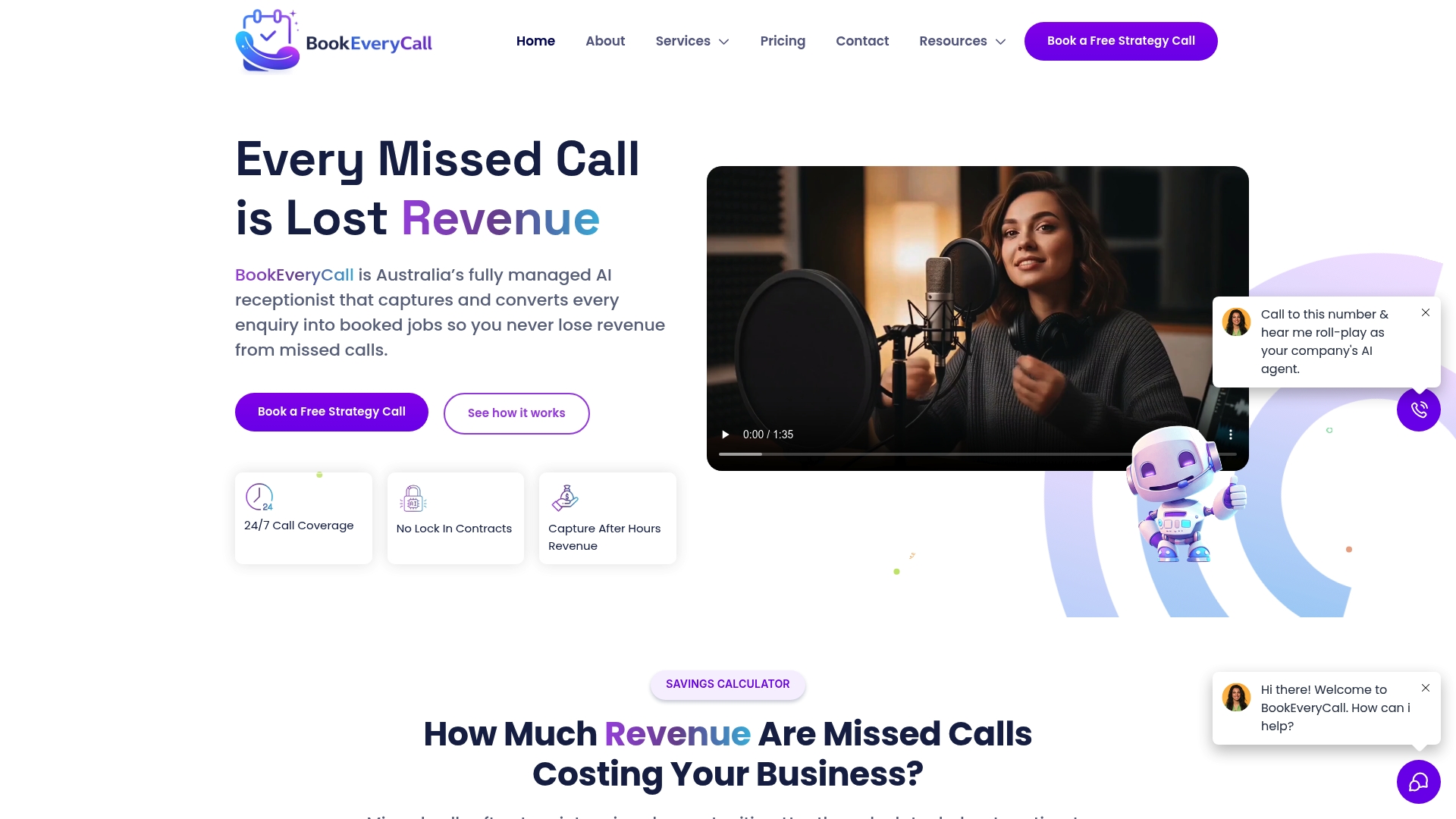
Bookeverycall’s missed call AI captures enquiries that would otherwise go to a competitor, with businesses recovering up to $312,000 annually from calls that previously went unanswered. Whether you run an HVAC business in Melbourne or a cleaning company in Sydney, Bookeverycall connects the best practices in this guide to a working system you can deploy today. Visit bookeverycall.com to book a strategy call and see what your missed calls are actually costing you.
FAQ
What is an automated booking system?
An automated booking system is software that accepts, confirms, and manages appointments without manual staff involvement. It reads calendar availability, enforces business rules, and sends confirmation sequences automatically.
How do automated booking systems reduce no-shows?
Structured confirmation sequences that include an interactive T-1 confirmation via voice AI or SMS can cut no-shows by 40–60%. Passive email reminders alone produce far weaker results.
What causes double bookings in automated systems?
Double bookings occur when availability is not re-checked at the payment moment, or when webhook events are processed more than once. Idempotent webhook handling with unique event IDs prevents duplicate processing.
How should sydney and melbourne businesses handle after-hours bookings?
Both cities have high volumes of after-hours service requests. Businesses need a 24/7 booking path, SMS-based reminders, and a separate fast-track flow for emergency jobs. An AI receptionist covers all three without requiring staff to be on call.
How many questions should a booking intake form include?
Keep intake forms to three fields or fewer for most service bookings. Only ask additional questions if the answers directly change how you prepare for the appointment. Every extra field increases drop-off rate.
Permalink