

TL;DR:
- ChatGPT ads are sponsored cards beneath AI responses that target users through conversational context, not keywords. Early data shows high click-through rates and relevance-driven performance, especially for high-consideration service categories in Australia. Success depends on proper targeting, tracking, and integrating lead capture systems like AI receptionists for optimal ROI.
ChatGPT ads are sponsored placements displayed as clearly labelled cards beneath AI-generated responses, targeting users through natural language conversational context rather than keyword lists. OpenAI launched its self-serve Ads Manager beta in 2026, allowing businesses of all sizes to run cost-per-click and cost-per-mille campaigns with conversion tracking built in. This channel reaches users at the precise moment they are articulating a problem and seeking a recommendation, which makes it fundamentally different from search or social advertising. For Australian digital marketers and business owners, understanding how ChatGPT ads work now, before the platform matures and competition intensifies, is a genuine first-mover opportunity.
How do ChatGPT ads work?
ChatGPT ads operate on a model that is structurally different from anything Google Ads or Meta has offered. Ads appear clearly labelled beneath the AI-generated answer, never embedded within the response text itself. This separation preserves the integrity of the organic answer while giving advertisers a visible, trusted placement directly below content the user has just engaged with.
Targeting does not use keyword lists. Instead, advertisers write short natural language descriptions called “context hints” that describe the type of conversation in which their ad should appear. A plumbing supply company might write: “User is asking about fixing a burst pipe or finding a licensed plumber in Sydney.” OpenAI’s system matches that description to live conversations using contextual targeting signals, not user-level data or stored chat transcripts.
This distinction matters for privacy-conscious Australian audiences. Advertisers receive only aggregated metrics. No individual user data, no conversation transcripts, and no personal identifiers are accessible through the platform. Users on Free and Go tiers see ads; Plus and Business subscribers do not. Users can also manage their ad preferences and dismiss individual ads, which keeps the experience from feeling intrusive.
The practical implications for campaign setup are significant:
- Context hints replace keyword research. Write them as natural descriptions of the conversation, not as search terms.
- Ad creative must work as a standalone card. There is no surrounding editorial context to support it.
- Budget allocation should account for the fact that premium-tier users are excluded from the ad pool entirely.
- Conversion tracking requires installing the OpenAI pixel or connecting via the Conversions API before launching.
- Campaign objectives split into brand awareness (CPM) and direct response (CPC), and these should be run as separate campaigns with distinct budgets.
Pro Tip: Write at least five context hint variations per ad group and test them in rotation. Because you cannot see which conversations triggered your ad, broader hint variety gives the algorithm more matching opportunities early in the campaign.
What are the performance metrics for ChatGPT ads?
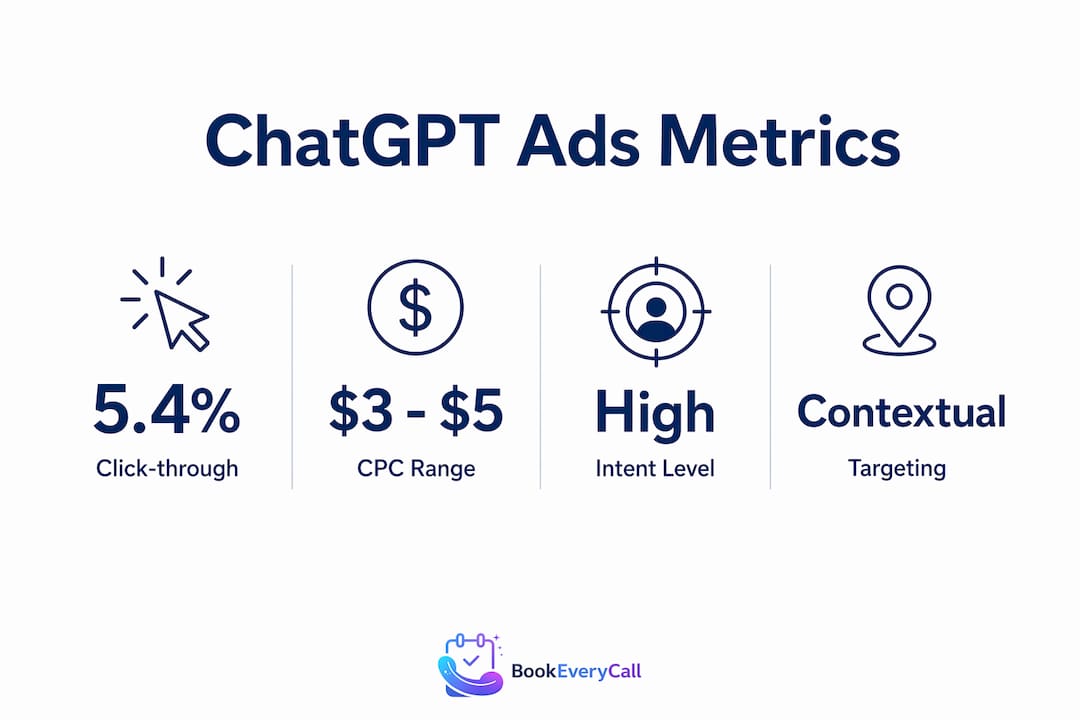
The early performance data from ChatGPT ads is genuinely striking. Click-through rates reach up to 5.4%, which outperforms industry averages for display advertising and podcast sponsorships. The median brand-level CTR sits around 0.5%, with the top quartile reaching 1%. That spread tells you the channel rewards relevance aggressively. Ads that match the conversational moment tightly perform well above average; generic placements fall to the median.
Cost structures are still forming. CPC rates currently start at US$3 to US$5, and CPM pricing is evolving as inventory grows. For Australian advertisers, converting those figures at current exchange rates means CPC campaigns are broadly comparable to mid-tier Google Search placements, but with a user who has already described their problem in detail rather than typed three words into a search bar.
| Metric | ChatGPT ads | Display advertising |
|---|---|---|
| Peak CTR | 5.4% | Under 1% |
| Median CTR | 0.5% | 0.1% |
| CPC start range | US$3 to US$5 | Varies widely |
| User intent signal | High (conversational) | Low to medium |
| Attribution model | Aggregated channel-level | User-level available |
Conversion tracking works through the OpenAI pixel and Conversions API, which lets you measure sign-ups, purchases, and lead form completions. Attribution is channel-level rather than user-level, which means you will know that ChatGPT ads drove conversions but not which specific user or conversation triggered the action. CPA bidding is on OpenAI’s roadmap, which will make direct response campaigns significantly easier to optimise.
“Conversational ads are strongest in high-consideration, research-heavy categories where users explicitly articulate problems seeking recommendations.” — Spicy Advisory, 2026
For Australian service businesses, this is a direct signal. Tradies, financial advisers, healthcare providers, and legal services all operate in exactly these high-consideration categories. A user asking ChatGPT “how do I find a reliable electrician in Melbourne” is a warmer lead than almost any search or social touchpoint.
How do ChatGPT ads compare to Google and social media ads?
The most important structural difference between ChatGPT ads and Google Search ads is the targeting unit. Google targets individual keyword queries, typically two to five words. ChatGPT ads target the entire conversational context, which may span multiple exchanges and include nuanced problem descriptions. A user who has spent three minutes explaining their situation to ChatGPT before seeing your ad has given the platform far more signal than a user who typed “plumber near me” into Google.

That depth of context produces higher intent impressions but lower volume. ChatGPT’s user base, while large, is smaller than Google’s search volume. Advertisers should expect fewer impressions per dollar than on Google or Meta, but with a meaningfully higher proportion of those impressions reaching users in active research mode.
Compared to social media advertising, ChatGPT ads offer greater transparency on placement. You know your ad appears beneath an AI answer, not buried in a feed between unrelated content. The trade-off is attribution. Social platforms offer granular user-level tracking; ChatGPT ads currently offer aggregated channel-level data only.
| Platform | Targeting unit | Attribution | Intent level | Ad format |
|---|---|---|---|---|
| ChatGPT ads | Conversational context | Channel-level | Very high | Labelled card below answer |
| Google Search | Keywords | User-level | High | Text ad above/below results |
| Meta (Facebook/Instagram) | Audience segments | User-level | Low to medium | Feed, story, reel placements |
| Google Display | Audience and context | User-level | Low | Banner across publisher sites |
Pro Tip: Do not treat ChatGPT ads as a replacement for Google Search. Run them as a complementary channel targeting the research and consideration phase, while Google Search captures users ready to act. The two channels cover different moments in the same buying journey.
Effective campaign structure separates organic AI presence, which is generative engine optimisation, from paid placements to maximise visibility without cannibalising either channel. If your brand already appears in organic ChatGPT responses, paid ads give you a second touchpoint in the same conversation.
What are best practices for setting up ChatGPT ad campaigns in Australia?
Setting up a ChatGPT ad campaign that actually performs requires a different mindset from traditional paid search. The following steps reflect what is working for early adopters in 2026.
Write context hints in plain conversational language. Describe the user’s situation, not your product. “User is researching home loan options and comparing lenders in Brisbane” outperforms “home loans Brisbane.” The system matches on conversational signals, so write the hint the way a user would speak.
Build a ChatGPT Project with brand context documents. Grounding your campaign with structured offer documents, persona descriptions, and tone guidelines reduces generic output and produces ad creative that reflects your actual brand voice. This is the difference between copy that converts and copy that reads like it was written for no one in particular.
Separate CPM and CPC campaigns from the start. Brand awareness and direct response have different success metrics. Mixing them in one campaign makes optimisation impossible. Run CPM campaigns to build recognition in relevant conversational contexts, and CPC campaigns to drive specific actions like booking a call or requesting a quote.
Install the OpenAI conversion pixel before launch. Pixel and API tracking must be in place before your campaign goes live. Retroactive attribution is not available. Connect the pixel to your existing analytics stack and set up UTM parameters on all destination URLs so you can segment ChatGPT ad traffic in Google Analytics 4 or your preferred reporting tool.
Use UTM parameters consistently. Tag every ad with source, medium, campaign, and content parameters. Because attribution is channel-level within OpenAI’s platform, UTM data in your own analytics is the most granular view you will get of which creative and context combinations drive results.
Adapt creative to the format constraints. ChatGPT ad cards are modest in size. A clear headline, one sentence of supporting copy, and a direct call to action is the right structure. There is no room for brand storytelling in the ad unit itself. Save that for the landing page.
Run A/B tests on context hints and headlines simultaneously. Because the platform optimises over aggregated metrics, you need enough volume to read results. Set a minimum test period of three weeks before drawing conclusions, and change only one variable at a time.
For Australian businesses targeting specific cities, context hints should include location signals. A Melbourne-based air conditioning installer might write: “User is asking about ducted air conditioning installation or quotes in Melbourne or Victoria.” City-level specificity in your hints improves match quality and reduces wasted impressions on users outside your service area.
Missed call costs for Australian businesses are a real and measurable problem, particularly for tradies and service businesses running paid campaigns. Driving traffic from ChatGPT ads to a phone number that goes unanswered is a direct loss on your ad spend. Build the full lead capture pathway before you start spending.
Pro Tip: Check your landing page load speed on mobile before launching any ChatGPT ad campaign. A user clicking from a ChatGPT conversation is on mobile more often than not. A slow landing page will kill your conversion rate regardless of how well your ad performs.
How do Australian SMEs and tradies benefit from ChatGPT ads?
For small and medium businesses in Sydney, Melbourne, Brisbane, Perth, and Adelaide, ChatGPT ads offer something that most digital advertising channels do not: access to users who have already described their problem in detail. A tradie running ads on Meta is interrupting someone scrolling through photos. A tradie running ChatGPT ads is reaching someone who has just typed “I need a licensed electrician in Perth for a switchboard upgrade.” That is a categorically different conversation to enter.
The benefits for Australian SMEs and tradespeople are concrete:
- Higher intent per impression. Users on ChatGPT are in research or decision mode. The conversational format filters out passive browsers.
- Lower competition in 2026. Most Australian small businesses are not yet running ChatGPT ads. Early movers face less auction competition and lower effective CPCs.
- City-level targeting through context hints. A plumber in Brisbane can write hints that reference Brisbane suburbs and local problem types, reaching users in their exact service area.
- Complementary to AI receptionist services. ChatGPT ads drive inbound enquiries. An AI voice receptionist captures those enquiries 24/7, including after hours when most tradies are on the tools and cannot answer the phone.
The economic case is straightforward. Australian businesses lose substantial revenue from missed calls, particularly in the tradie and service sectors where customers often call multiple providers and book the first one who answers. Running ChatGPT ads without a reliable call answering system in place means paying to generate leads you then fail to capture. The synergy between AI advertising and AI-powered lead capture is where the real return on investment sits for local businesses.
Conversational AI for Australian businesses is no longer a technology experiment. It is a practical operational tool that connects the moment a customer decides they need help to the moment they book a job.
Key takeaways
ChatGPT ads deliver the highest return when paired with a complete lead capture system, because high-intent traffic is only valuable if your business can answer when the customer calls.
| Point | Details |
|---|---|
| Contextual targeting replaces keywords | Write context hints as natural conversation descriptions, not search terms. |
| CTR outperforms display advertising | Peak CTR reaches 5.4%, driven by high user intent in conversational moments. |
| Attribution is channel-level only | Install the OpenAI pixel before launch and use UTM parameters for granular tracking. |
| Separate CPM and CPC campaigns | Brand awareness and direct response require distinct budgets and success metrics. |
| Lead capture must match ad investment | AI receptionist services prevent missed calls from converting ChatGPT ad spend into lost revenue. |
Why I think most marketers are approaching ChatGPT ads backwards
The most common mistake I see Australian marketers make with ChatGPT ads is treating them like a smarter version of Google Search. They write context hints that read like keyword lists, set up a single campaign with a mixed objective, and then judge the channel after two weeks of thin data. That is not a fair test, and it is not how this channel works.
ChatGPT ads perform best in the consideration phase of a buying journey, not at the bottom of the funnel. The user is still forming their decision. Your ad needs to give them a reason to choose you at that moment, not just confirm that you exist. That requires a different creative brief, a different landing page, and a different definition of success than a Google Search campaign.
The other thing I would push back on is the assumption that AI handles everything once the campaign is live. Human oversight of final creative and legal review remains non-negotiable. AI-drafted copy can be generic, off-brand, or legally problematic in regulated industries. The platform automates distribution; it does not automate judgement.
My honest recommendation for Australian marketers in 2026 is to allocate a modest test budget, perhaps $1,500 to $3,000 AUD per month, run it for six weeks with proper tracking in place, and measure incrementality against your existing channels. The platform is evolving fast. CPA bidding and third-party measurement are coming. Getting your campaign structure right now means you will be positioned to scale when those tools arrive.
— Chay
Turn your ChatGPT ad traffic into booked jobs with Bookeverycall
Running ChatGPT ads generates high-intent enquiries from users who have already described exactly what they need. The question is whether your business is set up to capture every one of those calls when they come in. Bookeverycall operates as a fully managed AI voice receptionist that answers calls 24/7, qualifies enquiries, and books appointments directly into your calendar. For Australian tradies and SMEs in Sydney, Melbourne, Brisbane, Perth, and Adelaide, this means no lead from your ad spend goes unanswered. Australian businesses can recover up to $312,000 annually in lost revenue from missed calls. Book a strategy call today and see how Bookeverycall connects your ChatGPT advertising to real booked jobs.
FAQ
What are ChatGPT ads?
ChatGPT ads are clearly labelled sponsored cards that appear beneath AI-generated responses in ChatGPT, targeting users based on the conversational context of their session rather than keywords. They are available to Free and Go tier users only; Plus and Business subscribers see no ads.
How much do ChatGPT ads cost in Australia?
CPC rates start at approximately US$3 to US$5 per click, with CPM pricing evolving as inventory grows. Australian advertisers should convert these figures at current exchange rates and factor them into campaign budgets alongside existing paid search and social spend.
How is ChatGPT ad targeting different from Google Ads?
ChatGPT ads use natural language “context hints” to match ads to entire conversational contexts, while Google Ads targets individual keyword queries. This gives ChatGPT ads access to richer intent signals but produces lower impression volumes than search advertising.
Can I track conversions from ChatGPT ads?
Yes. The OpenAI pixel and Conversions API allow advertisers to track sign-ups, purchases, and leads. Attribution is channel-level rather than user-level, so UTM parameters in your own analytics platform are the best tool for granular campaign analysis.
Are ChatGPT ads worth it for small businesses in Sydney or Melbourne?
ChatGPT ads are particularly well suited to high-consideration service categories, including trades, professional services, and home improvement, where users articulate specific problems. For Sydney and Melbourne businesses with a reliable lead capture system in place, the high intent per impression makes this channel worth testing in 2026.