

TL;DR:
- Conversational AI understands natural language, remembers context, and completes tasks beyond simple chatbots. It enables small Australian businesses to handle calls around the clock, capturing missed revenue and improving customer experience. The hybrid approach, combining AI and human agents, enhances service efficiency while maintaining high-quality customer interactions.
Most business owners have heard the term “conversational AI” and assumed it just means a fancier chatbot. That assumption is costing them customers. What is conversational AI explained properly? It is a technology that understands natural human language, remembers context across a conversation, and responds in ways that feel genuinely useful rather than scripted. Unlike the basic bots that frustrate callers with rigid menus, true conversational AI interprets intent, handles follow-up questions, and completes tasks like booking appointments or qualifying leads. For Australian businesses losing revenue to missed calls every day, understanding this technology is the first practical step toward doing something about it.
Table of Contents
- Key takeaways
- What is conversational AI explained: the technology underneath
- Conversational AI vs traditional chatbots
- Conversational AI applications across Australian industries
- The contact centre shift: AI and human agents together
- Deploying conversational AI in Australian cities
- My take: stop treating AI as a cost cutter
- How Bookeverycall puts this into practice
- FAQ
Key takeaways
| Point | Details |
|---|---|
| More than a chatbot | Conversational AI uses NLP, memory, and dialogue management to hold context-aware, multi-turn conversations. |
| Built on layered technology | Multiple coordinated components including NLU, NLG, and backend integration work together in real time. |
| Real business value locally | Australian tradies, clinics, and small businesses use AI voice receptionists to capture calls and book jobs 24/7. |
| Hybrid models outperform pure automation | Combining AI for routine tasks with human agents for complex cases delivers better outcomes than either alone. |
| Memory is the difference maker | Tying conversation context to customer profiles prevents cold starts and keeps interactions relevant across channels. |
What is conversational AI explained: the technology underneath
The industry term for this technology is conversational AI, and it sits well above the scripted decision trees most people picture when they hear “chatbot.” At its core, conversational AI enables machines to understand, process, and respond to human language naturally through a combination of natural language processing (NLP), machine learning, and dialogue management working in concert.
To understand how it actually functions, it helps to break the architecture into its key layers.
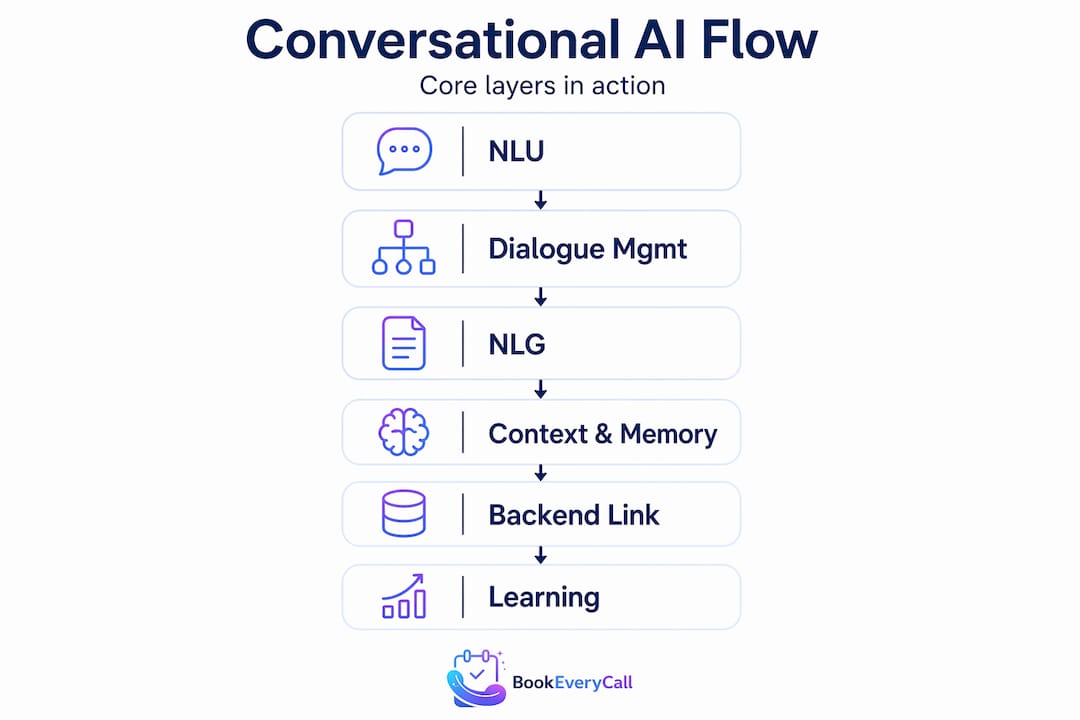
Natural language understanding (NLU) is where the system interprets what the user actually means, not just what they typed or said. If a customer calls a plumber in Brisbane and says “my hot water’s been playing up since yesterday morning,” NLU extracts the intent (service request) and the entities (hot water system, timeframe). The system does not need the customer to say “I would like to book a hot water repair.”
Dialogue management tracks the state of the conversation as it progresses. This is what allows the AI to ask a relevant follow-up question rather than starting from scratch every time the user speaks. Conversational AI architecture involves multiple coordinated layers working together in real time to enable exactly this kind of multi-turn, context-aware exchange.
Natural language generation (NLG) handles the response side. Once the system knows what the user wants and what it needs to say, NLG produces a reply that sounds natural rather than robotic.
Memory and context retrieval is where things get genuinely sophisticated. A well-built system does not treat each message as an isolated event. It pulls relevant history from the customer’s profile and injects it at the start of the interaction. Effective memory systems tie conversation context directly to the customer profile, keyed by phone number or account, enabling continuity across multiple channels and even multiple days.
Backend integration is the final layer that makes conversational AI genuinely useful for business. The AI connects to calendars, booking systems, CRMs, and databases to complete tasks in real time rather than just providing information.
The machine learning component is what separates conversational AI from static software. Every interaction generates data that the system uses to improve its intent recognition and response quality over time. A voice AI handling calls for a Sydney electrician gets measurably better at understanding the specific language that electrician’s customers use.
Pro Tip: When evaluating any conversational AI platform, ask specifically how it handles multi-turn conversations. If the vendor cannot explain their dialogue management and memory architecture clearly, the product is likely a sophisticated chatbot rather than true conversational AI.
For voice-based applications, the pipeline adds two more steps. Conversational AI voice systems use speech-to-text to convert spoken input, pass it through the reasoning layers, then convert the response back to speech via text-to-speech technology. The entire process runs in near real time, which is why a well-built AI voice receptionist can hold a natural phone conversation without noticeable lag.
Conversational AI vs traditional chatbots
The distinction matters because businesses that deploy basic chatbots expecting conversational AI results end up with frustrated customers and wasted budgets. Here is a direct comparison.
| Feature | Traditional chatbot | Conversational AI |
|---|---|---|
| Language understanding | Keyword matching and decision trees | NLU with intent and entity extraction |
| Context retention | None across turns | Full multi-turn memory tied to customer profile |
| Handling unexpected input | Falls back to default or fails | Interprets and responds to novel phrasing |
| Task completion | Provides information only | Connects to backend systems to complete actions |
| Learning over time | Static rules | Improves through machine learning |
| Voice capability | Limited or none | Full speech-to-text and text-to-speech pipeline |
A traditional chatbot on a tradie’s website might answer “What are your hours?” with a canned response. A conversational AI system on the same website can understand “Can someone come out this arvo?” as an urgent booking request, check the calendar, confirm availability, collect the customer’s address, and lock in the job. That is not a marginal improvement. It is a fundamentally different capability.
The real-time coordination of multiple AI components is what makes this possible. Without that orchestration layer managing turn-taking, context, and tool calling, conversations degrade quickly into disconnected exchanges that frustrate users rather than serve them.
Pro Tip: Before signing up for any AI receptionist or chatbot service, ask the vendor to demonstrate a multi-turn conversation where the customer changes their mind mid-booking. How the system handles that scenario tells you everything about its actual capability.
For a deeper look at how these two technologies compare in a local context, the AI voice agent vs virtual receptionist breakdown covers the practical differences for Australian businesses specifically.
Conversational AI applications across Australian industries
The benefits of conversational AI become concrete when you look at what it is actually doing for Australian businesses right now. The applications span well beyond customer service desks.
Tradies and field service businesses in Melbourne, Brisbane, and Perth are using AI voice receptionists to answer calls after hours, qualify the job type, and book appointments directly into their scheduling software. A plumber who misses three calls on a Saturday is not just losing those three jobs. Repeat callers who go unanswered rarely call back. The AI receptionist for tradies model addresses this directly.
Medical and allied health clinics across Sydney and Adelaide use conversational AI to handle appointment bookings, cancellations, and basic triage questions without tying up reception staff. The AI handles the routine volume so staff can focus on patients in the room.
Real estate agencies use AI to qualify inbound enquiries on rental listings, collect applicant details, and schedule inspections. A property manager in Perth handling 200 listings cannot personally answer every call at 7pm on a Sunday.
Small retail and hospitality businesses use conversational AI across chat, SMS, and phone to answer product queries, process simple orders, and manage reservations.
The numbers behind these applications are significant. Conversational commerce currently handles 31% of ecommerce customer interactions, with expectations to approach 50% within two years. The best-performing businesses use AI for routine queries and route complex cases to human staff. That balance is the model worth replicating.
For Australian small businesses specifically, the missed call problem is the most immediate pain point. A business missing five calls per week at an average job value of $400 loses over $100,000 annually in potential revenue. An AI answering service for small business solves this without the overhead of a full-time receptionist.
The conversational AI analyses user input for intent and entities, then draws from backend systems to generate personalised responses. For a tradie, that means the AI can tell a caller “We have a slot available Thursday at 2pm in your area. Can I lock that in for you?” rather than just taking a message.
The contact centre shift: AI and human agents together
One of the most persistent fears about conversational AI is that it eliminates jobs. The data does not support that conclusion, at least not in the way most people expect.
A 2026 Gartner survey found that 85% of service leaders are expanding human agent responsibilities, while only 31% plan any layoffs through AI adoption by 2027. AI is reducing contact volume for simple queries and shifting agent roles toward higher-value tasks that require judgement and empathy.
“Rather than eliminating jobs, AI adoption is mostly redefining and expanding service roles, creating hybrid models where human empathy and judgement complement AI efficiency.”
This is the hybrid model that actually works in practice. The AI handles the high-volume, repeatable interactions. Booking confirmations, status updates, basic FAQs, after-hours calls. Human agents handle escalations, complaints, and situations where a customer needs to feel genuinely heard.
The economics of this model are worth understanding clearly. Generative AI cost per resolution may exceed $3 by 2030, which is higher than offshore human agents. That figure sounds alarming until you consider what the AI does that an offshore agent cannot. It answers at 2am. It never has a bad day. It integrates directly with your booking system and completes the transaction rather than taking a message.
| Model | Best suited for | Key advantage |
|---|---|---|
| AI only | High-volume, routine queries | 24/7 availability, consistent quality |
| Human only | Complex, emotional, high-stakes interactions | Empathy, judgement, relationship building |
| Hybrid AI + human | Most real-world service environments | Efficiency at scale with quality where it counts |
The takeaway for Australian business owners is straightforward. Focus on outcomes like customer effort reduction and resolution quality rather than treating AI purely as a cost-cutting exercise. A business that recovers $312,000 in previously missed revenue is not doing that by cutting costs. It is doing it by capturing value that was already there.
Deploying conversational AI in Australian cities
Understanding the technology is one thing. Getting it working well in your business is another. Here are the practical steps that matter most for Australian businesses across Sydney, Melbourne, Brisbane, Perth, and Adelaide.
Map your highest-volume, repeatable interactions first. For a Brisbane electrician, that is probably after-hours booking calls. For a Sydney property manager, it is rental enquiries on new listings. Start where the volume is highest and the interaction is most predictable.
Treat memory as a customer profile, not a chat log. Conversation memory tied to customer profiles avoids cold starts and keeps interactions relevant. When a returning customer calls your Melbourne clinic, the AI should already know their name and last appointment. That is not a luxury feature. It is the baseline for a decent customer experience.
Integrate with your existing booking and CRM systems before launch. Conversational AI that cannot complete a transaction is just a sophisticated message-taking service. The value comes from the AI actually booking the job, not just noting the request.
Set clear escalation paths to human staff. Define the scenarios where the AI hands off to a person. Complaints, medical questions, and large-value jobs are common examples. The handoff should be smooth, with full context passed to the human agent.
Monitor conversation transcripts weekly in the first month. You will quickly spot patterns where the AI is misunderstanding intent or giving unhelpful responses. These are fixable, but only if you are looking.
Pro Tip: In Adelaide and Perth especially, where small business communities are tight-knit, the tone of your AI voice receptionist matters as much as its accuracy. A system that sounds warm and local will convert better than one that sounds like a generic automated service. Test your AI’s voice and phrasing with a few real customers before full deployment.
Conversation orchestration and memory management are the infrastructure elements that keep AI-driven dialogues coherent across multiple turns and channels. Without them, conversations degrade into disconnected exchanges that leave customers more frustrated than if they had just left a voicemail. Choosing a platform that handles orchestration well is not a technical nicety. It is the difference between an AI that wins customers and one that loses them.
My take: stop treating AI as a cost cutter
I have watched a lot of Australian businesses approach conversational AI with one question in mind: “How much will this save me?” That framing leads to bad decisions almost every time.
In my experience, the businesses that get the most out of conversational AI are the ones that ask a different question: “What revenue am I currently leaving on the table?” A tradie in Melbourne missing eight calls a week is not primarily facing a cost problem. They are facing a revenue capture problem. The AI does not save them money on a receptionist. It recovers jobs they were already losing.
The hybrid model is where I have seen the clearest results. AI handles the volume, humans handle the nuance. A Perth real estate agency I know of uses an AI to qualify every inbound rental enquiry after hours, then flags the high-priority ones for a human follow-up the next morning. Their application-to-inspection conversion rate went up significantly because no enquiry fell through the cracks overnight.
What I have also learned is that trust erodes fast if the AI gets things wrong in front of customers. Monitoring performance is not optional. The businesses that treat their AI as a set-and-forget tool are the ones that end up with bad reviews about their “automated system.” The ones that review transcripts, refine responses, and keep humans in the loop for edge cases are the ones that see sustained results.
The technology is genuinely capable. But capability without oversight is just risk.
— Chay
How Bookeverycall puts this into practice
Bookeverycall is built specifically for Australian tradies, clinics, real estate agencies, and small businesses that cannot afford to miss another call. The platform functions as a fully managed AI voice receptionist that answers calls 24/7, qualifies the enquiry, and books the job directly into your calendar. No messages left to chase. No revenue lost to after-hours silence.
For businesses in Sydney, Melbourne, Brisbane, Perth, and Adelaide, the numbers are real. Bookeverycall clients recover up to $312,000 annually in previously missed revenue by simply having every call answered and converted. The voice AI platform integrates with your existing booking systems and handles the full conversation from greeting to confirmed appointment. If you are ready to stop losing jobs to unanswered calls, visit bookeverycall.com to see how it works for your industry.
FAQ
What is conversational AI and how is it different from a chatbot?
Conversational AI uses natural language processing, machine learning, and dialogue management to hold context-aware, multi-turn conversations. A traditional chatbot follows scripted decision trees and cannot retain context or complete backend tasks the way conversational AI can.
How does conversational AI work in a voice call?
A voice-based conversational AI converts spoken input to text, processes it through intent and entity recognition, generates a relevant response, and converts that response back to speech in near real time. Memory and context retrieval keep the conversation coherent across multiple turns.
What are the main benefits of conversational AI for small businesses in Australia?
The primary benefits are 24/7 availability, consistent call handling, direct integration with booking systems, and the ability to qualify and convert leads without human intervention. Australian small businesses commonly use it to recover revenue lost to missed calls outside business hours.
Is conversational AI going to replace human staff?
A 2026 Gartner survey found that 85% of service leaders are expanding human agent roles rather than cutting them. AI handles routine volume while humans focus on complex, high-value interactions.
Which Australian industries benefit most from conversational AI applications?
Tradies, medical clinics, real estate agencies, and small retail and hospitality businesses see the strongest results. These sectors share high call volumes, predictable enquiry types, and significant revenue exposure from missed or after-hours contacts.