

TL;DR:
- AI automates the entire property viewing booking process, from inquiry capture to appointment confirmation, increasing efficiency and productivity. It handles lead qualification, real-time calendar integration, and geo-spatial scheduling, reducing missed leads and no-shows significantly. Proper implementation requires compliance with privacy laws and careful configuration, especially in high-volume markets like Sydney and Melbourne.
Most real estate agents lose at least one qualified lead every week to a missed call or a scheduling conflict they never knew happened. Understanding how AI books property viewings is no longer a curiosity for early adopters. It is a practical necessity for any agent or property manager who wants to stay competitive in 2026. The formal industry term for this technology is automated showing management, and it covers everything from conversational AI intake to geo-spatial scheduling logic. This guide walks you through exactly how it works, what it delivers, and how to implement it in your business.
Table of Contents
- Key takeaways
- How AI books property viewings automatically
- Operational benefits for real estate professionals
- Compliance and practical considerations in Australia
- Sydney and Melbourne: adapting AI for high-volume markets
- Steps to implement AI booking in your business
- My honest take on AI booking in real estate
- How Bookeverycall helps you capture every viewing enquiry
- FAQ
Key takeaways
| Point | Details |
|---|---|
| AI automates the full booking cycle | Conversational AI handles enquiries, qualifies leads, and locks in appointments without agent involvement. |
| Scheduling efficiency gains are measurable | AI schedulers can increase appointment density by up to 40% using route and time optimisation. |
| Compliance requires a two-layer approach | Keep conversational AI separate from formal credit and background screening to stay legally sound. |
| Sydney and Melbourne demand local tuning | High-volume markets need AI configured for suburb-level scheduling density and local CRM integration. |
| Human oversight remains non-negotiable | AI handles the logistics; agents handle the relationship and final approval at key decision points. |
How AI books property viewings automatically
Automated showing management works through a sequence of connected steps, not a single piece of software. Here is how the process runs from first contact to confirmed appointment.
1. Conversational AI captures the initial enquiry
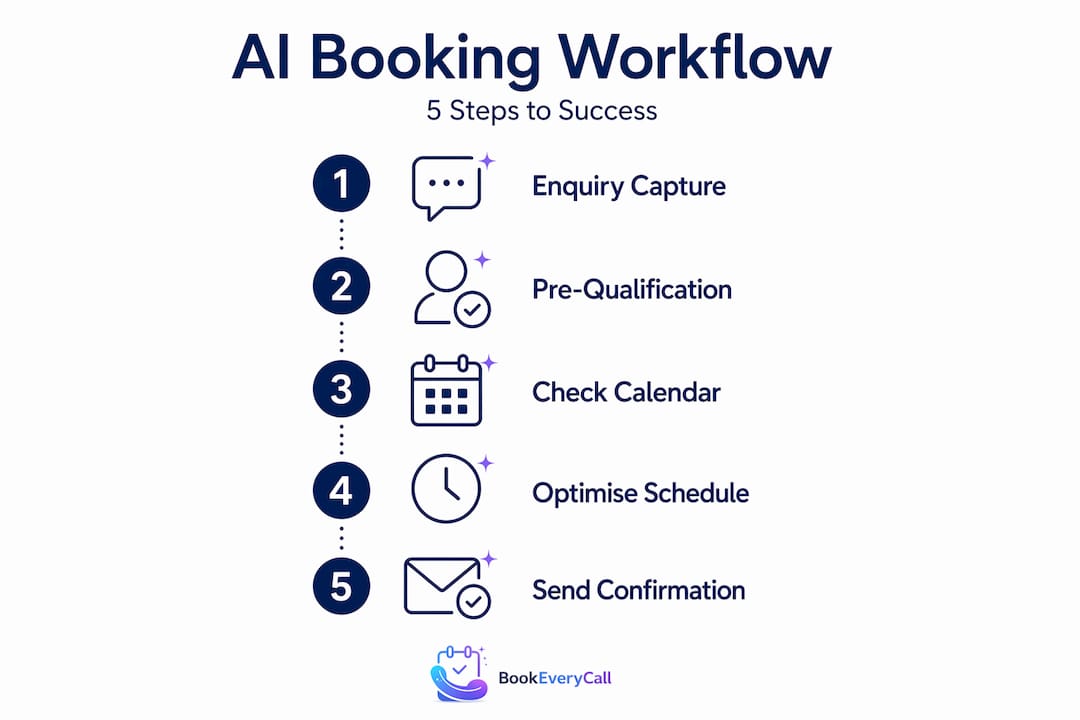
When a prospective buyer or tenant submits an enquiry through a portal, website, or phone call, a conversational AI agent responds immediately. This is not a basic chatbot with a menu of options. Modern AI voice and chat agents understand natural language, ask clarifying questions, and gather the details needed to assess fit. AI classifies leads by intent and routes high-potential prospects to a voice interaction, while lower-intent leads receive an SMS nurture sequence.
2. Pre-qualification runs before any calendar slot is offered
Before the AI offers a viewing time, it runs a qualification sequence. Effective pre-qualification sequences use 6 to 8 questions covering income, move-in date, pet ownership, eviction history, and document readiness. This filters out poor-fit applicants before a single agent minute is spent. The AI collects self-reported data only. Formal credit and background checks are handed off to compliant third-party screening providers, which keeps the process legally clean.
3. Calendar integration checks real-time availability
Once a lead clears the qualification threshold, the AI queries the agent’s calendar via API. It checks existing bookings, travel buffers, and property-specific constraints such as open home windows or strata access requirements. API bridges normalise lead data and verify contact information in real time, so the AI is always working from accurate, current data rather than a static spreadsheet.
4. Geo-spatial and temporal optimisation clusters appointments
This is where automated showing management separates itself from basic diary software. Rather than booking appointments in the order they arrive, the AI groups viewings by location and time window. A buyer inspecting three properties in Surry Hills should not be scheduled at 9am, 1pm, and 4pm across different suburbs. The AI clusters those viewings into a logical sequence that minimises travel time and maximises the number of appointments an agent can run in a day.
5. Confirmation and reminder sequences reduce no-shows
Once a time is confirmed, the AI sends automated confirmations via SMS or email. SMS reminders achieve up to 98% open rates, and the system dynamically releases cancelled slots back into the available pool so another lead can fill the gap immediately.
Pro Tip: Set your AI qualification threshold to require document readiness confirmation before offering premium time slots. This single step eliminates a large proportion of no-shows from tenancy applicants who are not yet serious.
Operational benefits for real estate professionals
The productivity case for AI real estate booking is not theoretical. The numbers are specific and verifiable.
- Time recovered per listing. Automated showing management saves 6 to 12 hours monthly per active listing. For an agent carrying a four-property portfolio at a $100 per hour billing rate, that translates to $2,400 to $4,800 in recovered productivity every month.
- Higher appointment density. AI schedulers increase appointment density by up to 40% through geo-spatial and temporal optimisation. An agent who previously ran five viewings a day can run seven without adding a single hour to their working day.
- Better buyer readiness. AI-enhanced listings with virtual tours are 10% more likely to go pending within the first 14 days compared to equivalent listings without AI tools. Pre-qualified leads who have already completed a virtual walkthrough arrive at physical viewings with genuine intent.
- Fewer missed leads. Every unanswered call during an open home or after hours is a lead that goes to a competitor. AI handles those calls around the clock, qualifying and booking without any agent input.
- Smarter post-viewing analytics. Aggregated feedback sentiment analysis generated from showing data helps sellers understand pricing objections faster than agent opinion alone. When 12 out of 15 viewers flag the same concern, the data makes the pricing conversation straightforward.
The cumulative effect is an agent who spends less time on administration and more time on negotiation, relationship building, and closing. That is where the real income is generated.
Compliance and practical considerations in Australia

Using AI for property showings in Australia requires deliberate attention to privacy law and fair practice obligations. Getting this wrong does not just create operational problems. It creates legal exposure.
The most important structural decision is separating your conversational AI layer from formal screening. AI booking systems require a two-layer setup that keeps the chatbot’s self-reported data collection entirely separate from credit and background screening conducted by FCRA-equivalent compliant providers. In the Australian context, this means your AI intake process must comply with the Privacy Act 1988 and the Australian Privacy Principles. You cannot use AI to make tenancy decisions based on protected attributes, and any data collected must be stored and handled in accordance with those principles.
Beyond privacy, there are several practical pitfalls worth knowing before you deploy:
- Over-automation without human checkpoints. AI should confirm appointments, but a human agent should review any booking that involves unusual access requirements, complex strata rules, or a lead flagged as high-risk by the qualification system.
- Poor CRM integration. An AI booking tool that does not sync with your existing property management software creates double-handling. Platforms that embed AI tools still require manager review and approval at key workflow stages. Choose tools with native integrations or open API access.
- Accuracy gaps in availability data. If your calendar data is stale or incomplete, the AI will book conflicts. Real-time API connections to your diary are not optional. They are the foundation the whole system depends on.
- Ignoring disclosure requirements. AI booking must incorporate layered reasoning to handle conditional queries, including property disclosure verification before confirming viewing appointments. If a property has a known defect that requires disclosure, the AI needs to be configured to surface that before a booking is locked in.
Pro Tip: Build a monthly audit into your AI workflow. Review a random sample of 20 bookings to check that qualification questions were answered honestly, disclosure requirements were met, and no protected-attribute data influenced scheduling decisions.
Sydney and Melbourne: adapting AI for high-volume markets
Sydney and Melbourne are the two most demanding real estate markets in Australia, and they present different challenges for AI property tour scheduling.
| Factor | Sydney | Melbourne |
|---|---|---|
| Market volume | Extremely high in inner suburbs; strong auction culture | High volume with strong rental demand in inner north and south-east |
| Scheduling complexity | Multi-agent open homes, strict strata access windows | Larger land parcels, more standalone inspections, flexible access |
| Client behaviour | Fast-moving buyers, high competition, short decision windows | More deliberate buyers, higher proportion of investor enquiries |
| CRM landscape | Strong REA Group and Domain integration requirements | Similar portal dependency; strong use of PropertyMe and Console |
| AI optimisation priority | Time-slot clustering in high-demand suburbs like Newtown, Surry Hills, and Bondi | Route optimisation across spread-out suburbs like Glen Waverley, Doncaster, and Werribee |
In Sydney, the priority is time-slot density. An agent managing properties in Newtown, Surry Hills, and Redfern can use AI to cluster Saturday morning viewings into a tight geographic sequence, cutting travel time between properties to under ten minutes. Without AI scheduling, the same agent might spend 40% of their inspection day in transit.
In Melbourne, the challenge is different. Properties are more spread out, and investors often request weekday viewings that conflict with residential tenant schedules. AI scheduling tools configured for Melbourne need to account for tenant notification requirements under the Residential Tenancies Act 1997 and build appropriate notice periods into the booking logic automatically.
For both cities, the recommendation is to select an AI receptionist built for real estate that integrates directly with REA Group, Domain, PropertyMe, or Console. Manually re-entering data from your AI tool into your CRM defeats the purpose entirely.
Steps to implement AI booking in your business
Getting AI-powered property viewing bookings running in your business is a project, not a plug-in. These steps will get you there without the common missteps.
1. Audit your current data and listings
Before you connect any AI tool, make sure your listing data is clean and your calendar system is current. Stale data produces bad bookings. Spend a week normalising your property records, confirming agent availability windows, and documenting any property-specific access constraints.
2. Define your qualification criteria
Write out exactly what a qualified lead looks like for each property type you manage. Residential tenancy leads need different qualification questions than buyer leads for a $2 million home. Your AI flows need to reflect those differences from day one.
3. Select an AI solution with real-time calendar integration
Evaluate tools on three criteria: native integration with your existing CRM or property management platform, real-time API access to your calendar, and configurable qualification flows. Automated appointment setting tools that lack real-time sync create more problems than they solve.
4. Build and test your conversational AI flows
Set up your qualification sequences, disclosure check logic, and confirmation messages before going live. Run at least 20 test bookings with colleagues acting as leads. Check that edge cases, such as a lead who answers a qualification question ambiguously, are handled gracefully rather than breaking the flow.
5. Go live with human oversight in place
For the first four weeks, have an agent review every booking the AI generates before it is confirmed. This is not a permanent step. It is a calibration period that lets you catch configuration errors before they affect real clients.
6. Monitor and refine based on conversion data
Track three metrics from week one: lead-to-booking conversion rate, no-show rate, and agent time saved per week. If your no-show rate is above 15%, your qualification threshold is too low. If your conversion rate is below 30%, your AI dialogue may be too abrupt or asking questions in the wrong order.
Pro Tip: Connect your post-viewing feedback collection to your AI system from the start. Sentiment data from early viewings will tell you more about your pricing and presentation than any amount of manual follow-up calls.
My honest take on AI booking in real estate
I have watched a lot of real estate businesses adopt AI scheduling tools with the expectation that the technology would solve their problems on its own. It does not work that way. What I have found, consistently, is that the businesses getting genuine results are the ones that treated implementation as a process redesign, not a software purchase.
The biggest misconception I see is that AI booking removes the need for agent judgement. It does not. What it does is remove the need for agent administration. There is a meaningful difference. When an AI handles the first three touchpoints with a lead, qualifies them, and locks in a time, the agent walks into that viewing already knowing the lead’s budget, timeline, and document status. That is a better conversation. The agent’s expertise is applied where it actually matters.
I have also seen the compliance side go wrong when businesses skip the two-layer screening setup. Collecting income and employment data through a conversational AI and then using that data to make tenancy decisions without a compliant screening provider in the middle is a real risk. The Privacy Act obligations are not optional, and the cost of getting it wrong far exceeds the cost of setting it up correctly from the start.
The other thing I would say is that AI booking systems reward patience. The first month of data is rarely representative. The agents who stick with it, refine their qualification flows, and adjust their scheduling logic based on actual conversion data are the ones who end up with a system that genuinely runs itself. The ones who give up after two weeks of imperfect results miss out on what the technology actually delivers when it is properly calibrated.
My advice: start with one property type, one geographic area, and one agent. Get that working well before you scale. The temptation to deploy across your whole portfolio immediately is understandable, but a focused rollout gives you clean data and a much faster path to a system you can trust.
— Chay
How Bookeverycall helps you capture every viewing enquiry
If you are managing a real estate or property management business in Australia and still relying on manual call handling to book viewings, you are leaving money on the table every single day. Bookeverycall’s AI voice receptionist for real estate answers enquiries around the clock, qualifies leads using configurable screening questions, and books appointments directly into your calendar without any agent involvement. For businesses recovering from missed calls, the numbers are significant. Australian businesses lose up to $312,000 annually from unanswered enquiries. Bookeverycall’s Voice AI service integrates with your existing CRM and calendar systems, so every lead that calls outside business hours or during an open home gets captured, qualified, and scheduled automatically. Explore how it works at bookeverycall.com.
FAQ
How does AI book property viewings without an agent?
AI booking systems use conversational AI to qualify leads, check real-time calendar availability, and confirm appointments automatically. The agent receives a fully booked, pre-qualified viewing without handling the scheduling process manually.
Is AI property booking compliant with Australian privacy law?
Yes, if configured correctly. The system must separate conversational data collection from formal credit and background screening, and all data handling must comply with the Privacy Act 1988 and the Australian Privacy Principles.
How much time can AI scheduling save a real estate agent?
Automated showing management saves 6 to 12 hours monthly per active listing, which translates to thousands of dollars in recovered productivity for agents managing multiple properties.
Can AI scheduling work for both Sydney and Melbourne markets?
Yes, but it needs local configuration. Sydney requires tight time-slot clustering in high-density suburbs, while Melbourne needs route optimisation across larger geographic areas and tenant notification logic built into the booking flow.
What happens when a lead cancels a booked viewing?
AI scheduling systems dynamically release cancelled slots back into the available pool and can immediately offer that time to the next qualified lead in the pipeline, reducing gaps in the inspection schedule automatically.