

TL;DR:
- Humans offer emotional intelligence, moral judgment, and nuanced reasoning, which AI cannot replicate. AI excels in speed, consistency, and handling routine tasks but struggles with complex, high-stakes interactions. Effective customer service balances AI efficiency with human oversight, especially for emotionally sensitive or complex inquiries.
Human agents and AI differ fundamentally because humans bring emotional intelligence, moral judgement, and context-aware reasoning, while AI delivers speed, consistency, and data-processing at scale. This distinction, explored in depth by Harvard Online and supported by a 2026 meta-analysis of 162 studies, shapes every customer service decision a business makes. For Australian businesses, getting this balance right is not optional. A tradie in Brisbane who relies entirely on AI risks losing the nuanced conversation that converts a nervous caller into a booked job. A Sydney call centre that ignores AI pays for labour it does not need on routine queries. Understanding why human agents and AI differ is the starting point for building a customer service model that actually works.
Why human agents and AI differ in cognition and emotion
Human agents bring something no algorithm currently replicates: genuine emotional experience combined with moral reasoning. When a distressed customer calls about a flooded bathroom at 11pm, a human agent reads tone, adjusts language, and makes a judgement call about urgency. AI processes the words and matches them to a response pattern. The difference is not subtle.
A meta-analysis of 162 studies on human-agent interaction found that users report similar functional trust in AI and human agents for straightforward tasks. The same research found users attribute significantly lower moral agency and social presence to AI. That gap matters for long-term relationship building, which is the foundation of repeat business in service industries.
Human cognition also relies on what researchers call implicit world models. These are the unstated assumptions people carry from lived experience that allow them to navigate ambiguity without explicit instructions. A plumber’s receptionist who hears hesitation in a caller’s voice knows to slow down and ask more questions. Current AI systems, including large language models like GPT-4o, lack this cross-domain generalisation entirely. They perform well within defined parameters and fail unpredictably outside them.
AI simulates empathy through language patterns. It does not experience empathy. That distinction becomes critical when a customer is upset, confused, or making a high-value decision. Consumers often cannot identify whether they are speaking to AI or a human, yet still prefer human interaction for emotional connection and trust. Businesses that ignore this preference risk eroding customer loyalty even when their AI sounds convincing.
- Human agents apply lived experience and contextual judgement to ambiguous situations
- AI agents match inputs to trained patterns without genuine comprehension
- Moral reasoning and accountability sit exclusively with human agents
- Emotional connection, even when AI mimics it fluently, remains a human strength
- Long-term trust and relationship building depend on perceived social presence, which AI scores lower on
Pro Tip: When designing your customer service workflow, map every interaction type against emotional complexity. Any interaction involving distress, complaint resolution, or high-value decision-making should route to a human agent by default.
How do speed, scalability, and accuracy compare?
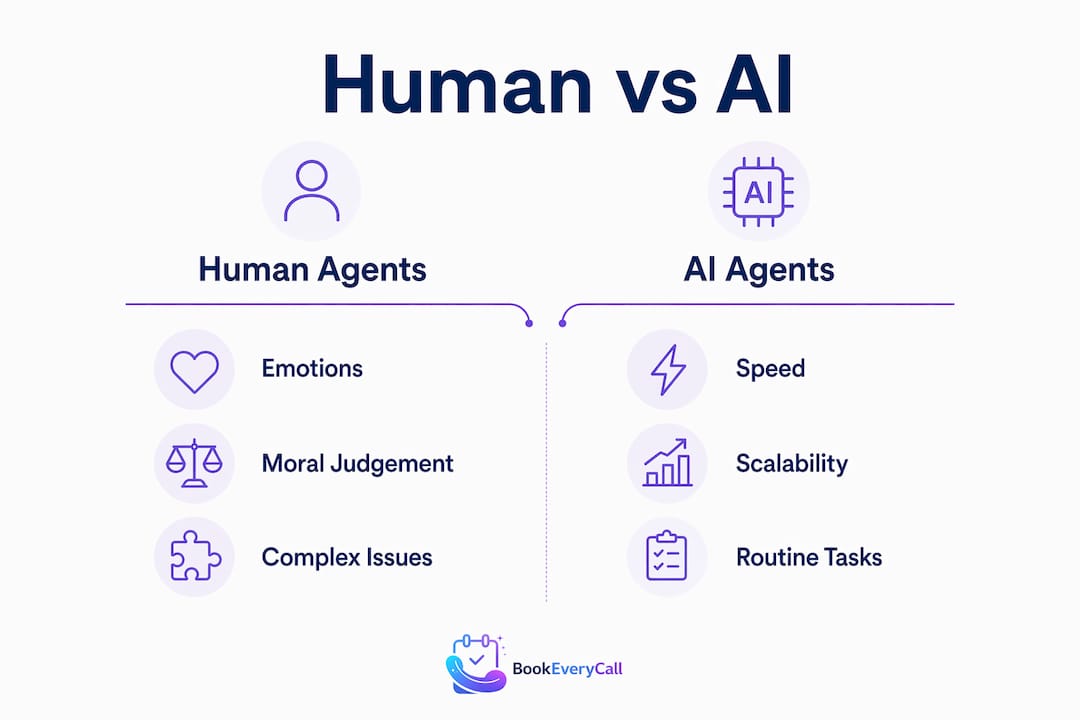
AI agents outperform humans on speed and volume without question. A single AI voice receptionist can handle hundreds of simultaneous calls, never tires, and responds in milliseconds. For Australian businesses managing high call volumes during peak periods, that capacity is genuinely valuable.

Accuracy tells a more complicated story. AI achieves approximately 35% accuracy on multi-step problems in 2026 benchmarks. That figure means AI fails on roughly two in three complex service interactions when left to operate without human oversight. For a Melbourne HVAC company fielding calls about system faults, that failure rate is commercially unacceptable.
The table below shows how human and AI agents compare across the tasks most relevant to Australian service businesses.
| Task type | Human agent | AI agent |
|---|---|---|
| Routine booking and scheduling | Reliable but slower | Fast, consistent, scalable |
| Complex fault diagnosis queries | High accuracy with judgement | ~35% accuracy, high error risk |
| Emotional complaint resolution | Strong, context-aware | Simulated, often inadequate |
| After-hours availability | Limited, costly | 24/7 at low marginal cost |
| Multi-step problem solving | Strong with experience | Weak without human oversight |
| Consistent script adherence | Variable | Near-perfect |
The “fluency gap” is the most dangerous trap in this comparison. AI systems like GPT-4o and similar large language models produce grammatically fluent, confident-sounding responses even when the underlying answer is wrong. AI-generated fluency can create false trust, leading customers and staff to accept incorrect information without challenge. A human agent who is uncertain says so. An AI agent that is uncertain often does not.
Human agents also adapt mid-conversation in ways AI cannot. If a caller changes the subject, adds context, or contradicts themselves, a human recalibrates instantly. AI systems can lose the thread of a conversation when inputs deviate from trained patterns, producing responses that are technically coherent but contextually wrong.
Pro Tip: Never deploy AI on tasks where a wrong answer carries financial, legal, or safety consequences without a clear human escalation path. The fluency gap means errors will sound authoritative.
What are the practical implications for Australian businesses?
The core principle for Australian businesses is task allocation by complexity. High-performing companies assign routine tasks to AI and high-stakes interactions to humans. This is not a compromise. It is the architecture that extracts maximum value from both.
Here is how that allocation plays out across five Australian cities:
Sydney service businesses handling large inbound call volumes, such as real estate agencies and property managers, use AI to qualify leads and book inspections automatically. Human agents step in for lease negotiations, complaints, and sensitive tenancy conversations. The AI appointment scheduling layer removes administrative load without removing human judgement from decisions that matter.
Melbourne trade businesses, including electricians and plumbers, face high after-hours call volumes. AI receptionists handle booking and triage at 11pm when no human staff are available. A human reviews flagged calls the next morning. This model captures jobs that would otherwise be lost entirely.
Brisbane HVAC companies use AI to handle seasonal demand spikes. During summer, call volumes can triple. AI absorbs the volume spike on standard service bookings while human technicians focus on complex fault calls. The HVAC AI receptionist model is a direct application of this principle.
Perth small businesses, particularly in cleaning and allied health, use AI to handle appointment confirmations, rescheduling, and FAQ responses. Human staff manage new client onboarding and sensitive health-related conversations.
Adelaide retail and hospitality businesses use AI for reservation management and routine enquiries. Human staff handle complaints and high-value customer relationships.
The economic case is clear. Australian SMEs lose significant revenue from missed calls, with some businesses losing up to $312,000 annually when recurring missed calls are factored across a year. AI receptionists recover that revenue on routine calls. Human agents protect it on complex ones.
The human-in-the-loop model also protects your reputation. When AI handles a call badly, the customer blames your business, not the technology. Accountability sits with you. Building clear escalation protocols where AI hands off to a human at defined trigger points is not optional. It is the minimum standard for responsible deployment.
What are common pitfalls when integrating AI with human agents?
The most common mistake Australian businesses make is copying their existing human workflow directly into an AI system. This approach, sometimes called “copy-paste automation,” fails because AI-human handoffs require purpose-built escalation points, not a digital version of what a human used to do manually.
- Overreliance on AI fluency. Because AI sounds confident, staff and customers accept its outputs without verification. This creates scaled errors. One wrong piece of information repeated across hundreds of calls becomes a serious liability.
- No escalation protocol. AI without a defined handoff point will attempt to resolve every query, including ones it cannot handle accurately. The result is a frustrated customer who has already wasted time before reaching a human.
- Ignoring organisational change. Staff who feel replaced by AI disengage. Businesses that frame AI as a tool that removes administrative burden from human agents, rather than a replacement for them, see better adoption and better outcomes.
- Skipping training on AI outputs. Human agents who receive AI-handled call summaries need to know how to verify and act on that information. Treating AI summaries as ground truth without review is a governance failure.
- Neglecting the human problem definition step. An MIT study found that only 5% of AI implementations deliver measurable business returns. The primary cause is businesses deploying AI without first defining the human problem it needs to solve.
For Australian tradies and small business owners, the practical advice is straightforward. Start with one use case, typically after-hours call answering or routine booking, and build the escalation protocol before you go live. Test it with real calls before removing human oversight. Expand only after the first use case is working reliably.
AI voice agent comparisons for the Australian market show that businesses which deploy AI with clear human oversight protocols consistently outperform those that treat AI as a fully autonomous solution.
Key takeaways
Human agents and AI differ most critically in emotional intelligence, moral judgement, and complex problem-solving, while AI leads on speed, consistency, and after-hours availability.
| Point | Details |
|---|---|
| Emotional intelligence gap | Human agents handle distress, ambiguity, and trust-building in ways AI cannot replicate. |
| AI accuracy on complex tasks | AI achieves roughly 35% accuracy on multi-step problems, requiring human oversight for high-stakes calls. |
| Task allocation by complexity | Assign routine bookings and FAQs to AI; reserve complaint resolution and high-value conversations for humans. |
| Fluency gap risk | AI sounds confident even when wrong, so human review of AI outputs is a non-negotiable safeguard. |
| Australian revenue impact | Missed calls cost Australian SMEs up to $312,000 annually; AI receptionists recover routine call revenue without replacing human judgement. |
The balance I’ve seen work in practice
The framing of “AI versus humans” is the wrong question for any business serious about customer service. The right question is: which tasks genuinely require human judgement, and which ones are we wasting human capacity on?
I’ve watched businesses in Melbourne and Sydney deploy AI receptionists and immediately see two things happen. First, their human staff stop spending 40% of their day on repetitive call handling. Second, the quality of their human interactions improves because staff are no longer fatigued from volume. That is the AI as a multiplier effect that Harvard Online’s research describes, and it is real.
What I’ve also seen is businesses that deploy AI without accountability structures and then wonder why their customer satisfaction scores drop. The technology is not the problem. The absence of human oversight is. AI-generated conversational fluency is genuinely impressive. It is also genuinely dangerous when no one is checking the outputs.
My honest view for 2026 and beyond is this: the businesses that win are the ones that treat AI as a skilled but unsupervised junior staff member. You would not let an unsupervised junior handle a complex complaint or a high-value client call on their first week. The same logic applies to AI. Give it clear tasks, defined limits, and a human to escalate to. That structure is what separates a successful deployment from a liability.
The distinct traits of AI, speed, consistency, and availability, are most valuable when they free up human agents to do what humans actually do well. That is not a compromise position. It is the architecture of every high-performing customer service operation I have seen.
— Chay
How Bookeverycall helps Australian businesses get this balance right
Bookeverycall is built on exactly this principle: AI handles the volume, humans handle the judgement calls. The Voice AI service answers calls 24/7, qualifies enquiries, and books jobs directly into your calendar, without replacing the human conversations that build client trust. For tradies, HVAC businesses, electricians, and cleaning companies across Sydney, Melbourne, Brisbane, Perth, and Adelaide, this means no more lost jobs after hours and no more administrative overload during peak periods. If you want to see how this works for your specific business, book a strategy call and we will map out exactly where AI can take the load off your team.
FAQ
Why can’t AI fully replace human agents in customer service?
AI lacks genuine emotional intelligence, moral reasoning, and the ability to handle unpredictable, multi-step problems reliably. A 2026 benchmark shows AI accuracy on complex tasks sits at roughly 35%, making human oversight necessary for high-stakes interactions.
What tasks should AI handle versus human agents?
AI performs best on routine, repetitive tasks such as appointment booking, FAQ responses, and after-hours call answering. Human agents should handle complaints, high-value client conversations, and any interaction requiring empathy or contextual judgement.
How do AI and humans compare on customer trust?
Research from a meta-analysis of 162 studies shows users trust AI and humans similarly for functional tasks but rate AI significantly lower on moral agency and social presence. That gap affects long-term loyalty and relationship building.
What is the fluency gap and why does it matter for Australian businesses?
The fluency gap refers to AI producing confident, grammatically correct responses even when the underlying information is wrong. For Australian service businesses, this means AI errors can go unchallenged, creating reputational and financial risk without human review processes in place.
How much revenue can Australian businesses recover by using AI receptionists?
Australian SMEs can recover up to $312,000 annually by capturing missed calls through an AI receptionist. The key is pairing AI availability with human escalation protocols so complex enquiries still receive the attention they require.