

Most trade business owners assume AI is something for tech companies or corporate giants. That assumption is costing them jobs. The role of AI in trade business growth has shifted from theoretical to measurable, with 60% of businesses reporting ROI from AI adoption as of Q2 2026. For tradies running lean operations, that ROI shows up in booked jobs, faster quotes, fewer missed calls, and better margins. This article cuts through the noise and shows you exactly where AI delivers real results in a trade business, and where most owners go wrong trying to implement it.
Table of Contents
- Key takeaways
- The role of AI in trade business growth today
- AI applications that actually move the needle
- Challenges holding trade businesses back
- Strategic steps to implement AI for sustainable growth
- My take on where trade businesses get this wrong
- How Bookeverycall helps trade businesses grow with AI
- FAQ
Key takeaways
| Point | Details |
|---|---|
| AI ROI is now measurable | Over 60% of businesses report tangible returns from AI, making now the right time to act. |
| Data readiness beats tool choice | Only 5% of organisations have data ready for AI, so fix your foundations before buying software. |
| Workflow redesign is non-negotiable | AI fails without restructuring how your team works, not just adding a new tool on top. |
| AI receptionists recover real revenue | Missed calls cost trades businesses tens of thousands annually; AI call handling recaptures that directly. |
| Start narrow, then expand | Pilot AI in one high-impact area first, measure results, then roll it out across the business. |
The role of AI in trade business growth today
The numbers have finally caught up with the hype. AI-related goods drove nearly 50% of global trade growth in 2025, expanding at 21.9% year on year. More directly relevant to your business: AI integration is projected to increase global trade values by nearly 40% by 2040. These are not abstract figures. They reflect a shift in how competitive businesses operate, and trade businesses are no exception.
Here is what the current adoption picture looks like for businesses in the trades sector:
- ROI is real but uneven. 56% of businesses plan to increase AI investment within 12 months, yet results vary sharply based on how well AI is integrated into actual workflows.
- Adoption is widespread but shallow. 70% of firms actively use AI, but executives spend an average of just 1.5 hours per week on AI applications, suggesting most businesses are barely scratching the surface.
- Data is the hidden bottleneck. Only 5% of organisations have data adequately prepared for AI, which limits reliable outcomes even when the tools themselves are solid.
For a plumbing or electrical business, this translates to a specific pattern. You might have a scheduling tool, a quoting app, and a CRM that do not talk to each other. AI sitting on top of disconnected systems produces unreliable outputs. The businesses seeing genuine growth from AI are the ones that sorted their data and processes first, then layered AI on top.
Pro Tip: Before evaluating any AI tool, audit your existing data. If your customer records, job histories, and invoicing are scattered across spreadsheets and paper, fix that first. Clean, centralised data is what makes AI outputs trustworthy.
AI applications that actually move the needle
The AI impact on trade businesses is most visible in four specific areas. Each one addresses a problem that costs trade businesses time or money every single week.
Scheduling and dispatch. AI tools can analyse job duration history, technician location, and customer priority to build optimised schedules automatically. A plumbing business with five vans on the road can recover 30 to 60 minutes per technician per day just by removing manual scheduling decisions.
Quoting and pricing. AI-assisted quoting pulls from historical job data, materials costs, and labour rates to generate accurate quotes faster. For trade businesses where underquoting is a chronic margin killer, this is significant. Some electrical contractors have reduced quote preparation time by more than 50% using AI-assisted templates trained on their own past jobs.
Customer service and call handling. This is where AI technology for business expansion delivers the most immediate and measurable return for trades. An AI receptionist answers calls 24/7, qualifies the enquiry, and books the job directly into your calendar. You can read about how Australian tradies are using AI to win more jobs in 2026 for specific examples of this in practice.
Supply chain and compliance. AI-supported trade leadership can transform departments from cost centres to strategic partners, particularly when it comes to predicting material shortages or flagging compliance risks before they become expensive problems.
AI venture building compresses team size, capital, and time to market, which means a small trades business can now operate with the responsiveness of a much larger competitor. That is the practical promise of artificial intelligence in business, and it is available to you right now, not in five years.
Pro Tip: Start with AI in customer-facing functions like call answering or quote follow-up. These generate measurable revenue impact quickly and build internal confidence in AI before you tackle more complex back-end processes.

Challenges holding trade businesses back
Here is the uncomfortable truth about AI adoption in the trades sector. Most businesses that struggle are not failing because they chose the wrong software. They are failing because they skipped the foundational work.
The biggest barriers break down like this:
- Data readiness. The main obstacle to AI ROI is the absence of a verified business identity layer across systems. If your customer data lives in three different places with inconsistent formats, AI cannot make reliable decisions from it.
- Leadership engagement gaps. Executives spend an average of 1.5 hours per week on AI, which is not enough to understand what is working and what needs adjustment. AI requires active oversight, not set-and-forget thinking.
- Misaligned expectations. Executives expect workforce reductions while staff foresee net job creation due to AI. This gap creates friction and resistance that slows adoption down significantly.
“Without redesigning workflows and implementing governance for human-AI collaboration, AI adoption often fails to improve operational efficiency.” — Stanford Graduate School of Business
The workflow redesign point deserves more attention. Most trade business owners bolt AI onto existing processes and wonder why nothing changes. A real example: adding an AI scheduling tool to a business where the office manager still manually confirms every booking by phone defeats the purpose entirely. The tool is only as useful as the process it sits inside.
Pro Tip: Map your current workflow before implementing any AI tool. Identify the three steps that consume the most time or cause the most errors. Target those specifically, and redesign the process around the AI capability rather than forcing the AI to fit your old process.
Strategic steps to implement AI for sustainable growth
Business growth strategies with AI work best when they follow a deliberate sequence rather than a scattered approach. Here is a practical framework for trade business owners.
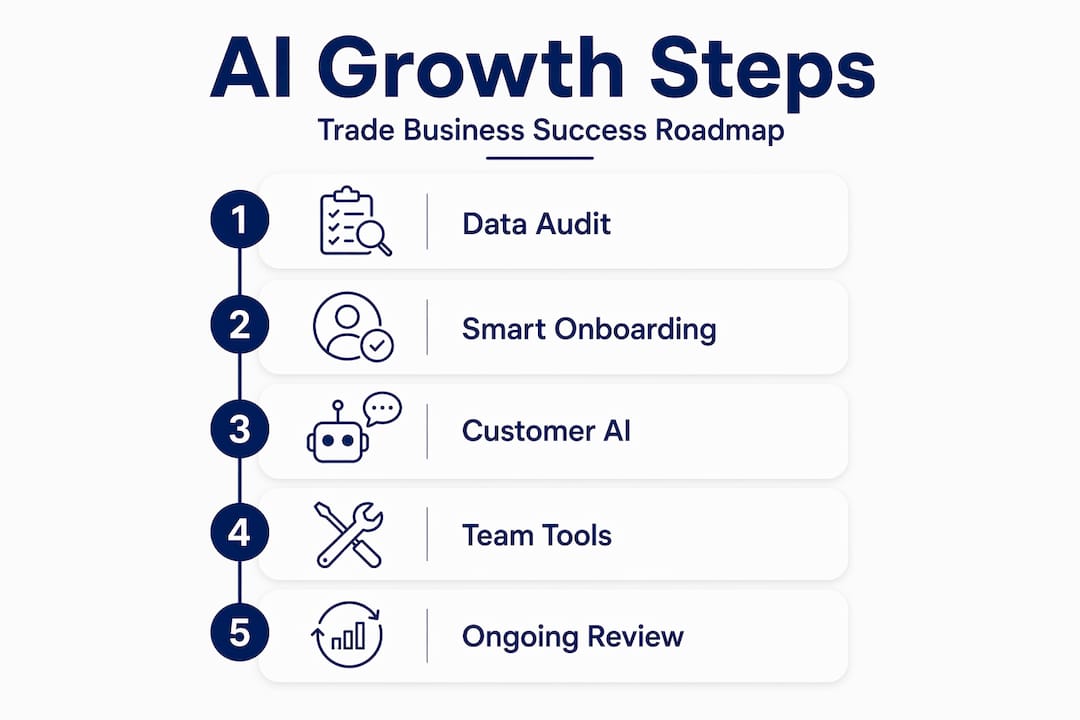
| Stage | What to do | What to avoid |
|---|---|---|
| Foundation | Centralise customer data, job records, and invoicing into one system | Buying AI tools before your data is clean and consistent |
| Pilot | Choose one high-impact area (e.g. call handling or quoting) and test AI there first | Rolling out AI across the whole business simultaneously |
| Redesign | Rebuild the workflow around the AI capability, not alongside it | Keeping manual fallback processes that undermine AI adoption |
| Measure | Track specific metrics: response time, conversion rate, jobs booked per week | Using vague success criteria like “feels more efficient” |
| Scale | Expand AI to adjacent functions once the pilot shows consistent results | Scaling before the pilot is producing reliable, repeatable outcomes |
Trade professionals who adopt AI shift from compliance roles to value creation roles, which is exactly the shift a trade business owner needs to make. When AI handles the repetitive, time-consuming tasks, your energy goes toward growing the business rather than running it.
The benefits of AI in commerce compound over time. A business that starts with AI call handling, then moves to AI-assisted quoting, then adds predictive scheduling, builds a compounding operational advantage that becomes very difficult for competitors to close.
Pro Tip: Set a 90-day review cycle for every AI tool you implement. At each review, ask one question: is this producing a measurable outcome that justifies the cost? If not, either the tool is wrong or the workflow around it needs fixing.
My take on where trade businesses get this wrong
I’ve watched a lot of trade businesses approach AI the same way they approach a new power tool. Buy it, turn it on, expect results. What I’ve learned is that the tool is almost never the problem.
In my experience, the businesses that get the most from AI are the ones where the owner treats it as an organisational challenge, not a technology purchase. They ask “how do we need to work differently?” before they ask “which app should we buy?” That order of thinking makes an enormous difference to outcomes.
I’ve also seen the leadership gap play out in real businesses. An owner invests in an AI scheduling system, hands it to the office manager, and checks back in six months expecting transformation. What they find instead is that the team worked around the AI rather than with it, because no one redesigned the process or explained the purpose. The technology was fine. The change management was absent.
The other thing I’d push back on is the idea that AI is primarily about cutting headcount. The trade businesses I’ve seen grow fastest with AI are the ones using it to do more with the same team, not fewer people doing the same work. An AI receptionist that answers calls at 11pm and books a job for the next morning is not replacing anyone. It is capturing revenue that would have been lost entirely.
If you are a trade business owner reading this, the window to get ahead of competitors on AI is still open. But it is closing. Start with your data, pick one high-value problem, and build from there.
— Chay
How Bookeverycall helps trade businesses grow with AI
Missed calls are one of the most direct and measurable ways trade businesses lose revenue every week. Bookeverycall functions as a fully managed AI voice receptionist that answers calls around the clock, qualifies each enquiry, and books jobs directly into your calendar without you lifting a finger.
For trade businesses specifically, this means no more lost leads after hours, no more voicemails that never get returned, and no more revenue walking out the door because you were on a job site when the phone rang. Bookeverycall estimates that recurring missed calls can cost businesses up to $312,000 annually. The best AI receptionist options for trades in 2026 are purpose-built for exactly this problem. If you want to see what this looks like for your specific business, book a strategy call and get a clear picture of what you are currently losing and how to recover it.
FAQ
What is the role of AI in trade business growth?
AI drives trade business growth by automating high-volume tasks like call handling, scheduling, and quoting, freeing owners to focus on higher-value work. The measurable result is more jobs booked, faster response times, and lower operational costs.
How much ROI can a trade business expect from AI?
60% of businesses report measurable ROI from AI adoption as of 2026, with returns varying based on how well AI is integrated into existing workflows. Trade businesses using AI for call handling and scheduling typically see results within the first 90 days.
Why do so many AI implementations fail in small businesses?
The most common reason is poor data readiness. Only 5% of organisations have data adequately prepared for AI, which means the tools cannot produce reliable outputs regardless of their quality.
What is the best first AI investment for a trade business?
Customer-facing AI, particularly call answering and job booking, delivers the fastest and most measurable return. It directly captures revenue that would otherwise be lost to missed calls, especially outside business hours.
Do I need a large team to implement AI in my trade business?
No. AI venture building enables small teams to achieve outcomes that previously required entire departments. A sole trader or small team can start with a single AI tool and scale from there.