

TL;DR:
- AI answering services in Australia answer all calls instantly, reducing missed revenue and automating bookings. They cost less per minute than human receptionists, operate 24/7, and log every call for follow-up. Businesses benefit from compliance, native Australian voices, and faster setup, ensuring every inquiry is handled efficiently.
An AI answering service Australia businesses rely on is an automated phone system that answers every call instantly, using native Australian voices and live CRM integration, so no enquiry goes unanswered. Missed calls are not a minor inconvenience. Bookeverycall reports that businesses losing calls repeatedly can forfeit up to $312,000 in annual revenue. The technology behind these services, formally known as AI voice receptionist or automated call handling, has matured to the point where callers often cannot tell they are speaking with a machine. For local businesses in Sydney, Melbourne, Brisbane, Perth, and Adelaide, that distinction matters less than the result: every call answered, every job booked.
How AI answering services reduce missed calls and revenue loss
Missed calls cost Australian businesses significant revenue, and the loss compounds every time a caller rings a competitor instead. AI answering services answer every call inside one ring, including calls at midnight on a Sunday or during a busy on-site job. That consistency is the single biggest operational advantage over a human receptionist, who is constrained by rosters, sick days, and lunch breaks.
The financial comparison is direct. AI call handling costs approximately $0.55 AUD per minute, compared to $1.50 to $3.00 per minute for a human virtual receptionist. For a small business taking 200 calls a month at an average of three minutes each, that gap represents thousands of dollars saved annually before counting a single recovered booking.
What happens to calls that fall through
When a business misses a call, the caller rarely leaves a voicemail and waits. They ring the next number in their search results. Missed calls cause lost revenue that most business owners never see because there is no record of what never came in. An AI phone answering service creates that record: every call is logged, transcribed, and acted on.
The table below compares AI call handling against a human virtual receptionist across the factors that matter most to small business owners.
| Factor | AI answering service | Human virtual receptionist |
|---|---|---|
| Availability | 24/7, no gaps | Business hours, roster dependent |
| Cost per minute | ~$0.55 AUD | $1.50–$3.00 AUD |
| Hold time | Zero | Variable |
| CRM integration | Live, automatic | Manual or delayed |
| Consistency | Identical every call | Varies by operator |
| Setup time | Same day to two weeks | Weeks to months |
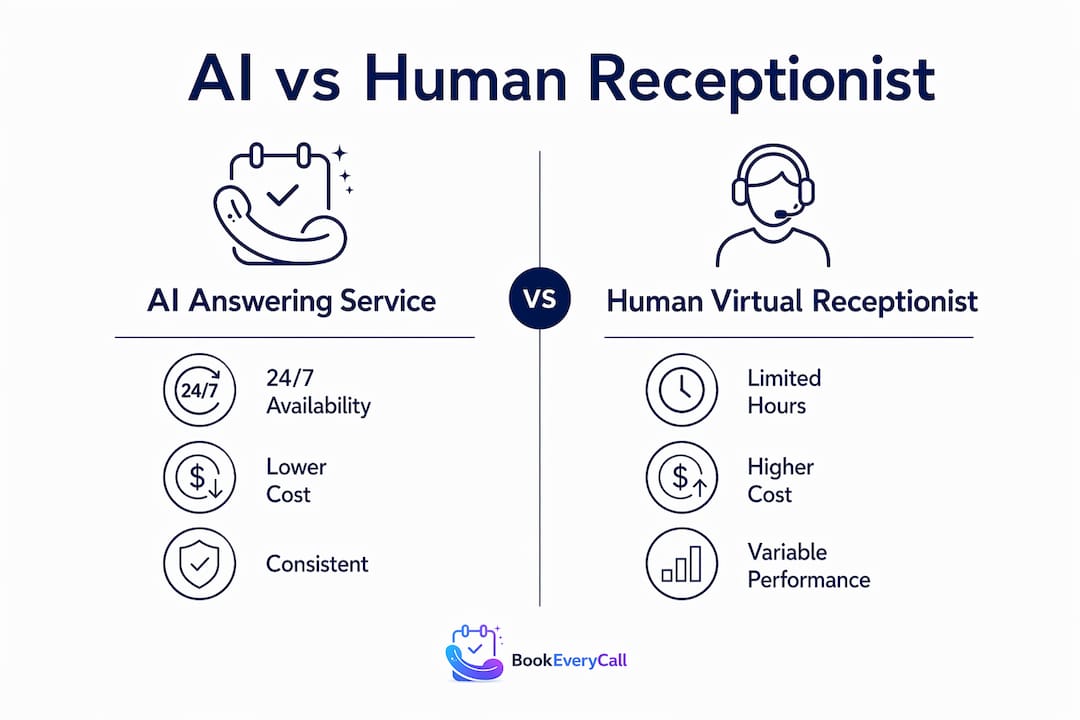
The numbers make the case plainly. A business that takes calls after hours, on weekends, or during peak trade periods gains a direct revenue advantage by switching to automated call handling.
Key features of AI call handling in Australia
The most effective AI call handling systems do more than answer the phone. They qualify the caller, book the job, and hand off complex enquiries to a human with full context already captured.
AI answering services handle 70–80% of calls structured as FAQs, bookings, or status updates, routing only complex calls to humans with full transcripts attached. That means your team spends time on work that requires judgement, not on repeating your opening hours for the fifteenth time that day.
Core features worth evaluating
When assessing any AI voice receptionist for your business, these are the capabilities that separate a useful tool from a basic auto-attendant:
- Live CRM integration. The system recognises returning callers and pulls their history before the conversation starts. No caller has to repeat themselves.
- Structured call routing. Simple calls are handled instantly. Complex calls are transferred to a human with a full transcript and caller summary.
- Multi-calendar booking. The AI books directly into your calendar or your team’s calendars, with round-robin distribution by territory, skill, or product line.
- Native Australian voice. Callers respond better to a voice that sounds local. Accent and phrasing matter for trust.
- After-hours coverage. The system operates identically at 2am as it does at 10am. No degradation in quality or capability.
Multi-calendar booking and round-robin distribution by territory or skill set improve efficiency for businesses with multiple staff or service areas. A plumbing business with three technicians across different suburbs, for example, can route calls to the right person automatically.
Pro Tip: Choose an AI answering service with native integration inside your phone or CRM system rather than a bolt-on tool. Native integrations reduce latency and eliminate the failure points that cause dropped calls or missed bookings.
Does Australian consumer law require AI disclosure?
Yes. Under Australian Consumer Law, disclosing AI interaction in the initial call greeting is a legal requirement. Businesses that fail to disclose this risk consumer complaints and potential regulatory action. The disclosure does not need to be lengthy or awkward. It simply needs to be present.
A compliant AI receptionist greeting sounds like this: “Hi, you’ve reached [Business Name]. I’m an AI assistant. I can help you book an appointment, answer questions, or connect you with our team. How can I help?” That single sentence satisfies the legal requirement and sets a clear expectation for the caller.
Transparency also builds trust. Callers who know they are speaking with an AI and still receive fast, accurate, helpful service form a positive impression of the business. Transparency in AI usage is both a legal requirement and a genuine trust-building practice for Australian businesses.
Practical compliance checklist
Every AI receptionist greeting should include:
- A clear statement that the caller is speaking with an AI assistant
- The business name
- A brief list of what the AI can help with
- An option to speak with a human if needed
Getting this right from day one protects your business and removes any ambiguity for callers. It also signals professionalism, which matters in trade and service sectors where reputation drives referrals.
Implementing AI answering services across Australian cities and trade sectors
AI voice receptionist technology applies across every major Australian city and most service-based industries. The implementation details differ by sector, but the core benefit is the same: no call goes unanswered, and every qualified lead gets booked.
City-specific applications
- Sydney. High call volumes in construction, real estate, and professional services make after-hours coverage critical. A real estate AI receptionist handles after-hours property enquiries and books inspections without a human on the line.
- Melbourne. Hospitality and retail businesses face peak call periods that overwhelm a single receptionist. AI handles the overflow without putting callers on hold.
- Brisbane. Trade businesses, particularly HVAC and electrical, receive urgent calls outside business hours. An AI receptionist for HVAC captures emergency job requests and books them directly.
- Perth. The time zone difference from the eastern states means Perth businesses often receive calls when staff are unavailable. 24/7 AI support closes that gap completely.
- Adelaide. Small service businesses in Adelaide benefit from AI call handling that qualifies leads before passing them to the owner, reducing time spent on low-value enquiries.
Trade and service sector fit
Tradies are among the biggest beneficiaries of automated customer service in Australia. A plumber on a job site cannot answer the phone. An AI receptionist for plumbers answers the call, qualifies the job, and books it into the calendar while the plumber keeps working. The same logic applies to electricians, landscapers, cleaners, and any trade where the operator is hands-on during business hours.
Real estate agents, medical practices, and hospitality businesses also see strong results. Any business where calls represent direct revenue opportunities and where missing a call means losing that revenue to a competitor is a strong candidate for AI call handling.
Pro Tip: Customise your AI receptionist’s FAQ responses for your specific suburb or service area. A caller in Parramatta asking about response times should hear a different answer than a caller in the CBD. Localisation improves booking conversion rates.
Cost and ROI of AI answering services for Australian businesses
The pricing for AI answering services starts at approximately $0.55 AUD per minute or around $89 per month for entry-level plans. Human virtual receptionist services cost $1.50 to $3.00 per minute. That cost difference compounds quickly for any business taking more than a few dozen calls per month.
Setup times range from same day to two weeks depending on the complexity of the FAQ library and CRM integration required. Most small businesses can be fully operational within a week. That speed matters because every day without coverage is another day of missed calls.
Understanding the return on investment
The ROI calculation for an AI answering service is straightforward. Take the number of calls your business misses each week, estimate the average job value, and multiply. If you miss five calls a week at an average job value of $400, that is $2,000 in potential revenue lost every week, or over $100,000 per year. Bookeverycall states that businesses with recurring missed calls can lose up to $312,000 annually.
| Cost factor | AI answering service | Human virtual receptionist |
|---|---|---|
| Per-minute rate | ~$0.55 AUD | $1.50–$3.00 AUD |
| Monthly entry price | From ~$89/month | Significantly higher |
| After-hours coverage | Included | Extra cost or unavailable |
| Setup time | Same day to 2 weeks | Weeks to months |
| Scalability | Instant | Roster-dependent |
Pro Tip: Before signing up for any AI answering plan, calculate your current missed call rate for one week. That number is your baseline. Measure it again 30 days after going live with AI call handling. The difference is your direct ROI.
Key takeaways
An AI answering service is the most cost-effective way for Australian small businesses to capture every call, qualify every lead, and book every job without adding headcount.
| Point | Details |
|---|---|
| Cost advantage is significant | AI call handling costs ~$0.55/min versus $1.50–$3.00/min for human receptionists. |
| Compliance is mandatory | Australian Consumer Law requires AI disclosure in every call greeting from day one. |
| 24/7 coverage closes the revenue gap | After-hours and weekend calls represent real jobs lost without automated answering. |
| Native integration beats bolt-on tools | AI built into your phone or CRM system reduces latency and missed bookings. |
| ROI is measurable within 30 days | Track missed calls before and after implementation to quantify recovered revenue directly. |
What I’ve learned from watching businesses implement AI answering
The most common mistake I see is businesses treating AI call handling as a set-and-forget tool. They get it live, hear it working, and never revisit the FAQ library or call routing logic. Six months later, the AI is still quoting prices from a promotion that ended in march, or routing calls to a staff member who left the business.
The second mistake is choosing a bolt-on AI tool because it is cheaper upfront. Native integrations inside your phone system or CRM eliminate the latency and dropout issues that make bolt-on tools frustrating for callers. A caller who experiences a two-second delay before the AI responds will hang up. That is a missed call by a different name.
What actually works is treating the AI receptionist like a new staff member. Brief it properly. Give it accurate information. Update it when your services, prices, or team change. Businesses that do this report genuine improvements in customer satisfaction because callers get fast, accurate answers every time.
The transparency requirement under Australian Consumer Law is not a burden. It is an opportunity. Businesses that disclose AI use confidently and then deliver a genuinely helpful experience build more trust than those that try to pass the AI off as a human. Callers are not naive. They appreciate honesty paired with competence.
My honest recommendation: start with a clear brief, choose a service with native CRM integration, and review your call logs every fortnight for the first three months. The data will tell you exactly where to improve.
— Chay
How Bookeverycall helps Australian businesses answer every call
Bookeverycall is a fully managed AI receptionist service built specifically for Australian small and medium businesses. It answers calls 24/7 using native Australian voices, qualifies enquiries, and books jobs directly into your calendar without any manual handling required.
The service covers after-hours calls, peak-period overflow, and trade sector bookings across Sydney, Melbourne, Brisbane, Perth, and Adelaide. Setup follows a clear process designed for businesses that need results quickly, not a months-long IT project. If you are ready to stop losing jobs to missed calls, the AI receptionist setup guide walks you through every step. You can also book a strategy call directly with the Bookeverycall team to get a solution matched to your business. Visit bookeverycall.com to get started.
FAQ
What is an AI answering service?
An AI answering service is an automated phone system that answers calls instantly using artificial intelligence, handles bookings and FAQs, and routes complex calls to a human with a full transcript.
How much does an AI answering service cost in Australia?
AI answering services start at approximately $0.55 AUD per minute or around $89 per month, compared to $1.50 to $3.00 per minute for a human virtual receptionist.
Is it legal to use AI to answer business calls in Australia?
Yes, but Australian Consumer Law requires businesses to disclose in the initial greeting that the caller is speaking with an AI. Failure to disclose this creates compliance risk.
What types of businesses benefit most from AI call handling in Australia?
Trade businesses such as plumbers, electricians, and HVAC operators benefit most, along with real estate agents, medical practices, and any service business where missed calls mean lost revenue.
How quickly can an AI answering service be set up?
Setup times range from same day to two weeks depending on the complexity of the FAQ library and CRM integration required. Most small businesses are fully operational within one week.