
TL;DR:
- Instant booking is an automated confirmation system crucial for rapid emergency response in Australian service industries. It eliminates approval delays, significantly increasing conversion rates, revenue, and customer trust during urgent situations. Implementing real-time synchronization and automated dispatch ensures speed, accuracy, and operational efficiency for businesses across Australia.
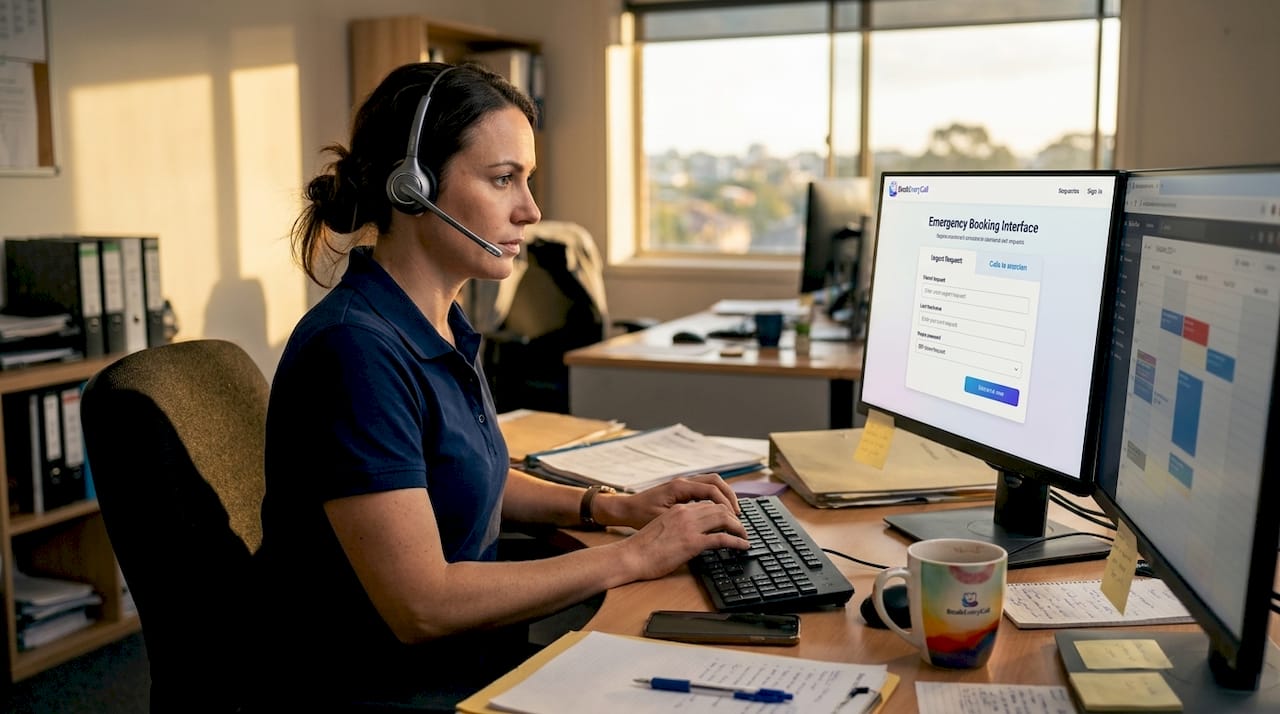
Instant booking is defined as an automated confirmation system that secures an urgent service appointment without waiting for manual approval, making it the single most critical factor in emergency response speed for Australian businesses. When a pipe bursts at 2am in Sydney or a tenant calls about a gas fault in Brisbane, the difference between a confirmed booking and a “we’ll get back to you” response can mean the difference between a retained customer and a lost one. Survival after cardiac arrest decreases by 5%–12% per minute of treatment delay, and the same principle applies to every urgent service industry: time lost in approval queues costs both outcomes and revenue. Bookeverycall’s AI receptionist platform is built on this exact premise, capturing and converting urgent enquiries into confirmed bookings around the clock.
What does the evidence say about fast bookings and emergency outcomes?
The case for removing approval delays from emergency booking systems is not theoretical. It is built on data from healthcare, travel, and hospitality sectors that all point to the same conclusion: speed of confirmation directly determines whether a customer gets served or walks away.
The healthcare parallel every service business should understand
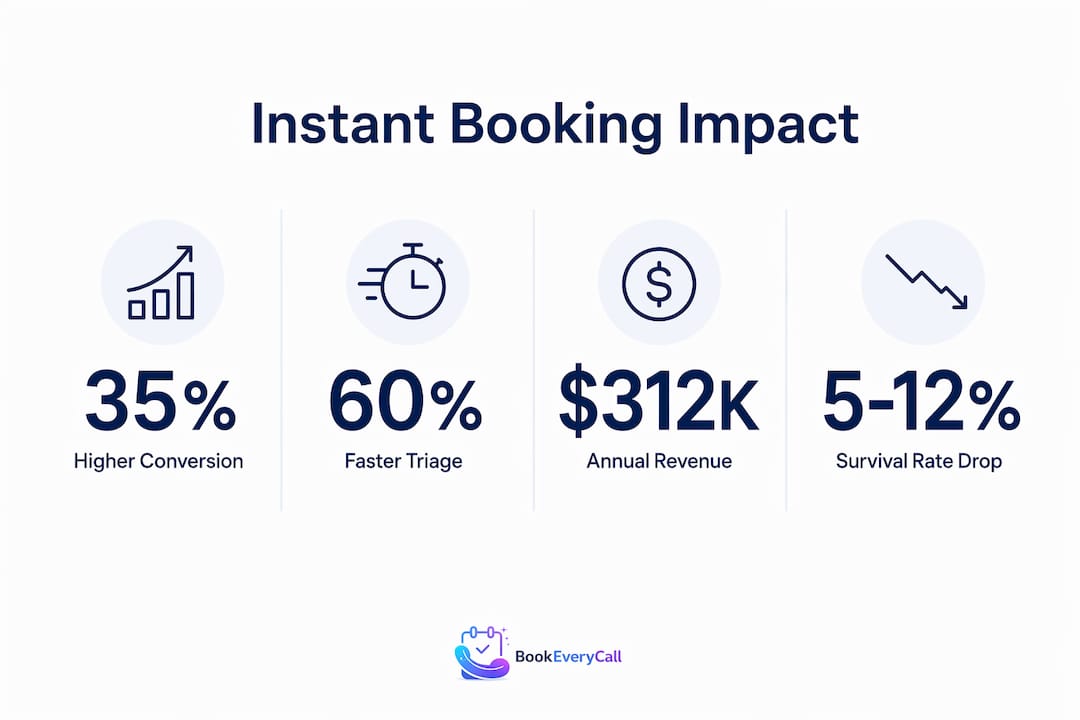
The most compelling evidence comes from emergency medicine. Earlier emergency calls improve survival probability significantly, with each minute of delay in treatment reducing cardiac arrest survival by 5% to 12%. This is not a metaphor for business. It is a direct analogy: every minute a customer spends waiting for booking confirmation during an emergency is a minute they are likely calling your competitor instead.
A 2026 simulation study found the Ten Second Triage tool reduced triage times by over 60% compared to traditional NHS tools, averaging 377 seconds versus 1,500 seconds for the standard approach. The business translation is straightforward: cutting the steps between a customer’s first contact and a confirmed appointment produces measurably better outcomes for both parties.
Research on NHS 111 callers who abandoned calls before triage showed they attended emergency departments more slowly and were more likely to use those departments for avoidable reasons. Incomplete confirmation, in any urgent service context, leads to delayed action and misdirected effort. For a plumbing business or an emergency electrician, an unanswered call that ends without a booking is the operational equivalent of an abandoned triage.
What the travel and hospitality data shows
The commercial evidence is equally strong. Expedia Group reports instant booking delivers approximately 35% higher conversion and 25% more net revenue compared to request-and-approval booking models. That gap exists because customers in urgent situations do not wait. They move to the next available option.
Guest funnel completion rates are about 18% higher for instant booking than for 24-hour approval waits. When response rates drop below 90%, booking rankings and host standings suffer, creating a compounding revenue problem. For Australian urgent service businesses, this data maps directly onto call conversion rates and job completion volumes.
“Instant booking prevents the waiting clock from starting, protecting response rates and improving funnel completion. This is essential during urgent demand spikes to maintain conversion and trustworthiness.”
Even in travel documentation, emergency passport processing can be expedited in under 14 days compared to the standard 4 to 6 weeks, but only when appointments are available immediately. Booking delays in urgent travel scenarios produce the same outcome as booking delays in urgent trades work: the customer’s problem does not get resolved on time.
| Evidence area | Key finding |
|---|---|
| Cardiac arrest response | Each minute of delay reduces survival by 5%–12% |
| NHS 111 triage abandonment | Incomplete confirmation leads to slower service and avoidable ED use |
| Expedia instant booking data | 35% higher conversion and 25% more net revenue vs request models |
| Funnel completion rates | 18% higher completion for instant booking vs 24-hour approval waits |
| Emergency travel documentation | Booking delays directly delay urgent outcomes regardless of processing speed |
How does instant booking compare to request-and-approval models?
Understanding the operational difference between instant booking and request-to-book workflows is the starting point for any urgent service business evaluating its systems.
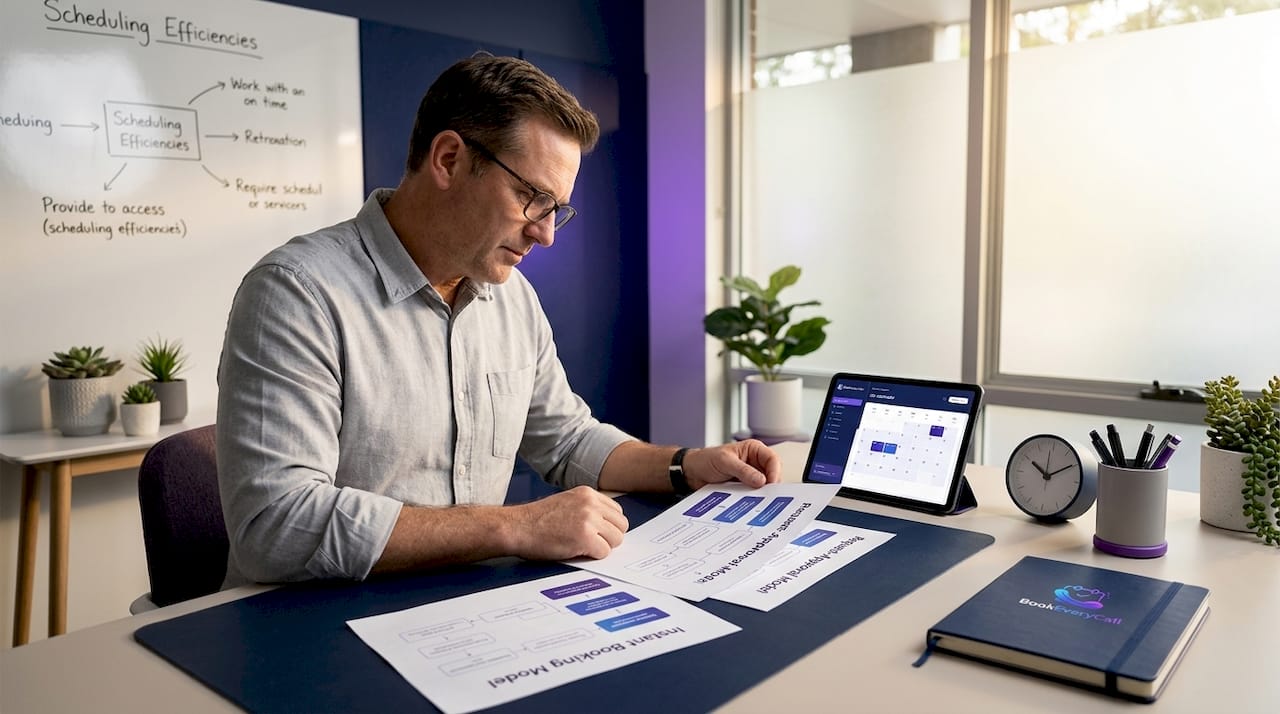
In a request-and-approval model, a customer submits a booking enquiry and waits for a human to review and confirm it. In non-urgent contexts, a 24-hour response window is acceptable. In emergency contexts, it is a conversion killer. A customer with a flooded bathroom or a failed electrical switchboard will not wait 24 hours. They will call three more businesses in the next ten minutes.
Instant booking removes that approval step entirely. The system confirms the appointment automatically, based on pre-set eligibility rules and real-time availability. The customer receives confirmation within seconds. The business captures the job without any manual intervention.
Conversion and revenue differences
The revenue gap between the two models is significant. Instant booking delivers 35% higher conversion over request models, and the effect is amplified in emergency contexts where customer patience is near zero. For a Sydney plumbing business receiving 20 emergency calls per week, a 35% conversion improvement translates directly into additional booked jobs and recovered revenue.
The risks of instant booking are real but manageable. Real-time two-way calendar synchronisation is non-negotiable. Without it, double bookings occur, creating penalties, brand damage, and operational chaos during the periods when your business can least afford it. The solution is not to slow down the booking process. It is to invest in synchronisation infrastructure that keeps pace with instant confirmation.
Here is how to structure an instant booking system that preserves speed without sacrificing accuracy:
- Set eligibility rules in advance so the system only confirms bookings that match your service area, availability window, and job type.
- Connect your booking platform to a real-time calendar or property management system with two-way sync, not one-way feeds.
- Automate post-confirmation dispatch so your team receives job details, client contact information, and access instructions the moment a booking is confirmed.
- Build in automated client communications so the customer receives confirmation, arrival time estimates, and technician details without any manual steps.
- Monitor response rate metrics weekly to identify any gaps between confirmed bookings and completed jobs.
Pro Tip: Set a maximum lead time for instant booking eligibility. Jobs booked more than 48 hours in advance can go through a light review process. Jobs booked within a four-hour window should always confirm instantly, as these are your highest-value emergency conversions.
How do Australian urgent service businesses implement instant booking?
Practical implementation of instant booking for Australian trades, healthcare providers, and professional service firms requires more than switching on an automated confirmation toggle. It requires integrating booking technology with dispatch systems, client communication tools, and real-time availability data.
AI receptionists and the Australian trades market
Bookeverycall operates as a fully managed AI receptionist that answers calls 24/7, qualifies the enquiry, and books the job directly into the business calendar. For plumbers, electricians, and property managers across Sydney, Melbourne, and Brisbane, this means an emergency call at 11pm receives the same quality of response as a call at 9am on a Monday. The AI receptionist for plumbers model is particularly relevant here, as plumbing emergencies are among the highest-frequency urgent service calls in Australian residential markets.
The same principle applies to electricians. A tripped switchboard or a sparking outlet generates an immediate call. If that call goes to voicemail, the customer calls the next electrician on Google. Bookeverycall’s AI receptionist for electricians captures those calls and converts them to confirmed bookings before the customer has time to search for an alternative.
Real-time synchronisation in multi-channel environments
For businesses operating across multiple booking channels, real-time synchronisation is the operational backbone of instant booking. A property manager in Brisbane receiving emergency maintenance requests through a website form, a phone line, and a property management platform simultaneously needs all three channels feeding into a single live calendar. Without this, double bookings cause severe penalties and brand damage, particularly during high-demand periods like storm season or public holidays.
Best practice workflows for urgent service involve instant booking confirmation followed immediately by automated team dispatch and client communications. This removes the operational scrambling that typically follows a last-minute emergency booking and ensures the technician arrives prepared rather than reactive.
Pro Tip: For Sydney and Brisbane businesses handling storm season surges, pre-load your instant booking system with surge-specific eligibility rules two weeks before the forecast season begins. This prevents the system from over-committing capacity during peak demand and protects your response rate metrics.
Key metrics to track once instant booking is live:
- Call-to-booking conversion rate, measured weekly
- Time between first contact and booking confirmation, measured in minutes
- Double booking incidents per month, targeting zero
- Customer satisfaction scores for emergency jobs versus standard jobs
- Revenue recovered from after-hours bookings as a percentage of total monthly revenue
Bookeverycall reports that businesses recovering from recurring missed calls can recapture up to $312,000 annually. That figure reflects the compounding effect of capturing every emergency call rather than losing a percentage to voicemail, slow approvals, or after-hours gaps.
How does instant booking improve customer experience and revenue recovery?
Customer behaviour during emergencies follows a predictable pattern. The customer calls, expects an immediate response, and moves on within minutes if they do not receive one. This is not impatience. It is rational behaviour under stress. A customer with a burst pipe does not have the luxury of waiting for a callback.
Instant booking prevents the waiting clock from starting, which is the single most important factor in protecting conversion rates during urgent demand spikes. When a customer receives a confirmed booking within 60 seconds of calling, their stress response is partially resolved. They stop searching for alternatives. The job is yours.
The financial case for Australian businesses
The revenue impact of instant booking compounds over time. Consider a Melbourne HVAC business receiving 15 emergency calls per week during summer. If 30% of those calls go unanswered or receive a delayed response, that is roughly four to five lost jobs per week. At an average emergency call-out rate of $350, that is $1,400 to $1,750 in lost revenue every week, or over $70,000 per year from a single gap in the booking process.
Small time advantages gained through instant booking during emergency demand significantly improve business revenue and service reputation, particularly in competitive Australian urban markets like Sydney and Melbourne. The businesses that win emergency work are not always the cheapest or the most experienced. They are the ones that answer first and confirm fastest.
The customer experience benefits extend beyond the immediate transaction. A customer who receives instant confirmation during a stressful emergency becomes a repeat customer and a referral source. A customer who calls and gets voicemail does not. For Australian urgent service businesses operating in competitive urban markets, this distinction is the margin between growth and stagnation.
Bookeverycall’s booking forms for service businesses approach reinforces this point: the structure of how a booking is captured determines whether the customer completes the transaction or abandons it. Instant confirmation removes the final friction point in that process.
Key takeaways
Instant booking in emergencies is the most direct lever Australian urgent service businesses have to improve both customer outcomes and revenue recovery simultaneously.
| Point | Details |
|---|---|
| Speed determines conversion | Each minute of approval delay reduces the chance of capturing an emergency booking. |
| Revenue gap is measurable | Instant booking delivers up to 35% higher conversion than request-and-approval models. |
| Synchronisation is non-negotiable | Real-time two-way calendar sync prevents double bookings and protects brand reputation. |
| Automation follows confirmation | Instant booking must trigger automated dispatch and client communications to be fully effective. |
| Australian urban markets reward speed | Sydney, Melbourne, and Brisbane businesses gain a direct competitive advantage from faster confirmation. |
Why most businesses are still underestimating booking friction
I have spent years watching urgent service businesses invest heavily in marketing, equipment, and staff training, then lose jobs at the final step because their booking process was too slow. The frustration is that booking friction is invisible until you measure it. Nobody calls you to say they chose a competitor because your phone rang out. They just disappear.
The research from healthcare is the most honest mirror I have found for this problem. When the Ten Second Triage tool cut triage times by over 60%, it did not improve outcomes by being smarter. It improved outcomes by being faster. The same logic applies to a tradie’s booking system. You do not need a more sophisticated process. You need a faster one.
What I find consistently undervalued is the post-confirmation step. Businesses focus on getting the booking confirmed, then leave the technician to scramble for job details and the customer to wonder if anyone is actually coming. Automating the dispatch and client communication that follows instant confirmation is where the real operational gains sit. It is also where customer trust is built or broken.
The businesses I see winning emergency work in Sydney and Brisbane right now are not the ones with the best websites or the lowest prices. They are the ones that answer every call, confirm every booking instantly, and send the technician out with everything they need before the customer has finished reading the confirmation message. That is the standard instant booking sets, and it is achievable for any Australian urgent service business willing to invest in the right technology.
— Chay
How Bookeverycall helps you capture every emergency booking
Urgent service businesses across Australia are losing revenue not because they lack capacity, but because calls go unanswered and bookings stall in approval queues. Bookeverycall’s AI voice receptionist answers every call 24/7, qualifies the enquiry, and confirms the booking directly into your calendar without any manual intervention.
Whether you run a plumbing business in Sydney, an electrical contracting firm in Brisbane, or a property management operation in Melbourne, Bookeverycall removes the gap between an emergency call and a confirmed job. Businesses using the platform recover up to $312,000 annually from previously missed calls. Visit bookeverycall.com to see how the system works for your industry and start capturing the emergency bookings your competitors are missing.
FAQ
What is instant booking in an emergency service context?
Instant booking is an automated system that confirms a service appointment immediately upon customer request, without requiring manual review or approval. It is the standard for urgent service industries where any delay in confirmation risks losing the customer to a competitor.
How much revenue can a business lose from slow booking approvals?
A business missing four to five emergency calls per week at an average job value of $350 loses over $70,000 annually from booking delays alone. Bookeverycall estimates businesses with recurring missed calls can recover up to $312,000 per year by capturing every enquiry.
What is the biggest operational risk of instant booking?
The primary risk is double bookings caused by poor calendar synchronisation. Real-time two-way sync between all booking channels is the non-negotiable technical requirement for instant booking to work without creating operational problems.
How does instant booking affect customer trust during emergencies?
Customers who receive immediate confirmation during a stressful emergency stop searching for alternatives and are significantly more likely to become repeat clients. Incomplete confirmation leads to delayed service and misdirected effort, both of which damage trust and brand reputation.
Is instant booking suitable for all Australian urgent service businesses?
Instant booking is most valuable for businesses receiving time-sensitive enquiries, including plumbers, electricians, HVAC technicians, and property managers. Any business where a customer’s problem requires same-day or same-hour resolution will see measurable conversion and revenue improvements from removing approval delays. For guidance on setting up the right system, the after-hours booking setup guide from Bookeverycall covers the practical steps for Australian businesses.